
Safeguarding Your Agricultural Livelihood
When the skies darken and severe weather threatens everything you’ve built, that’s when the true value of protection becomes clear. As a farmer, you know that Mother Nature doesn’t always cooperate with your plans.
Agricultural business insurance isn’t just another expense—it’s your financial safety net when the unexpected happens. This specialized coverage is specifically designed with the unique needs of farms, ranches, and agribusinesses in mind.
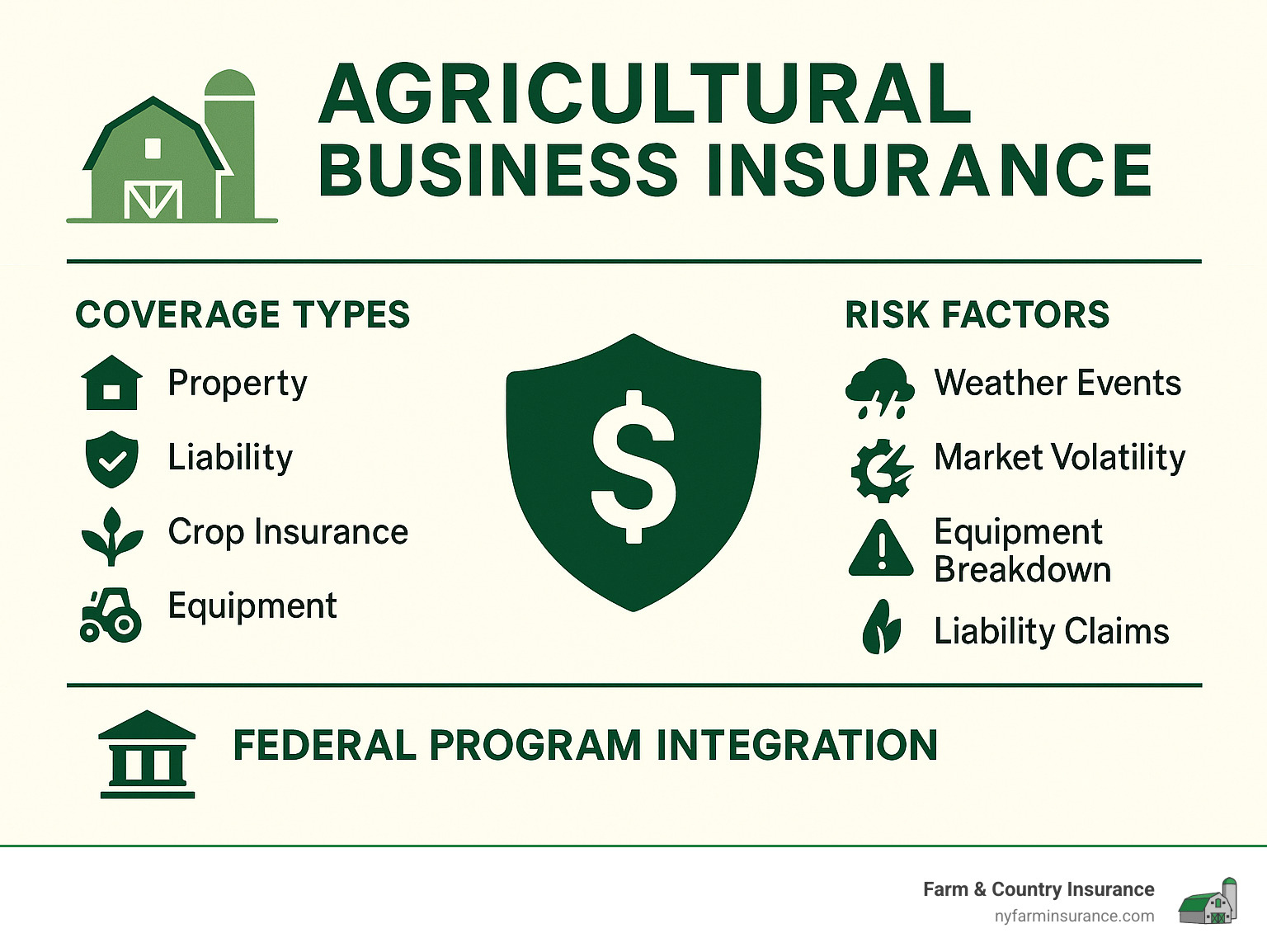
What exactly does it protect? Everything from your barns and equipment to your livestock and crops. It shields your operation from property damage, defends against liability claims when someone gets injured on your land, and helps keep money flowing when disaster interrupts your business.
The cost of your coverage will depend on several factors: the size of your operation, what type of farming you do, where you’re located, and your claims history. While standard coverage includes your buildings, equipment, livestock, vehicles, and liability protection, you might also want to consider optional coverages like business interruption insurance, pollution liability, or even cyber protection in today’s digital farming environment.
The stakes couldn’t be higher. In 2023 alone, American farmers suffered more than $21.94 billion in crop and rangeland losses due to natural disasters—from punishing drought and excessive heat to devastating wildfires, floods, and hailstorms. Behind these staggering numbers are real families and real livelihoods hanging in the balance.
I’ve seen how quickly disaster can strike. I’m Casey Love, owner of Farm & Country Insurance, and for over 15 years, I’ve helped New York farmers develop protection plans that stand up to whatever challenges come their way. The standard homeowners or business policies simply don’t address the specific risks you face as a farmer.
When extreme weather strikes, equipment breaks down at the worst possible moment, or a visitor is injured on your property, the right agricultural business insurance policy becomes the difference between recovery and financial ruin.

Understanding Agricultural Business Insurance
Agricultural business insurance is a specialized insurance package crafted specifically for farms, ranches, and agribusinesses. What makes this coverage unique is its recognition that your farm is both your home and your livelihood. It protects everything under your care – from your family dwelling to your crops, livestock, equipment, and business operations.
As one leading agricultural risk management specialist puts it, “In the worst case scenario, insurance could be all that stands between you and the compromise of your entire business.” This powerful statement captures why proper coverage isn’t optional – it’s essential for farm sustainability.
For America’s two million-plus farms – more than 90% of which are family-owned – agricultural business insurance provides critical protection against the unexpected. Whether you run a small hobby farm in Cayuga County or manage a large commercial dairy operation in Aurelius, customized insurance coverage ensures your business can weather inevitable challenges.
At Farm & Country Insurance, we’ve seen how proper coverage has rescued countless New York farms from financial disaster. One Owasco dairy farmer shared with us, “When that freak hailstorm destroyed my barn roof last spring, I thought we might lose everything. But our comprehensive farm policy covered not just the repairs but also the lost milk production during downtime.”
The Backbone of Agricultural Business Insurance
Effective agricultural business insurance is built on understanding regulatory requirements and compliance standards. The Food Safety Modernization Act (FSMA) has fundamentally changed risk management for agricultural businesses. This legislation requires implementing preventive controls and maintaining detailed records – activities that carry their own liability risks if not properly executed.
Farm operations face unique liability triggers that standard business policies simply don’t address. A visitor injured during a farm tour, produce contamination causing consumer illness, chemical drift affecting neighboring properties, equipment malfunctions hurting workers, or livestock escaping and causing damage – these are all scenarios we’ve helped farmers prepare for.
At Farm & Country Insurance, we specialize in identifying these potential liability triggers before they become claims. Our thorough risk assessment process helps farmers in Moravia, Niles, and throughout New York implement preventative measures while ensuring appropriate coverage protects their operations.
Agricultural Business Insurance and Your Bottom Line
Many farmers worry that agricultural business insurance will break the bank. The reality is much more favorable – many coverages benefit from premium subsidies through federal-private partnerships. For example, the federal government pays approximately 65 percent of the premium cost for the Supplemental Coverage Option (SCO) in crop insurance.
Even better news for small farms: Catastrophic Risk Protection (CAT) crop insurance is available to all farmers regardless of size for no premium cost – you’ll pay only a $300 administrative fee per crop insured in each county. This makes basic protection accessible to operations of all sizes.
Several factors influence insurance costs for agricultural businesses:
| Cost Factor | Impact on Premiums | How to Optimize |
|---|---|---|
| Farm Size | Larger operations typically have higher premiums | Tailor coverage to actual needs rather than blanket policies |
| Location | Areas prone to specific weather events cost more | Implement risk mitigation strategies specific to regional threats |
| Operation Type | Dairy, grain, fruit and vegetable farms have different risk profiles | Work with specialists who understand your specific operation |
| Claims History | Previous claims can increase future premiums | Invest in preventative measures and safety protocols |
| Coverage Limits | Higher limits mean higher premiums | Balance adequate protection with budget constraints |
“Understanding that farm insurance can be customized to your specific operation is key to managing costs,” explains our senior risk consultant at Farm & Country Insurance. “Many farmers in Sterling and Summerhill have finded that working with our farm-certified agents leads to more appropriate coverage at better rates.”
The right insurance isn’t just about meeting minimum requirements – it’s about protecting generations of hard work and investment. That’s why we take the time to understand your unique operation before recommending coverage options.
What Risks Do Agricultural Businesses Face?
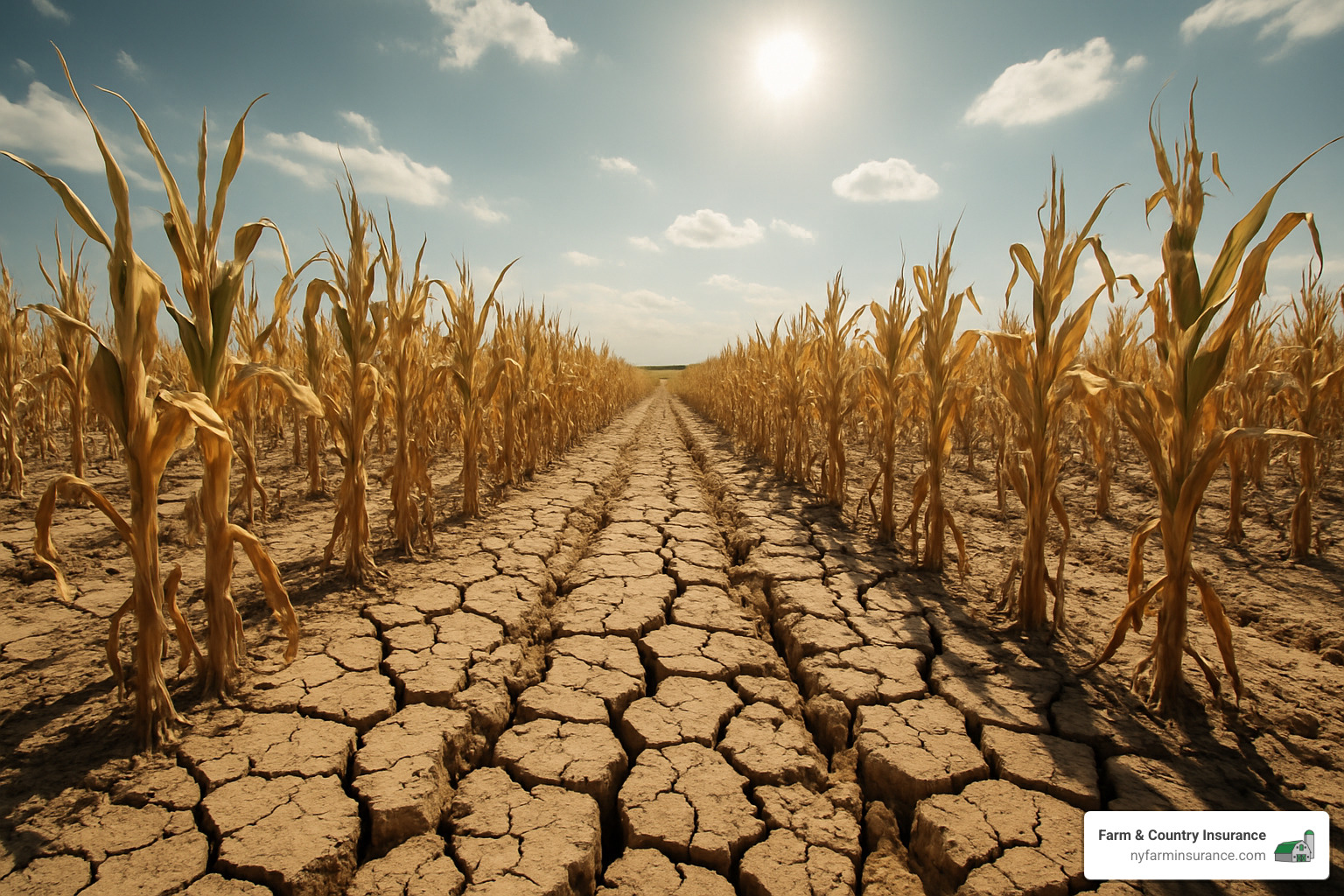
Farming isn’t just a job—it’s a calling that comes with risks as vast as the fields you tend. Every morning when you step outside to begin your day’s work, you’re facing challenges that most business owners never have to consider.
Mother Nature sits at the top of every farmer’s risk list. The devastating weather events of 2023 left a $21.94 billion hole in America’s agricultural economy through droughts, floods, hailstorms, and other natural disasters. I’ve sat at kitchen tables with farmers in Cayuga County who watched an entire season’s work disappear in 20 minutes of severe weather.
“My grandfather always said farming is betting your life savings on the weather every year,” a third-generation farmer from Scipio told me recently. “When our irrigation system failed during last summer’s drought, we lost nearly 40% of our vegetable crop. Without agricultural business insurance covering both the equipment and the crop loss, we might have gone under.”
Equipment breakdowns create another layer of vulnerability. That combine that decides to quit mid-harvest doesn’t just need repairs—it threatens your entire year’s income as crops stand waiting in the field. For dairy farmers, a failed milking system can lead to animal health issues and lost production that cascades for weeks.
If you welcome visitors to your farm—whether for apple picking, farm tours, or your roadside stand—you’re opening yourself to liability exposures that can be financially devastating without proper coverage. A Springport orchard owner learned this firsthand: “A visitor slipped in our apple orchard and broke her arm. Our farm liability coverage handled her medical expenses and protected us from what could have been a devastating lawsuit.”
Beyond these obvious threats, today’s farmers face supply chain disruptions that can leave you without critical inputs, labor accidents that harm both workers and operations, environmental pollution risks from everyday farm activities, and even cyber threats as farming becomes increasingly digital. At Farm & Country Insurance, we’ve helped farmers throughout New York identify these risks before they become claims.
Traditional Hazards vs Emerging Exposures
The risks your grandparents worried about on the farm haven’t disappeared—they’ve been joined by a new generation of concerns.
Hail still pounds crops into submission. Wildfires threaten property and livestock with increasing frequency. Windstorms can still level barns and equipment sheds. But today’s agricultural risk landscape has expanded in ways previous generations couldn’t have imagined.
The COVID-19 pandemic taught us all a harsh lesson about supply chain vulnerability. I remember talking with a vegetable farmer who had beautiful, healthy crops but nowhere to sell them when restaurants closed overnight. Market access disruptions aren’t covered by traditional crop insurance, yet they can be just as financially devastating as a hailstorm.
“I invested nearly $200,000 in precision agriculture technology,” a grain farmer from Venice told me recently. “It’s revolutionized our efficiency, but when the system goes down, we’re essentially blind in the field.” AgTech failures represent a whole new category of risk—your farm management software, GPS guidance systems, and automated equipment create dependencies that can halt operations when they fail.
Data breaches might seem like a problem for banks and retailers, but modern farms collect and store valuable information that’s increasingly targeted by cybercriminals. Your customer data, financial records, and operational information need protection that traditional farm policies don’t automatically provide.
At Farm & Country Insurance, we’ve evolved our agricultural business insurance offerings to address these emerging exposures, helping farmers across Victory, Venice and throughout New York protect against both the risks their grandparents faced and those unique to modern agriculture.
Business Interruption Safeguards
When disaster strikes your farm, the damage you can see is often just the beginning of your financial challenge. A barn can be rebuilt and equipment replaced, but what about the income you lose while you’re getting back on your feet?
Business interruption coverage within your agricultural business insurance policy protects against the invisible but very real costs of recovery:
- The income you lose while facilities are being repaired
- Extra expenses you incur to keep operations going
- Temporary relocation costs for livestock or operations
- Fixed costs that continue even when production stops
I’ll never forget visiting a Throop dairy farmer after a devastating fire damaged their milking parlor. “The property coverage rebuilt our facility,” they told me, “but it was the business interruption insurance that kept us afloat during the six months we couldn’t produce milk. It covered our fixed expenses and gave us breathing room to recover properly.”
The seasonal nature of farming makes business interruption particularly critical. If a disaster strikes during harvest, you can’t simply make up that production time later—you’ve lost your narrow window of opportunity. Good business continuity planning complements your insurance coverage by establishing protocols for maintaining critical operations during a crisis.
At Farm & Country Insurance, we don’t just sell policies—we help you think through what would happen if disaster struck tomorrow. What would you do first? Who would you call? How would you keep your animals fed or your crops protected? These questions form the backbone of a business continuity plan that can make the difference between recovery and financial ruin.
Core Coverages Every Farm Should Consider
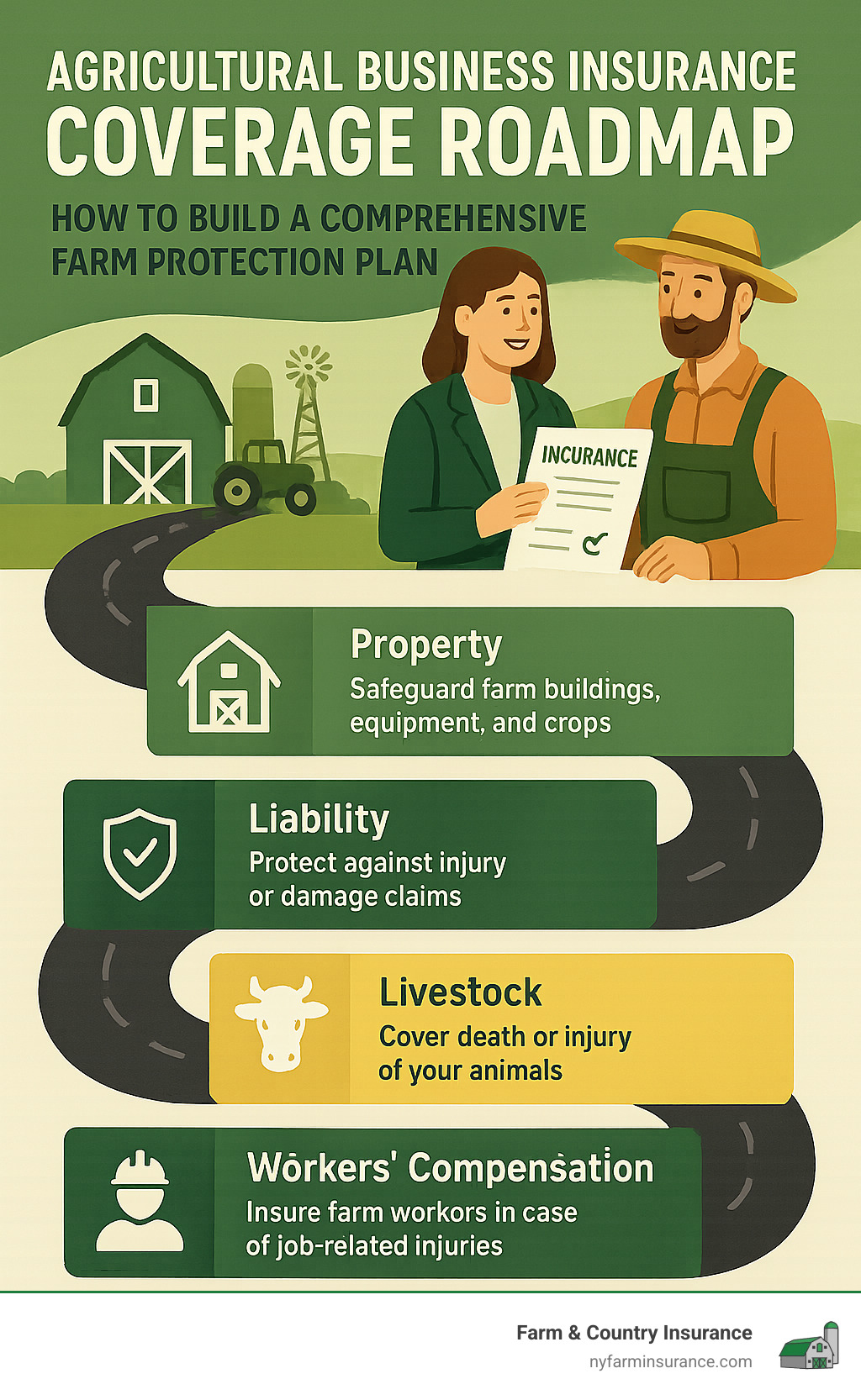
Building a strong safety net for your farm isn’t just about having insurance—it’s about having the right insurance. When I sit down with farmers across New York, I always emphasize that effective agricultural business insurance works like a shield with multiple layers, each protecting against different threats to your livelihood.
Every farm has unique needs, but certain coverages form the foundation of solid protection for nearly all agricultural operations. Think of these as the non-negotiables that keep your farm resilient when challenges arise.
Property Insurance protects the physical heart of your operation—your home, barns, storage buildings, and fixed equipment—against fire, wind, theft, and other covered perils. For many farmers, these structures represent generations of investment and hard work.
Crop Insurance might be the difference between weathering a bad season and facing financial disaster. Whether it’s drought, floods, pests, or market price drops, these policies shield your income from forces beyond your control.
Livestock Mortality coverage steps in when animals die from accident, illness, or injury—protecting a significant portion of your farm’s assets and future income potential.
General Liability is your first line of defense when visitors get injured on your property or when your operations accidentally damage someone else’s property. This coverage handles legal costs and potential settlements that could otherwise be devastating.
Product Liability protects you when products you grow or produce cause illness or injury to consumers. In today’s litigious environment, this coverage is increasingly crucial for any farm that sells directly to the public.
Commercial Auto insures the vehicles that keep your operation moving—from pickups to specialized equipment that occasionally travels public roads.
Workers’ Compensation not only covers medical expenses and lost wages for injured employees but also protects your farm from related lawsuits that could threaten your financial stability.
Umbrella Insurance provides that extra layer of liability protection beyond your standard policies—essential protection against those once-in-a-lifetime catastrophic claims.
Inland Marine covers your mobile equipment, tools, and supplies while they’re in transit or at temporary locations away from your main property.
As one of our specialists at Farm & Country Insurance often tells clients, “The right combination of these coverages creates a safety net that lets you focus on production rather than lying awake worrying about what might go wrong.”
Property & Equipment Protection
The buildings, machinery, and infrastructure that make your farm work represent some of your biggest investments. That’s why standard homeowners insurance just doesn’t cut it for farm operations.
Farm property insurance typically covers your dwelling and household contents, but it also extends to your barns, silos, outbuildings, fixed equipment like grain dryers or milking systems, and even fencing and irrigation systems (though these often require specific endorsements).
For expensive mobile equipment like tractors, combines, and implements, scheduled coverage gives you the most comprehensive protection. Rather than lumping everything under a general blanket limit that might leave you short after a loss, this approach individually lists your high-value equipment with specific coverage amounts.
When claims happen, your policy will use one of three valuation methods:
Actual Cash Value (ACV) pays replacement cost minus depreciation—often leaving a gap between what you receive and what you need to replace equipment.
Replacement Cost Value (RCV) covers the full cost to replace damaged items with new equivalents—providing much more complete protection.
Functional Replacement Cost (FRC) pays for modern equivalents that serve the same function—particularly valuable for older facilities or equipment.
I remember working with a Fleming fruit grower whose packing facility was severely damaged in a storm. Because they had FRC coverage, they told me afterward, “Instead of getting stuck with outdated equipment again, we were able to install more efficient systems that actually improved our operation. That coverage decision turned a disaster into an opportunity.”
For more details on protecting your valuable equipment, visit our guide on Agricultural Equipment Insurance.
Liability Lines that Keep You Operational
When farmers tell me what keeps them up at night, liability concerns often top the list. A serious injury or product contamination incident can lead to legal costs and settlements that threaten even the most established operations.
Premises liability protects you when visitors, customers, or delivery personnel get injured while on your property. This becomes especially important if your farm welcomes the public for U-pick operations, farm stands, or agritourism activities.
Products liability addresses claims arising from products you grow or produce that cause illness or injury. Imagine a consumer becoming ill after eating your produce or dairy products—this coverage helps defend against and settle resulting claims.
What many farmers don’t realize until it’s too late is that standard farm liability policies often contain critical exclusions. That’s why at Farm & Country Insurance, we emphasize the importance of additional endorsements like:
Pollution endorsements cover cleanup costs and third-party claims from chemical spills, fertilizer runoff, or manure management issues that affect neighboring properties or water sources.
Agritourism riders extend your liability protection when you host on-farm recreational activities, tours, or educational programs.
Custom farming endorsements provide coverage when you perform agricultural services for others—something many policies exclude by default.
Our claims specialist at Farm & Country Insurance puts it plainly: “We’ve seen too many farmers find coverage gaps only after a claim is denied. That’s why we conduct thorough liability reviews for our clients in Montezuma, Sempronius, and throughout our service area.”
For comprehensive information about protecting yourself from liability claims, explore our detailed guide on Farm Liability Insurance.
Crop & Revenue Insurance Essentials
For many farmers, crop insurance is the cornerstone of their risk management strategy. These specialized policies protect against yield losses from natural disasters and revenue losses from price fluctuations—both equally capable of derailing your financial stability.
Several key crop insurance programs offer different levels of protection:
Multi-Peril Crop Insurance (MPCI) provides comprehensive protection against both yield and revenue losses. You can typically insure 50-75% of your average yield (up to 85% for major grains) and 55-100% of the expected price.
Revenue Protection guarantees a certain level of revenue regardless of whether losses come from reduced yields, falling prices, or both. This option provides crucial protection against market volatility that can be just as devastating as weather events.
Whole-Farm Revenue Protection offers coverage for all commodities on your farm under one policy, making it particularly valuable if you run a diversified operation or grow specialty crops.
Catastrophic Coverage (CAT) provides basic protection at minimal cost, covering 50% of your approved yield at 55% of the expected price for a flat fee of $300 per crop per county.
I’ll never forget what a Genoa grain farmer told me after last year’s drought: “When our corn yield dropped by 40%, our revenue protection policy made the difference between a minor setback and financial disaster. That premium now seems like the best money we ever spent.”
For more detailed information on crop insurance options, read our comprehensive guide: Crop Insurance: What You Need to Know.
Workers Comp & Farm Labor
Managing labor-related risks is critical if your operation employs workers. Workers’ compensation insurance covers medical expenses and lost wages for employees injured on the job while protecting your farm from related lawsuits that could otherwise be financially devastating.
State requirements vary significantly. In New York, agricultural businesses must provide workers’ compensation coverage if they paid $1,200 or more for farm labor in the preceding calendar year—though exemptions may apply for certain family members or small operations.
Farm labor presents several unique insurance challenges:
Seasonal workers need proper classification for accurate premium calculation. Misclassification can lead to either inadequate coverage or unnecessarily high premiums.
Volunteer helpers often fall through coverage gaps unless your policy includes specific endorsements to protect them.
H-2A workers come with special provisions that apply to temporary agricultural workers—requirements you need to understand to stay compliant.
Labor contractors create situations where insurance responsibilities must be clearly delineated to avoid dangerous coverage gaps.
CSA volunteers often require specific coverage arrangements that many standard policies don’t address.
At Farm & Country Insurance, we’ve helped farmers in Ledyard, Locke, and throughout New York steer these complexities. As our workers’ comp specialist often points out, “Workers’ compensation is traditionally more expensive through state-sponsored plans than private carriers. We help farmers find the most cost-effective solutions while maintaining full compliance.”
Beyond just having the right coverage, implementing safety training and injury prevention programs not only protects your workers but can also reduce your insurance premiums over time. We provide resources and guidance to help you create effective safety protocols custom to your specific operation.
Customizing an Agricultural Business Insurance Package Policy
When it comes to protecting your farm, one size definitely doesn’t fit all. That’s why most successful agricultural operations rely on a farm package policy that brings together multiple coverages under one umbrella. These customized packages offer both simplicity and thoroughness that standard insurance policies simply can’t match.
Unlike the generic Business Owners Policies (BOPs) that might work fine for a retail store or office, farm packages understand the unique reality of agricultural life – where your home, your business, and your livelihood all overlap in ways other businesses don’t experience.
“The kitchen table where your family eats breakfast might be the same place where you manage your farm finances,” explains our senior agent at Farm & Country Insurance. “Your property isn’t just a business location – it’s your heritage and your home. We get that.”
A well-designed farm package typically starts with core protections for your dwelling and personal belongings, then extends to cover farm structures like barns and silos, equipment, supplies, and livestock. The liability portion safeguards you when someone is injured on your property or when your operations cause damage to others. Most packages also include medical payments coverage for minor injuries that occur on your farm, regardless of who’s at fault.
But the real magic happens when we customize your package with endorsements custom to your specific operation. For instance, many of our clients benefit from peak season endorsements that automatically increase their coverage limits during harvest time when inventory values soar. A grain farmer in Scipio told me last year, “Having that automatic increase during September and October gives me one less thing to worry about during our busiest time.”
Other valuable add-ons include foreign object ingestion coverage (a lifesaver when your combine picks up that hidden rock), care, custody, and control endorsements for farmers who board animals or store others’ equipment, and umbrella policies that provide extra liability protection beyond standard limits.
At Farm & Country Insurance, we’ve been fine-tuning agricultural business insurance packages for New York farmers since 1984. We take the time to walk your property, understand your operation, and build protection that feels as comfortable as your favorite work boots.
Tailoring Coverage to Operation Type
The risks facing a dairy farm in Aurelius look dramatically different from those challenging a greenhouse operation in Summerhill or an apple orchard in Fleming. That’s why effective agricultural business insurance requires specialization by farm type.
For dairy farms, milk is literally your lifeblood. When a Throop dairy farmer’s bulk tank failed last summer, his specialized coverage not only replaced the equipment but also compensated him for the 800 gallons of milk that spoiled. Beyond milk protection, dairy operations need comprehensive coverage for livestock mortality, specialized milking equipment, and the increasingly complex manure management systems that can create environmental liability.
Grain operations face their own unique challenges. Between unpredictable weather at planting and harvest, expensive irrigation systems, and massive storage infrastructure, grain farmers need protection that understands these specialized risks. One Moravia farmer shared how his grain bin coverage saved his operation after a windstorm damaged three bins right after harvest: “Without that coverage specifically designed for grain storage, we might have lost the farm my grandfather started.”
Fruit and vegetable producers often need specialized crop insurance options that recognize the high value and perishability of their products. Cold storage protection, coverage for packing equipment, and liability protection for farm markets all become crucial components of their insurance package.
Greenhouse and nursery operations require policies that understand the unique vulnerabilities of growing structures – whether they’re made of glass, plastic, or newer materials. Plant inventory protection becomes particularly important when a single heating system failure can destroy months of work overnight.
For farms that have expanded into food processing, the insurance needs grow even more complex. Product liability and recall coverage become essential, along with protection for specialized processing equipment and refrigeration systems.
“When we expanded from just growing berries to making jams and sauces, our insurance needs completely changed,” a Locke berry farmer told us. “Farm & Country Insurance helped us steer those new risks without leaving gaps in our coverage.”
Agricultural Business Insurance for Vehicles & Mobility
That farm truck that hauls feed one day and takes the family to town the next creates unique insurance challenges. Most personal auto policies exclude vehicles used primarily for business purposes, which can leave farmers dangerously exposed.
Commercial auto insurance designed specifically for agricultural operations covers the vehicles that keep your farm moving – from everyday pickup trucks to specialized grain haulers and livestock trailers. Even self-propelled equipment that occasionally travels on public roads needs proper coverage.
“I never thought much about separate coverage for my truck until our agent explained the risks,” admits a farmer from Venice. “Now I sleep better knowing my farm is protected if there’s an accident while we’re hauling produce to market.”
For larger operations with multiple vehicles, fleet risk management becomes an important part of the insurance equation. This includes implementing driver qualification standards, maintaining regular vehicle maintenance schedules, and ensuring compliance with Department of Transportation regulations for larger vehicles.
Don’t forget about what you’re hauling, either. Cargo coverage protects your products during transport – whether that’s live animals, harvested crops, or supplies heading back to the farm. Special trailer coverage addresses the unique risks of moving livestock or equipment from place to place.
“Agricultural equipment isn’t cheap,” reminds our equipment specialist at Farm & Country Insurance. “When your $300,000 combine is traveling down a county road, you want to be absolutely certain it’s properly covered.”
For more details about protecting your valuable farm equipment, check out our comprehensive guide on Agricultural Equipment Insurance.
At Farm & Country Insurance, we understand that your vehicles are more than just transportation – they’re essential tools that keep your operation running smoothly. That’s why we take the time to review how each vehicle is used and build coverage that protects you both on and off the farm.
Navigating Federal Programs & Private Policies
One of the most unique aspects of protecting your farm is how agricultural business insurance blends federal programs with private policies to create a safety net that works for you. Think of it as having both a government partner and a private insurer working together to keep your operation secure.
This public-private partnership makes a lot of sense for agriculture. Private insurance companies sell and service the policies, bringing their expertise and customer service, while the federal government provides subsidies and reinsurance that make coverage more affordable for farmers like you.
When you’re looking at federal crop insurance programs, you’ll find some significant financial advantages:
The government provides premium subsidies ranging from 33% to a generous 62% for buy-up coverage, making comprehensive protection much more affordable. If you’re on a tight budget, Catastrophic Coverage (CAT) requires only a $300 administrative fee per crop per county – no premium payment required.
For those wanting additional protection, the Supplemental Coverage Option (SCO) comes with a 65% premium subsidy, and specialized options like Area Risk Protection Insurance use county-level data rather than individual farm results. There’s even Pasture, Rangeland, and Forage Insurance that uses rainfall indices to determine payments.
“Whether you’re a multi-generation farm family or just starting your agricultural business, insurance should be a cornerstone of your risk management strategy,” explains our team at Farm & Country Insurance. “The combination of federal support and private coverage creates protection that neither could provide alone.”
For comprehensive information about disaster assistance and additional risk management programs, we often direct our clients to the USDA’s Farm Service Agency, which offers resources beyond traditional insurance options.
Maximizing Federal Support Within Agricultural Business Insurance
Beyond the basic federal crop insurance programs, several specialized options can provide critical support during specific challenges. Understanding these programs helps us create truly comprehensive protection for your farm.
When extreme weather prevents timely planting, Prevented Planting Coverage becomes invaluable. The basic coverage equals 60% of your insurance guarantee, with options to buy up to higher coverage levels for an additional premium. I’ve seen this coverage save many farms during particularly wet springs when fields simply couldn’t be accessed.
For our specialty crop producers in areas like Cato and Conquest, the Noninsured Crop Disaster Assistance Program (NAP) offers protection for crops that aren’t covered through traditional federal crop insurance. This program fills important gaps for diverse operations growing specialty or niche crops.
When major disasters strike, Disaster Grants and Emergency Loans become available in areas declared disasters by the Secretary of Agriculture. These programs provide support beyond what insurance might cover, helping with recovery and rebuilding efforts.
At Farm & Country Insurance, we specialize in helping farmers throughout New York integrate these federal programs with private insurance coverage. The combination creates a much stronger safety net than either could provide alone.
One Aurelius farmer shared with me, “When flooding prevented us from planting nearly a third of our acreage last spring, the prevented planting coverage through our policy provided crucial financial support. Without it, we might not have made it through a season with such reduced income.”
Claims Process & Documentation
When disaster strikes your farm, knowing how to steer the claims process can make all the difference in how quickly you recover. With agricultural business insurance, proper documentation and prompt reporting are your best allies.
The basic claims process follows a straightforward path, though it helps to know what to expect:
First, contact your agent or insurance company as soon as possible after finding damage or loss. This immediate notice is often required by your policy and helps get the process moving quickly.
Next, document everything thoroughly. Take plenty of photographs and videos showing the damage from multiple angles. Write down descriptions while the details are fresh in your mind. This documentation becomes invaluable during the adjustment process.
An insurance adjuster will visit your property to inspect the damage and review your documentation. They’re assessing the extent of covered losses and verifying that the damage matches what’s reported.
After this evaluation, the insurance company will assess your claim based on your policy terms and coverage limits. This is where having a farm-specialized agent really pays off – they understand the unique aspects of agricultural claims.
Finally, once approved, payment is issued according to your policy provisions, helping you begin recovery and rebuilding.
For crop insurance claims specifically, you’ll need additional documentation that includes production records from previous years, planting and input records for the current season, harvest records or evidence of crop damage, and relevant weather data that supports your claim.
“Having detailed records readily available can accelerate the claims process by weeks,” our claims specialist at Farm & Country Insurance often tells clients. “We always advise our farm clients to maintain organized documentation systems before losses occur – it’s much harder to gather this information after a disaster.”
Managing Emerging Risks Beyond the Barn

Farming isn’t just about what happens in the barn or field anymore. Today’s agricultural operations face a whole new frontier of risks that would have seemed like science fiction to previous generations of farmers.
When I visit farms across New York, I’m amazed at how technology has transformed agriculture. Drones buzz overhead mapping fields, tractors drive themselves guided by satellites, and sophisticated sensors monitor everything from soil moisture to cattle health. It’s remarkable progress, but it brings new vulnerabilities that traditional farm policies weren’t built to handle.
“My grandfather worried about hail damaging his crops,” a Moravia farmer told me recently. “Now I’m worried about hackers accessing my irrigation system or my precision ag data being compromised.”
At Farm & Country Insurance, we’ve evolved our agricultural business insurance solutions to protect against these emerging threats. We understand that modern farming requires modern coverage, whether you’re running a small family operation in Mentz or a large commercial enterprise in Owasco.
Climate change presents another evolving challenge, with increasingly unpredictable weather patterns testing historical risk models. The drought that was once a once-in-a-generation event might now occur every few years. That’s why we’re working with carriers to develop parametric products that trigger payments based on weather data rather than waiting for documented crop losses.
“Technology today is expanding agriculture in ways we could never have imagined,” notes our agricultural technology specialist. “It also adds a host of new risks to your business that need thoughtful protection.”
Cyber & AgTech Liability Under Agricultural Business Insurance
When a dairy farmer in Scipio had his automated milking system compromised by ransomware last year, he finded the hard way that his standard farm policy didn’t cover technology failures. The system was down for three days, resulting in production losses, animal health issues, and costly IT repairs.
This scenario is becoming increasingly common as farms digitize their operations. Your agricultural business insurance needs to evolve accordingly. Standard policies typically exclude these modern risks, creating dangerous coverage gaps for tech-dependent farms.
Digital vulnerabilities on today’s farms include data breaches exposing employee or customer information, system failures affecting automated feeding or climate control systems, and even GPS guidance malfunctions leading to crop damage. When your tractor is essentially a computer on wheels, you need more than just physical damage coverage.
“Smart tractors and agribots can increase productivity but also crash or collide with people or livestock,” explains our technology risk specialist at Farm & Country Insurance. “Environmental conditions can skew the quality of thermal imaging and drone-collected data, leading to poor decisions and financial losses.”
We’ve developed specialized cyber liability and technology E&O (errors and omissions) coverage to address these unique exposures. Rather than treating these as exotic add-ons, we view them as essential components of a comprehensive farm protection strategy for modern operations.
When we sit down with farmers in Aurelius or Cato to review their insurance needs, we carefully assess their technology dependencies. How would your operation function if your farm management software was inaccessible for a week? What if your precision application data was corrupted, leading to over-application of expensive inputs? These scenarios require thoughtful planning and appropriate coverage solutions.
Environmental & Pollution Concerns
Environmental liability has become one of farming’s most significant financial risks, yet it’s frequently overlooked until it’s too late. Many farmers are shocked to learn that standard farm policies typically contain pollution exclusions that can leave them exposed to potentially catastrophic claims.
A Locke vegetable grower finded this gap when a small fuel leak from his storage tank contaminated a neighboring property’s well. The cleanup costs exceeded $150,000—none of which was covered by his standard farm policy.
Agricultural business insurance needs to specifically address environmental exposures like chemical drift from pesticide application, fertilizer or manure runoff contaminating water sources, and fuel or oil leaks from storage tanks. Without dedicated pollution coverage, these cleanup costs fall entirely on your operation.
“A small fuel leak that reaches groundwater can easily generate six-figure cleanup costs,” warns our environmental specialist at Farm & Country Insurance. “For many family farms, that kind of unexpected expense could be financially devastating.”
Environmental pollution liability insurance provides crucial protection beyond standard coverage, handling cleanup costs mandated by regulatory agencies, third-party bodily injury claims, and legal defense costs for pollution-related lawsuits. It can even cover business interruption during mandated cleanup periods.
As stewards of the land, farmers have always taken environmental responsibility seriously. At Farm & Country Insurance, we help protect that commitment by ensuring your operation has the financial resources to respond appropriately if an environmental incident occurs. Our specialized environmental liability solutions help farmers throughout New York safeguard both their financial security and their legacy of land stewardship.
Frequently Asked Questions about Agricultural Business Insurance
What is the difference between general liability and product liability?
When it comes to protecting your farm, understanding the nuances between different types of liability coverage is crucial. General liability insurance is your first line of defense against everyday risks that occur on your property. It covers those unexpected moments—like when a delivery person slips on your icy driveway or a visitor gets injured during a farm tour.
Think of general liability as your basic shield against claims involving bodily injury, property damage, or personal injury that happen on your premises or result from your normal operations.
Product liability insurance, however, focuses specifically on what happens after your products leave your farm. If someone gets sick from eating your produce, or a piece of equipment you sold malfunctions and causes damage, product liability coverage steps in to help with the fallout.
“Many farmers assume their general policy covers everything, then find gaps the hard way,” notes our claims specialist at Farm & Country Insurance. “For farms with farm stands or CSA programs, robust product liability protection isn’t optional—it’s essential.”
While general liability policies might include some product coverage, it’s often insufficient for farms that sell directly to consumers or process food products. At Farm & Country Insurance, we carefully review your operation to identify potential exposure points and recommend appropriate coverage levels.
How does whole-farm revenue protection work?
Whole-Farm Revenue Protection (WFRP) represents a different approach to farm insurance—instead of protecting individual crops, it safeguards your entire operation’s revenue under one comprehensive policy.
This federal crop insurance product is particularly valuable if you run a diversified farm with multiple revenue streams. Unlike traditional crop insurance that requires separate policies for each commodity, WFRP looks at your farm as a complete financial entity.
Here’s what makes WFRP especially powerful:
You can choose coverage levels between 50% and 85% of your expected revenue, with higher government premium subsidies available to make protection more affordable. The policy covers both crop and livestock revenue, protecting against yield losses and market price declines simultaneously.
“WFRP has been a game-changer for our diversified operation,” shared one Owasco farmer. “When late blight hit our tomatoes but our other crops performed well, the revenue-based approach meant we still had meaningful protection without having to file separate claims.”
To qualify, you’ll need to provide five years of tax forms (typically Schedule F) and supporting records to verify your farm’s revenue history. Farms with up to $8.5 million in insured revenue can participate, and there are premium discounts available if you grow multiple commodities—recognizing that diversification itself reduces risk.
At Farm & Country Insurance, we help farmers understand if WFRP aligns with their operation or if a combination of traditional policies might better serve their needs.
When is workers’ compensation mandatory on a farm?
The requirements for workers’ compensation on farms often confuse even experienced agricultural operators. In New York, the basic rule is straightforward: if you paid $1,200 or more for farm labor in the previous calendar year, you must provide workers’ compensation insurance.
However, as with many agricultural regulations, the details matter tremendously.
Family members working on your farm—including spouses, parents, and children—may be exempt if your operation isn’t incorporated. But this exemption doesn’t extend to more distant relatives like cousins or in-laws who might help out during busy seasons.
“The penalties for non-compliance can be severe,” warns our workers’ compensation specialist at Farm & Country Insurance. “Beyond hefty fines, farm owners become personally liable for all medical costs and lost wages if an uninsured worker gets injured—costs that can quickly reach hundreds of thousands of dollars.”
Workers’ compensation provides essential protection for both you and your employees. It covers medical expenses, rehabilitation services, and replacement income for workers injured on the job. Just as importantly, it shields your farm from potentially devastating injury-related lawsuits.
Some farmers attempt to classify workers as independent contractors to avoid these requirements, but misclassification carries significant legal risks. Labor departments have become increasingly vigilant about enforcing proper worker classification in agricultural settings.
At Farm & Country Insurance, we help farmers throughout New York steer these requirements while finding cost-effective solutions that maintain compliance and protect both workers and the farm’s financial stability. We understand that labor needs fluctuate seasonally, and we structure policies that accommodate the unique rhythms of agricultural employment.
Conclusion

Throughout this guide, we’ve walked the fields of knowledge about agricultural business insurance together. Like a good harvest, proper insurance coverage doesn’t happen by accident—it requires planning, expertise, and attention to the unique needs of your operation.
Farming has never been for the faint of heart. When unpredictable weather threatens your crops, market prices fluctuate wildly, or an unexpected liability claim appears on your doorstep, the right insurance protection isn’t just nice to have—your farm’s survival.
I’ve seen how proper coverage has saved countless New York farms from financial devastation. A dairy farmer in Scipio told me last year, “When that freak storm destroyed our main barn, I thought we might lose everything our family had built over three generations. But our comprehensive farm policy gave us the resources to rebuild and keep going.”
At Farm & Country Insurance, we’ve been proudly protecting New York’s agricultural heritage since 1984. We’re not just insurance agents—we’re farm insurance specialists who understand the difference between a combine and a cultivator, who know why dairy operations face different risks than vegetable farms, and who appreciate the challenges you face every day.
Our approach blends old-fashioned personal service with modern risk management techniques. We’ll walk your property, understand your operation, and design coverage that protects what matters most to you. When you call our office, you’ll speak with someone who understands farming, not a generic call center representative reading from a script.
Agricultural business insurance isn’t just about recovering from disasters—it’s about giving you the confidence to innovate, expand, and build a legacy that can weather any storm. Whether you’re managing a multi-generation operation in Cayuga County or just starting out with a small specialty crop farm in Aurelius, we’re here to help you protect what you’ve worked so hard to build.
As you consider your insurance needs, your coverage should grow and change with your operation. The policy that protected you perfectly five years ago might leave dangerous gaps today. That’s why we recommend regular insurance reviews to ensure your protection keeps pace with your farm’s evolution.
Ready to harvest some peace of mind? We invite you to explore our dairy farm insurance options and find how Farm & Country Insurance can tailor protection specifically for your agricultural operation.
In farming, as in life, the only certainty is uncertainty. But with the right insurance partner, you can face that uncertainty with confidence, knowing your farm, your family, and your future are protected—come drought or flood, boom or bust.