
Understanding Agricultural Risk Protection
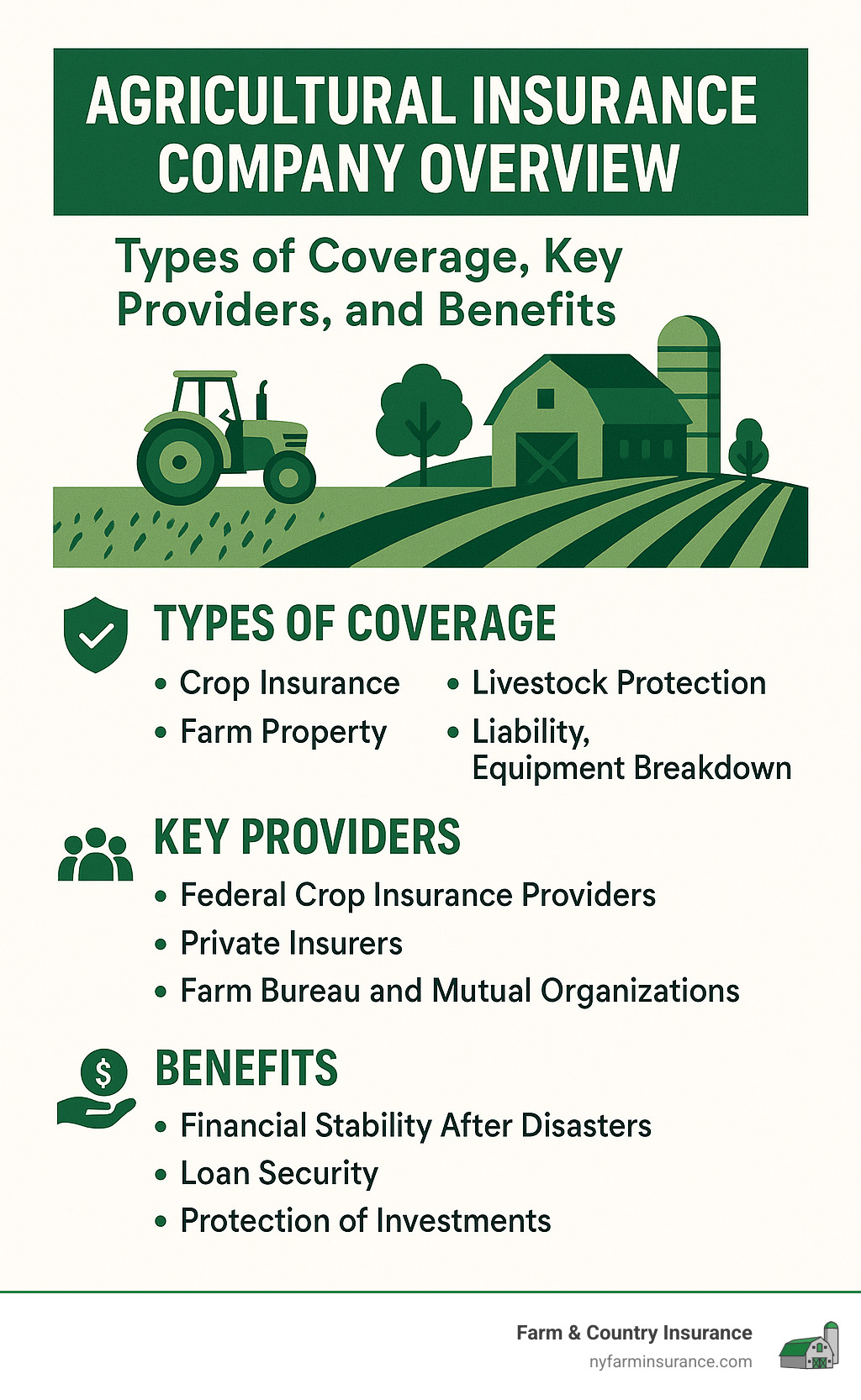
Agricultural insurance companies are specialized providers that offer financial protection for farmers against various risks including weather disasters, price fluctuations, and crop failures. If you’re looking for information about agricultural insurance companies, here’s what you need to know:
- Definition: Companies that offer policies specifically designed to protect farms, crops, livestock, and agricultural operations
- Types of providers:
- Federal crop insurance providers (13 private companies working with USDA)
- Private insurers with agricultural specialization
- Farm Bureau and mutual insurance organizations
- Coverage options: Crop insurance, livestock protection, farm property, liability, equipment breakdown
- Key benefits: Financial stability after disasters, loan security, protection of investments
In 2023, agricultural insurance companies partnered with the USDA to provide coverage for a record 540 million acres, protecting nearly $200 billion worth of crops and livestock across farms of all sizes.
Running a farm or ranch has always involved significant risks and uncertainties. From unpredictable weather events to market volatility, farmers face challenges that can threaten their livelihood and the stability of America’s food supply. Agricultural insurance companies provide the critical safety net that allows farmers to invest in their operations with confidence, knowing they have protection against catastrophic losses.
My name is Casey Love, owner of Farm & Country Insurance, and I’ve dedicated my career to helping New York farmers find the right agricultural insurance company solutions to protect their operations. With over 15 years of experience specializing in farm coverage, I understand the unique risks faced by agricultural businesses across our state.
What Is Agricultural Insurance & Why It Matters to Every Farm
At its heart, agricultural insurance is a lifeline for farmers—a way to transfer unavoidable risks to an insurance provider in exchange for premium payments. It’s not just another business expense; it’s the safety net that protects a farm’s working capital, secures crucial loans, and provides financial stability when disaster strikes.
The impact of good farm insurance reaches far beyond your fence line. It strengthens rural communities, contributes to our national economy, and perhaps most importantly, helps ensure family farms can pass from one generation to the next. As one Minnesota farmer recently told us, “Without federal crop insurance, our six-generation family farm wouldn’t have survived the extreme weather patterns we’ve faced in recent years.”
Today’s farming environment makes proper insurance more essential than ever. Climate patterns have become increasingly unpredictable, creating growing seasons that can swing from drought to flood in a matter of weeks. Add in inflation affecting everything from fertilizer to fuel, and the financial stakes keep climbing higher.

Here at Farm & Country Insurance, we’ve stood beside New York farmers through devastating losses and remarkable recoveries. Whether it’s a dairy operation in Cayuga County weathering milk price rollercoasters or a vegetable farm in Owasco rebuilding after flooding, we’ve seen how the right coverage keeps farm businesses viable when nature throws its worst.
Key Risks Farmers Face Today
Modern farming requires navigating an obstacle course of risks that can threaten even the most well-managed operations:
Weather perils have always been farming’s greatest challenge. In 2023 alone, many New York farmers watched helplessly as excessive rainfall during critical growing periods washed away their profit potential. From hailstorms that can shred a cornfield in minutes to late spring frosts that devastate fruit blossoms, weather remains unpredictable and potentially devastating.
Pests and disease evolve constantly, creating new threats each season. The recent spread of spotted lanternfly across New York has created significant challenges for our fruit and vegetable producers, requiring additional management practices and expenses.
Price swings can turn a bumper crop into a financial disappointment when market values drop unexpectedly. Our dairy farmers understand this reality all too well, as milk prices can fluctuate dramatically from month to month.
Liability lawsuits represent a growing concern, especially for farms with direct-to-consumer sales or agritourism activities. One visitor injury or food safety issue can result in legal costs that threaten an operation’s financial stability.
Equipment loss through theft, damage, or mechanical breakdown can halt farm operations at critical times. With modern tractors and implements often representing investments of hundreds of thousands of dollars, protecting this equipment is essential.
The challenge for farmers is that these risks rarely arrive one at a time—they often compound each other, making a comprehensive insurance program absolutely essential.
Economic Benefits Beyond the Farm Gate
When an agricultural insurance company protects a farm, the benefits ripple throughout the entire rural economy:
Job stability in agricultural communities depends on farms remaining viable through good times and bad. Each farm operation supports multiple jobs beyond its boundaries—from equipment dealers and feed suppliers to veterinarians and grain elevator operators.
Lender confidence increases when farms have proper insurance protection. Banks and agricultural lenders are more willing to provide the capital needed for growth and improvement when they know their investment is protected against catastrophic losses.
Supply chain continuity matters to everyone who eats. Insurance helps maintain a consistent food supply despite regional production challenges. When farmers in one area face difficulties, insured producers elsewhere can expand production with confidence, knowing they’re protected against potential losses.
Community tax base in rural areas relies heavily on thriving agricultural operations. Farms contribute significantly to local tax revenues that support schools, roads, and essential services that benefit everyone in farming communities.
At Farm & Country Insurance, we understand that our work extends beyond policy paperwork. When we help protect a New York farm, we’re also helping sustain the broader agricultural economy that remains vital to our state’s identity and prosperity.
Types of Coverage Offered by an Agricultural Insurance Company
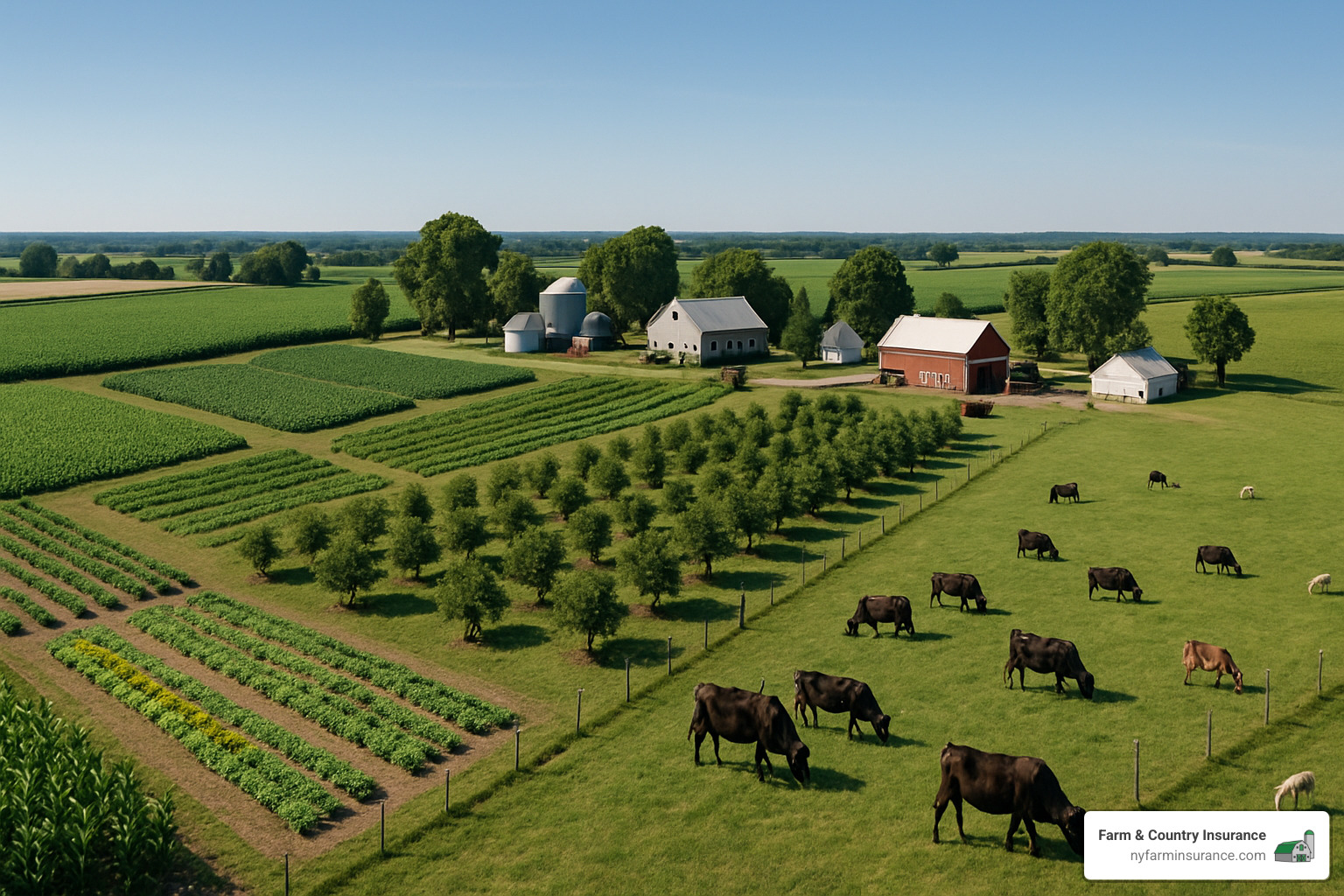
When I sit down with New York farmers to discuss their insurance needs, I’m always struck by how unique each operation truly is. That’s why agricultural insurance companies offer such a wide variety of coverage options – there’s simply no one-size-fits-all approach to protecting a farm.
Core Crop Policies Explained
At the heart of farm protection is crop insurance, which comes in several important forms:
Yield-based policies are the workhorses of crop insurance. They protect your production when Mother Nature doesn’t cooperate – whether that’s a devastating drought, a surprise frost, or persistent pests. The most common type is Actual Production History (APH) insurance, which guarantees a percentage of your farm’s proven yield history. I’ve seen this policy save countless grain farmers in Cayuga County when summer storms flattened their corn.
Revenue-based policies take protection a step further by combining yield and price protection. Revenue Protection (RP) is particularly popular among our clients because it guards against both poor yields and market price drops. When either one (or both) hits, you still have financial stability.
Whole-Farm Revenue Protection has been a game-changer for many of our diversified and organic operations. Rather than insuring each crop separately, this policy covers your entire farm revenue under one umbrella. For farms growing multiple specialty crops or raising several types of livestock, this simplifies insurance tremendously.
Catastrophic Coverage (CAT) provides basic protection against major disasters at minimal cost. While it won’t make you whole after a serious loss, it prevents complete financial ruin. I often recommend this as a starting point for beginning farmers with tight budgets.
Endorsements are the custom add-ons that tailor your policy to your specific needs. Prevented planting coverage, for example, has been invaluable for farmers in low-lying areas who sometimes can’t get equipment into soggy fields during wet springs.
Learn more about protecting your crops on our Crop Insurance page.
Livestock & Specialty Coverages
Livestock producers face entirely different risks than crop farmers, which is why agricultural insurance companies have developed specialized protections:
Dairy herd insurance protects more than just the animals – it safeguards your entire operation’s income stream. Beyond covering mortality, these policies can protect against disease outbreaks and milk contamination. When a Farm & Country Insurance client in Moravia lost three cows to a lightning strike last summer, their policy helped them recover quickly.
Poultry house insurance addresses the unique risks of poultry production, from building damage to equipment failure to flock loss. Temperature control failures can be devastating to poultry operations, and proper coverage ensures you can recover.
Aquaculture coverage protects fish farms against losses from flooding, oxygen depletion, and disease outbreaks. With aquaculture growing in New York, we’ve developed specialized knowledge to properly insure these operations.
Equine mortality insurance is essential for horse farms, providing protection against death due to accidents, illness, or disease. Additional coverage for infertility, medical expenses, and loss of use can be crucial for breeding operations.
Beekeeping insurance has become increasingly important as more New York farmers diversify into honey production. These policies protect hives, equipment, and production against various perils.
Farm Liability & Property Bundles
A complete farm insurance program also protects your physical assets and shields you from liability claims:
Farm structures coverage protects everything from your century-old barn to your state-of-the-art grain bin system. After the windstorm that tore through central New York last year, I was grateful so many of our clients had solid coverage for their damaged buildings.
Equipment insurance is non-negotiable in modern farming. When a client’s combine caught fire during harvest, their equipment policy not only replaced the machine but also provided rental coverage so they could complete their harvest.
Agritourism liability has become essential as more farms welcome visitors. Whether you’re running a corn maze, offering farm stays, or hosting school tours, this coverage protects you when the unexpected happens with guests on your property.
Product recall coverage provides crucial protection for farms that sell directly to consumers. If contamination or other safety concerns require you to recall products, this coverage helps manage the financial impact.
Umbrella liability extends your protection beyond standard policy limits. In today’s litigious environment, this additional layer of coverage can be the difference between recovering from a lawsuit and losing the farm.
Farm & Country Insurance specializes in creating customized insurance packages that address all these areas of risk. We understand that a U-pick apple orchard in Genoa has very different needs than a grain operation in Conquest.
Learn more about comprehensive protection for your operation on our Farm Business Insurance page.
Inside the Federal Crop Insurance Program: Public-Private Partnership
The Federal Crop Insurance Program (FCIP) represents a unique public-private partnership that forms the backbone of agricultural risk management in the United States. This program is administered by the USDA’s Risk Management Agency (RMA) and delivered by 13 approved private insurance companies.
The scale of this program is impressive: in 2023, it provided coverage on a record 540 million acres, protecting nearly $200 billion worth of crops and livestock. This extensive reach makes it one of the most important safety nets for American agriculture.
Key features of the FCIP include:
- Subsidized premiums: The federal government pays a portion of the premium cost to make coverage more affordable for farmers.
- Standardized policies: Core policy terms and rates are established by the Federal Crop Insurance Corporation (FCIC) to ensure consistency.
- Private delivery: While the government sets the rules, private agricultural insurance companies sell and service the policies.
This hybrid approach combines the financial backing of the federal government with the efficiency and customer service of private insurers. It ensures that farmers across the country have access to affordable, reliable crop insurance.
At Farm & Country Insurance, we work with several approved insurance providers to deliver federal crop insurance to our New York farm clients, helping them steer the complexities of the program and select the right coverage options.
The Annual Insurance Cycle
Understanding the insurance cycle is crucial for farmers to maximize their protection. The cycle includes several key deadlines and activities:
Application: Farmers must apply for coverage before the sales closing date for their crop and region.
Sales closing: This deadline, which varies by crop and location, is the last date to purchase or modify coverage for the upcoming growing season. For most spring-planted crops in New York, this date falls in March.
Acreage reporting: Farmers must report their planted acreage by a specific deadline, usually after planting is complete. This establishes the insured acreage for the policy.
Premium billing: Bills are typically sent after harvest when the actual value of coverage is known.
Loss notice: If crop damage occurs, farmers must notify their insurance provider within 72 hours of findy and no later than 15 days after the end of the insurance period.
Indemnity payment: After a claim is processed and approved, farmers receive compensation for their covered losses.
Missing any of these deadlines can result in reduced coverage or claim denials. At Farm & Country Insurance, we provide our New York farm clients with timely reminders of approaching deadlines and assist with the necessary paperwork to ensure compliance with program requirements.
Filing a Claim & Getting Paid
When disaster strikes, knowing how to file a claim efficiently can make a significant difference in recovery time. Here’s the process:
Prompt notification: Farmers must notify their insurance provider within 72 hours of finding damage. This can typically be done by phone, email, or through a mobile app.
Adjuster inspection: A trained adjuster will visit the farm to assess the damage. They may take samples, photographs, and measurements to document the loss.
Production records: Farmers need to provide accurate production records to verify their loss. This may include scale tickets, bin measurements, or sales receipts.
Settlement calculation: The adjuster calculates the indemnity based on the policy terms, the extent of the loss, and the production history.
Electronic funds transfer: Most payments are now made via direct deposit, speeding up the recovery process.
The efficiency of this process varies among agricultural insurance companies. Some have acceptd technology with mobile claims apps and rapid response teams, while others maintain more traditional approaches.
We at Farm & Country Insurance pride ourselves on our claims advocacy. When our clients face losses, we work closely with adjusters to ensure fair assessments and timely payments, helping New York farmers get back on their feet as quickly as possible.

How to Choose the Best Agricultural Insurance Company for Your Operation
Selecting the right agricultural insurance company is a critical decision that can significantly impact your farm’s financial stability. Here are key factors to consider during your due diligence process:
Financial strength: Look for companies with strong financial ratings from agencies like A.M. Best. For example, many leading agricultural insurers maintain “A” (Excellent) ratings or better, indicating their ability to pay claims even during widespread disasters.
Local expertise: Agricultural risks vary significantly by region. An insurer with specific knowledge of New York’s growing conditions, crops, and challenges will provide more relevant coverage and better claims service.
Digital tools: Modern agricultural insurance companies offer online account management, mobile apps for reporting acreage and claims, and integration with farm management software. These tools can save significant time and improve accuracy.
Premium discounts: Many insurers offer savings through multi-policy discounts, safety program credits, and loyalty programs. For example, some companies offer “Ag + Rewards” programs that provide increasing discounts as you add more policies.
Beginning-farmer incentives: Several insurers offer special programs for new and beginning farmers, including premium discounts and additional subsidies through federal programs.
At Farm & Country Insurance, we represent multiple top-rated agricultural insurance companies, allowing us to match New York farmers with the provider best suited to their specific operation. Our deep understanding of both local farming practices and insurance options ensures our clients receive optimal protection.
Comparing One Agricultural Insurance Company to Another
When evaluating different providers, consider these comparison points:
AM Best ratings: These financial strength ratings indicate an insurer’s ability to pay claims. Companies with ratings of A or higher generally demonstrate strong financial stability.
Claim turnaround: Some companies pride themselves on rapid claims processing, with adjusters arriving within days of a loss report and payments issued shortly thereafter.
Precision-ag integration: Leading insurers now integrate with farm management software and precision agriculture tools to streamline reporting and improve accuracy.
Specialty endorsements: Some companies offer unique endorsements for specific situations, such as improved replanting coverage, additional prevented planting options, or specialized coverage for organic transition periods.
We’ve found that the best agricultural insurance company for a particular farm depends on many factors, including the farm’s size, crop mix, and risk tolerance. What works perfectly for a dairy operation in Cato might not be ideal for a vineyard in Ledyard.
Eligibility & Enrollment Checklist
Before applying for agricultural insurance, ensure you meet these common eligibility requirements:
Entity type: Different policies may be available depending on whether you operate as an individual, partnership, corporation, or other entity structure.
Acreage minimums: Some policies require minimum acreage to qualify. For example, certain specialty crop policies may require at least five acres in production.
Conservation compliance: For federal crop insurance, farmers must comply with conservation requirements, including wetland protection and highly erodible land conservation plans.
Reporting deadlines: Be prepared to meet strict deadlines for applications, acreage reporting, and production history submission.
At Farm & Country Insurance, we guide our clients through this eligibility process, ensuring all requirements are met before enrollment deadlines.
Discounts & Incentives You Shouldn’t Miss
Many agricultural insurance companies offer valuable discounts that can significantly reduce premium costs:
Multi-policy discounts: Bundling farm property, liability, auto, and crop insurance with the same provider often yields substantial savings.
Safety programs: Implementing and documenting farm safety measures can qualify for premium reductions.
Precision planting data: Some insurers offer discounts for farms that use precision agriculture technology and share their data for more accurate coverage.
Ag + Rewards tiers: Several companies offer tiered reward programs where discounts increase as you add more policies or maintain coverage over multiple years.
For example, we recently helped a grain farmer in Aurelius save over 15% on their total insurance costs by consolidating multiple policies with one carrier and documenting their precision agriculture practices.
Innovations, Discounts & Climate-Smart Solutions

The world of farm insurance is undergoing a remarkable change. Gone are the days of one-size-fits-all policies and lengthy claims processes. Today’s agricultural insurance companies are embracing technology in ways that would have seemed like science fiction just a decade ago.
I’ve watched this evolution at Farm & Country Insurance. Just last month, I helped a Cayuga County grain farmer use drone imagery to document hail damage, which cut his claims processing time in half compared to traditional methods. These innovations aren’t just convenient—they’re changing how farmers manage risk.
Precision-ag data integration has become a game-changer for many of our clients. When farmers share their planting data directly from their equipment, we can create more accurate coverage that reflects exactly what’s in the ground. One Scipio farmer told me, “It’s like my tractor is talking directly to my insurance policy.”
Satellite imagery now allows us to monitor crop development throughout the season. After last spring’s flooding, we used this technology to quickly identify affected fields across multiple counties, prioritizing inspections for the hardest-hit farms. This meant faster relief for those who needed it most.
Some of our New York farmers are now benefiting from parametric rainfall triggers that automatically pay out when rainfall drops below critical levels. No adjusters, no paperwork—just financial help precisely when it’s needed. As one dairy farmer in Fleming put it, “It’s like having a financial sprinkler system that turns on automatically during a drought.”
The mobile claims apps offered by modern agricultural insurance companies have transformed how farmers report damage. After a windstorm last summer, several of our clients submitted photos and damage reports from their fields before they even returned to their homes. This kind of real-time reporting means faster assistance when it matters most.
Farmers concerned about climate change can now explore carbon market add-ons that protect their investments in sustainable practices. These innovative endorsements ensure that if weather prevents expected carbon sequestration, the financial impact is cushioned. You can learn more about these options through the Actuarial Information Browser.
Drought-index insurance has proven particularly valuable for our clients in drier regions of New York. Rather than waiting until harvest to determine losses, these policies trigger payments based on objective rainfall measurements. This provides critical cash flow during the growing season when expenses are highest and income is months away.
How an Agricultural Insurance Company Tackles Climate Change
Climate change isn’t some distant threat for farmers—it’s a daily reality that shapes every planting decision. At Farm & Country Insurance, we’re helping New York farmers adapt through innovative coverage options.
Advanced heat-stress models now allow us to quantify how temperature spikes affect different crops. This means we can design coverage that responds specifically to the climate challenges facing each farm. For a vegetable grower in Owasco, we recently implemented a policy with improved protection against the increasingly common early-summer heat waves that can devastate young plants.
Higher replant limits have become essential as weather patterns grow more erratic. When a late frost hit several of our fruit-growing clients last spring, expanded replanting coverage helped them quickly restore their orchards without devastating financial losses. As one Ledyard apple grower told me, “Having that extra replant coverage was the difference between a setback and a disaster.”
Perhaps most importantly, resilience analytics are helping our clients identify their farms’ specific vulnerabilities. I recently walked a Moravia dairy farm with the owner, using climate projection tools to identify which pastures were most at risk from changing rainfall patterns. Together, we developed a coverage plan that addressed these specific risks while encouraging adaptive management practices.
Tech-Forward Trends to Watch
The agricultural insurance landscape continues to evolve at a remarkable pace. Here are three innovations that have me particularly excited about the future:
Blockchain traceability is beginning to revolutionize specialty crop insurance. For organic and identity-preserved crops, this technology creates an unalterable record from planting through harvest and processing. For farmers, this means stronger protection against contamination claims and more accurate premium pricing that rewards careful management.
AI yield forecasting combines multiple data sources—from soil sensors to satellite imagery—to predict harvest outcomes with astonishing accuracy. Several agricultural insurance companies are now testing systems that can detect potential yield problems weeks earlier than traditional methods, allowing for intervention before losses occur.
Pay-as-you-plant coverage represents perhaps the most fundamental shift in how farm insurance works. Similar to how some car insurance policies track actual driving habits, these emerging programs adjust coverage and premiums based on real-time planting data. For one Cato farmer I work with, this approach reduced premium costs by 18% while maintaining comprehensive protection.
At Farm & Country Insurance, we’re constantly evaluating these innovations to determine which ones deliver genuine value to our New York farm clients. We believe that the best insurance combines cutting-edge technology with the human touch that comes from local expertise and personal relationships. After all, drones and satellites are wonderful tools, but they’ll never replace the value of walking your fields together and truly understanding your farm’s unique needs.
Frequently Asked Questions About Agricultural Insurance
How much does agricultural insurance cost and who pays the subsidy?
Farm insurance costs can vary dramatically depending on what you’re growing and where your land is located. For federal crop insurance, there’s good news – you won’t shoulder the entire premium yourself. Farmers typically pay between 25% and 67% of the total cost, with the federal government picking up the rest.
To put this in real terms, if you’re growing corn in Cayuga County, you might pay $20-40 per acre for Revenue Protection at the 75% coverage level. If you’re growing specialty crops like vegetables or fruits, expect to pay more – these crops are generally higher in value and carry more risk.
It’s worth noting that as you choose higher coverage levels, your subsidy percentage decreases. This creates a system that encourages more farmers to participate while still providing substantial support for those who want comprehensive coverage.
At Farm & Country Insurance, we take time to walk through both the gross and net costs with our clients. We’ve found that understanding this balance helps farmers find that sweet spot between solid protection and manageable premium costs for their specific operation.
Can small or beginning farmers qualify for the same protections?
Absolutely! In fact, if you’re just starting out or running a smaller operation, you might qualify for some additional benefits. The USDA has created several programs specifically designed to help farmers like you:
Beginning Farmer and Rancher benefits give farmers with less than five years of experience extra premium subsidies, waived administrative fees, and more favorable yield adjustments. These benefits can make a significant difference in affordability.
Whole Farm Revenue Protection works particularly well for smaller, diversified operations. If you’re selling through farmers markets or practicing organic methods, this policy type might be perfect for your needs.
The newer Micro Farm provisions have created more accessible options for very small farms, especially those with revenue under $100,000.
I remember helping a beginning vegetable farmer in Locke who was worried about affording coverage with limited production history. By utilizing these specialized programs, we were able to find affordable protection that gave them peace of mind during their critical early years.
What documents are required when an agricultural insurance company processes a claim?
When disaster strikes and you need to file a claim, having your paperwork organized makes all the difference. Here’s what you’ll typically need:
First, you’ll need to file a notice of loss within 72 hours of finding damage – this timeline is critical. Don’t delay on this step!
You’ll also need to provide production records showing what you actually harvested. This might include scale tickets, warehouse receipts, settlement sheets, bin measurements, or sales receipts.
Your planting records will be important too – seed receipts, planting maps, and equipment records all help verify when and how your crop was planted. If you’re using precision agriculture technology, this data can be extremely valuable during claims.
Insurance adjusters will also want to see input receipts for fertilizer and pesticides to verify you followed good farming practices, and they may request historical records from previous years for comparison.
At Farm & Country Insurance, we encourage our farmers to maintain organized records throughout the growing season. When clients call with a claim, we help gather and submit all required documentation. Having supported countless New York farmers through the claims process, we’ve seen how proper preparation leads to faster, smoother claim settlements when they’re needed most.
Conclusion
The agricultural landscape continues to evolve, with farmers facing increasingly complex challenges from climate change, market volatility, and rising input costs. A robust relationship with the right agricultural insurance company is more important than ever for future-proofing farm operations and ensuring rural prosperity.
As we’ve explored throughout this guide, agricultural insurance serves multiple critical functions beyond just financial protection. It creates the foundation that allows farms to weather storms both literal and figurative. When properly structured, insurance becomes a strategic asset that protects investments, secures access to operating capital, stabilizes income despite production challenges, supports the broader agricultural economy, and enables the long-term planning essential for generational transitions.
The most successful farmers we work with at Farm & Country Insurance view their coverage not as a necessary evil or mere expense, but as a strategic investment in their operation’s resilience. They understand that the right protection creates the confidence to innovate, expand, and plan for the future even in uncertain times.
By carefully selecting appropriate coverage types, levels, and providers, farmers can create a risk management system custom to their specific operation’s vulnerabilities and goals. This customization is where specialized agencies like ours truly shine – we bridge the gap between the complex worlds of agriculture and insurance.
Since 1984, Farm & Country Insurance has proudly served New York’s agricultural community with specialized expertise in farm insurance solutions. We’ve walked alongside dairy producers in Brutus navigating milk price volatility, grain farmers in Fleming rebuilding after devastating wind events, and specialty crop growers in Owasco expanding into new markets – providing the protection that makes these journeys possible.
Our deep understanding of both farming and insurance allows us to translate between these complex fields, ensuring our clients receive coverage that truly addresses their unique needs. Whether you’re managing a multi-generation dairy, a diversified vegetable operation, or a startup orchard, we have the knowledge and carrier relationships to design the right protection package.
The future of farming will require continuous improvement in risk management strategies as new challenges emerge. By partnering with a specialized agricultural insurance provider like Farm & Country Insurance, New York farmers can steer these challenges with confidence, knowing their livelihood and legacy are protected by people who understand the heart and soul of agriculture.
For more information about leading agricultural insurance providers and how they can support your operation, contact Farm & Country Insurance today. Our team is ready to help you develop a customized insurance program that safeguards not just your farm’s assets, but its future.