
Protecting Your Livelihood: Why Cattle Farm Insurance Matters
Cattle farm insurance is specialized coverage designed to protect your livestock operation from financial losses due to accidents, natural disasters, theft, and other risks. Here’s what you need to know:
| Key Components of Cattle Farm Insurance | What They Cover |
|---|---|
| Mortality Coverage | Death due to accidents, weather events, and specified perils |
| Livestock Transit Insurance | Protection during transportation |
| Property Coverage | Barns, equipment, and farm structures |
| Liability Protection | Legal costs from third-party injuries or property damage |
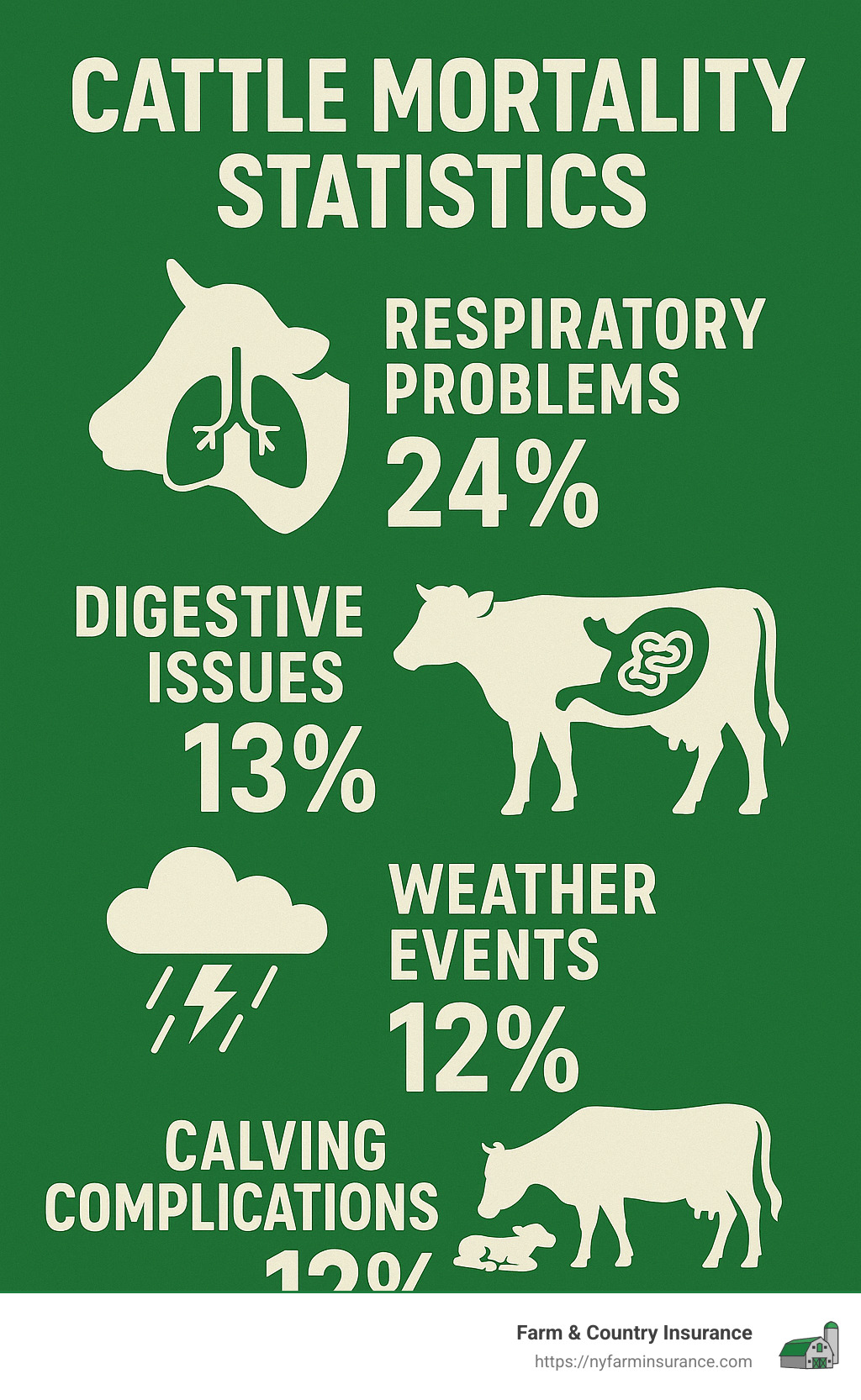
Raising cattle is an unpredictable business filled with unique risks. From respiratory issues (accounting for 24% of cattle deaths) to weather events (12%) and calving complications (12%), numerous threats can impact your herd’s health and your farm’s bottom line.
“Raising livestock and poultry to sell can be unpredictable and risky. That’s why a solid and affordable livestock or poultry insurance policy is a necessity.”
When a single animal can represent a significant investment, having proper insurance isn’t just smart—it’s essential for your farm’s financial stability. Without adequate coverage, one disaster could potentially devastate years of hard work and investment.
Most standard farm policies don’t cover losses from disease, natural causes, or old age in livestock. That’s why specialized cattle farm insurance exists, with options to customize coverage based on your operation’s specific needs.
I’m Casey Love, owner of Farm & Country Insurance, with over two decades of experience helping farmers secure comprehensive cattle farm insurance that protects their agricultural operations from unexpected losses while staying within budget.
Cattle farm insurance terms made easy:
– livestock risk protection
– livestock transport insurance
– can you insure livestock

Understanding Cattle Farm Insurance
When you’re in the cattle business, you know that Mother Nature, accidents, and unexpected events can strike at any time. That’s where cattle farm insurance steps in—it’s designed specifically to protect your livestock operation from the unique challenges farmers face every day.
What Does Cattle Farm Insurance Cover?
Your standard cattle farm insurance policy is your first line of defense against many common threats to your herd.
Most policies will protect you when accidents happen—like when a client’s cattle in Cayuga County escaped and fell into a neighbor’s swimming pool. Their policy covered both the lost animals and the damage to the neighbor’s property. Similar coverage extends to electrocution, drowning, accidental shootings, and collisions with vehicles.
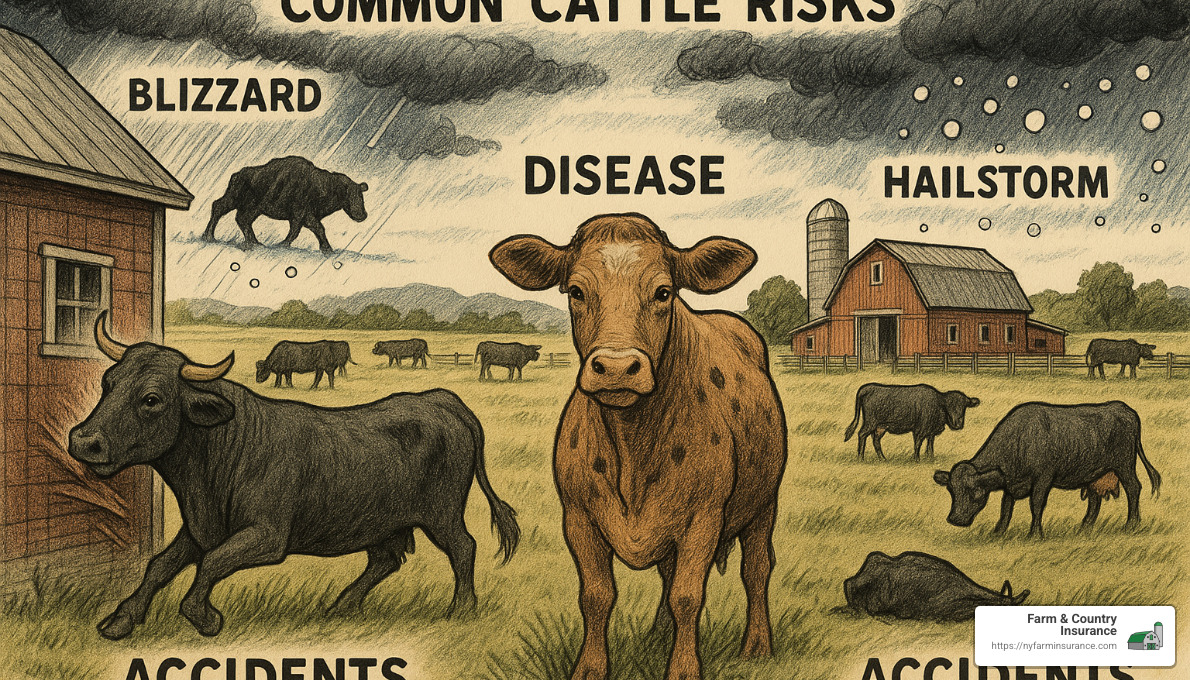
Natural disasters don’t wait for convenient timing. After last year’s severe windstorm swept through central New York, several Farm & Country Insurance clients received compensation for cattle lost when barn structures collapsed. Your policy typically covers earthquakes, floods, lightning strikes, and other acts of nature that can devastate a herd without warning.
Weather events account for about 12% of all cattle deaths, making this coverage particularly valuable for New York farmers facing harsh winters. Blizzards, hailstorms, and extreme temperatures can all be covered under your policy.
Theft and vandalism protection is especially important if you maintain high-value breeding stock. And if accidents occur while moving your animals—whether to market, between pastures, or to the vet—transit collision coverage can help recover those losses.
“From the 1917 Kansas City Stockyards fire to a present-day blizzard howling through a Plains feedlot… livestock insurance has been protecting farmers’ investments for over a century.”
At Farm & Country Insurance, we’ve been helping New York farmers customize their coverage since 1984, ensuring policies address the unique challenges of farming in the Northeast.
What Isn’t Covered in Standard Policies?
Knowing what your policy doesn’t cover is just as important as knowing what it does. Most standard cattle farm insurance policies have some significant gaps you should be aware of.
Disease is a major exclusion that catches many farmers by surprise. Given that respiratory problems cause 24% of cattle deaths and digestive issues another 13%, this is a serious concern. One Aurelius farmer learned this lesson the hard way when his cattle became sick from moldy hay. Because the illness was considered a disease rather than an accident, his standard policy didn’t cover the losses.
Natural death from old age or expected causes typically isn’t covered either. Your policy is designed for unexpected losses, not the natural lifecycle of your animals.
Market price fluctuations won’t be covered by standard policies. If cattle prices drop, that’s considered a business risk rather than an insurable event.
Poor management practices that lead to losses—like improper nutrition or inadequate care—are excluded from coverage. Insurance companies expect you to maintain reasonable standards of animal husbandry.
Animals with pre-existing conditions generally aren’t covered for those specific health issues. This is similar to how human health insurance treats pre-existing conditions.
For many dairy farmers in regions like Cayuga County, adding specialized coverage for milk production losses due to disease outbreaks has proven invaluable. It’s worth sitting down with an agent who understands farming to review your operation’s specific risks and fill any coverage gaps.
At Farm & Country Insurance, we recommend reviewing your policy annually to make sure it still matches your operation’s needs and risks. Farming changes, and your insurance should keep pace.
Types of Cattle Farm Insurance Policies
When it comes to protecting your cattle operation, choosing the right insurance structure is just as important as having coverage in the first place. At Farm & Country Insurance, we’ve seen how the right policy type can make all the difference when disaster strikes.
Individual vs. Blanket vs. Herd Coverage
Individual coverage feels a bit like having a personalized security detail for your most valuable animals. Each animal gets its own “policy” with a specific identification and valuation. I worked with a farmer in Skaneateles last year who had a prize-winning Holstein valued at $15,000. When lightning struck during a summer storm, his individual coverage meant he received the full value for that specific animal.
This approach makes perfect sense for registered breeding stock, show animals, and those special bulls or dairy cows that form the genetic foundation of your herd. The premium might be higher, but the peace of mind is worth it when you’ve invested years in developing superior genetics.
Blanket coverage, on the other hand, works more like a protective umbrella over your entire operation. Rather than assigning specific values to each animal, you set a total value for all your covered property, including livestock. This simplifies your paperwork considerably and works beautifully for operations with animals of similar value.
“Your per-head cost will be determined by the coverage you choose.”
One of our clients in Aurelius switched from individual to blanket coverage last year after growing his herd from 30 to 75 cattle. “The administrative burden of tracking each animal separately just became too much,” he told me. “With blanket coverage, I sleep better knowing everything’s protected without the paperwork headache.”
For larger operations, herd coverage often makes the most sense. This approach insures a predetermined number of animals based on a per-head cost. A feedlot operator in Cayuga County uses this method to cover his 200+ beef cattle, appreciating that it accommodates the constant buying and selling that’s part of his business model.
The beauty of herd coverage is its flexibility. When one animal leaves your operation and another takes its place, your coverage continues without interruption. This approach also typically offers the most economical premiums for larger operations where animals have similar values.
Many successful farmers actually combine these approaches. A dairy farmer I work with in Genoa uses individual coverage for his top 10% of producers and his breeding bulls, while covering the remainder of his herd under a more economical herd policy. This hybrid approach gives him precise protection where it matters most while keeping his overall premium manageable.
Choosing between these cattle farm insurance options doesn’t have to be overwhelming. At Farm & Country Insurance, we’ve been helping New York farmers find the right balance since 1984. We’ll walk through your operation, understand your specific risks, and help you determine whether individual, blanket, or herd coverage—or some combination—makes the most sense for your farm’s financial security.
Whichever approach you choose, the goal remains the same: protecting the livestock that represents both your livelihood and your legacy.
Specialized Coverage Options for Your Cattle Operation
When it comes to protecting your herd, one-size-fits-all solutions rarely work. Different cattle operations face unique challenges that require custom insurance approaches. Whether you’re milking Holsteins in Moravia or raising beef cattle in Springport, your needs are specific to your operation.
Dairy, Feedlot, and Pasture Cattle Insurance
Dairy Cattle Insurance goes beyond basic coverage to address the unique challenges dairy farmers face daily. If you’re running a dairy operation, you know that your cows aren’t just livestock—they’re your livelihood and a significant investment.
When working with dairy farmers across central New York, we often include production loss coverage that compensates you when milk production drops following a covered event. Imagine a storm damages your barn, disrupting your milking schedule. With the right policy, you’re not just covered for the physical damage but also for the lost milk income.
Many of our dairy clients also value contaminated milk protection. As one farmer in Fleming told me last year, “When our milk tested positive for antibiotics and we had to dump an entire bulk tank, our specialized coverage saved us thousands.”
For dairy operations in Scipio and similar areas, we typically recommend power interruption coverage. Nothing creates panic quite like a power outage when you have hundreds of cows needing to be milked and thousands of gallons of milk requiring refrigeration. This coverage can be a true lifesaver during those inevitable New York winter storms.
Feedlot Cattle Insurance addresses the concentrated risks that come with keeping large numbers of cattle in confined areas. These operations face unique challenges, from catastrophic mortality events to feed contamination issues.
One feedlot operator in Sennett learned the value of specialized coverage the hard way. During a particularly harsh winter storm, one of his feeding structures collapsed under heavy snow. Not only did he lose several animals, but the surviving cattle missed several feedings during the cleanup, resulting in significant weight loss. His specialized cattle farm insurance covered both the lost animals and compensated for the market value decrease in the underweight survivors.
For feedlot operations, we often recommend coverage options that protect against hypothermia—a serious concern during those brutal New York winters—and feed contamination issues that can affect entire groups of animals simultaneously.
Pasture Cattle Insurance protects against the distinct risks faced by operations raising cattle primarily on open land. When your animals have room to roam, different concerns emerge.
“After losing three heifers to a neighbor’s aggressive dog last year, I learned why pasture-specific coverage matters,” shared a client from Summerhill. His policy included predator protection, which covered losses that his standard farm policy would have excluded.
Other important coverages for pasture operations include protection against losses when cattle break through fences (something that seems to happen at the most inconvenient times), and coverage for poisonous plant ingestion—a risk that increases during drought conditions when normal forage is scarce.
Livestock Transit Insurance for Safe Transportation
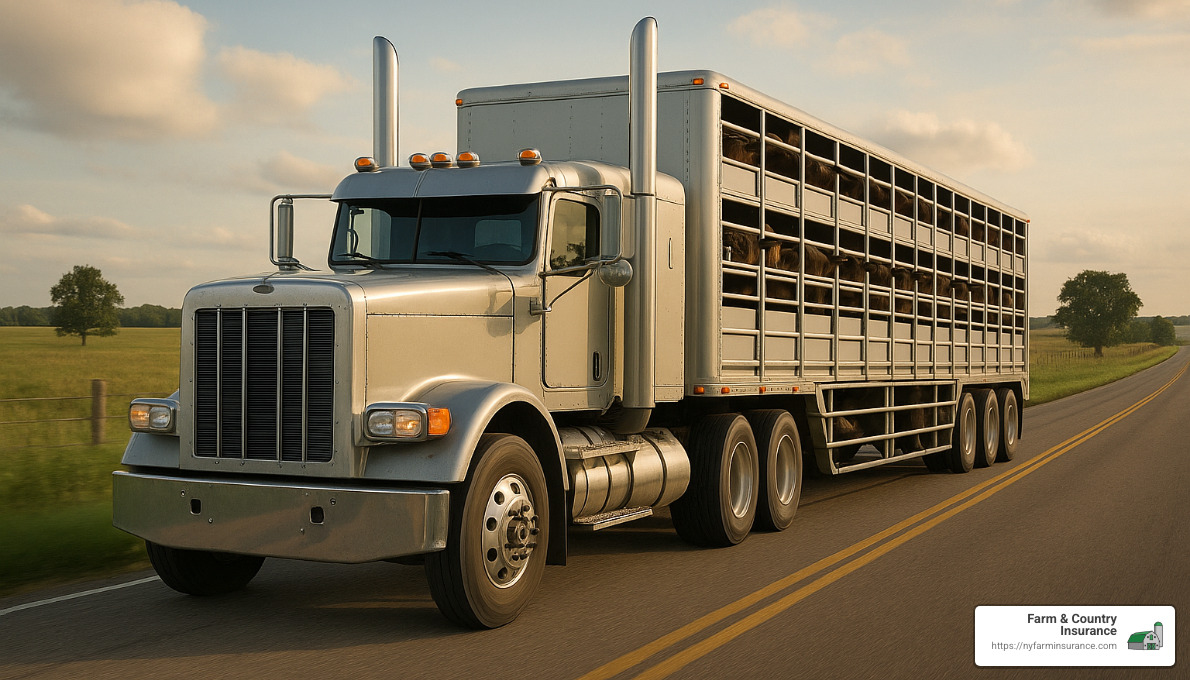
Moving cattle is one of the riskiest activities in livestock management. Whether you’re hauling animals to market, between pastures, or to the vet, Livestock Transport Insurance provides essential protection during these vulnerable times.
Think about it—your animals are confined in a moving vehicle, often stressed, and completely dependent on safe transport. A single accident can result in significant losses. Standard transit coverage typically protects against collision damages, loading/unloading accidents, and vehicle overturns.
At Farm & Country Insurance, we’ve improved our transit coverage based on real experiences of New York farmers. We now include extended coverage that protects animals for a defined period after they arrive at their destination—because we know that transport-related issues don’t always show up immediately.
A cattle producer from Brutus shared his experience: “I never thought I’d need transit coverage until our hauler was involved in an accident on Route 31. Not only did my policy cover the animals we lost, but it also paid for vet treatment for the injured ones and temporary housing until we could arrange new transportation. What could have been a complete financial disaster became manageable.”
For farmers who regularly transport cattle to auction markets in places like Cato or Auburn, robust transit coverage isn’t just an add-on—it’s essential protection for your investment. This coverage can also include carcass removal costs (an unfortunate but necessary consideration) and protection when animals are rejected at their destination.
Some of our clients have been surprised to learn that their regular farm policy doesn’t fully cover animals during transport. Adding specialized cattle farm insurance for transit situations closes this dangerous gap in protection, giving you peace of mind when your animals are on the move.
Factors Affecting Cattle Farm Insurance Premiums
When you’re shopping for cattle farm insurance, you might wonder why your neighbor’s premium is different from yours. The truth is, many factors go into determining what you’ll pay to protect your herd. At Farm & Country Insurance, we believe farmers deserve to understand exactly what influences their insurance costs.
Cattle Valuation and Coverage Limits
The value of your cattle is the foundation of your premium calculation. Simply put, more valuable animals cost more to insure – just like an expensive car costs more to insure than an economy model.
Your cattle can be valued in several ways. Market value pricing bases coverage on what similar animals are selling for at auction. Replacement cost considers what you’d need to spend to replace that animal with one of similar quality. With agreed value, you and the insurer settle on a specific amount upfront.
I remember working with a dairy farmer in Cato who had several prize-winning Holsteins. For these special animals, we used agreed value coverage to ensure they were properly protected given their exceptional genetics and production history. For his general milking herd, market value made more financial sense.
Your coverage limits – the maximum amount your policy will pay – directly impact what you’ll pay in premiums. While higher limits mean higher premiums, they also provide greater protection when disaster strikes. Finding the right balance is key.
Risk Factors Specific to Your Operation
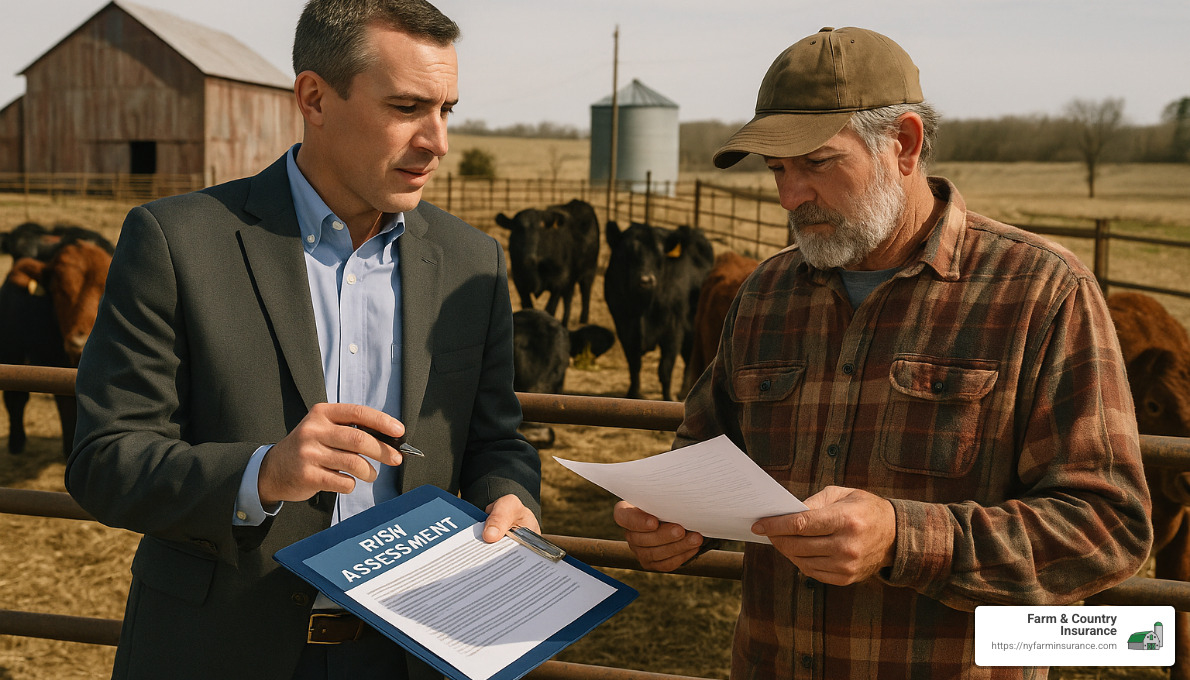
Your farm’s unique characteristics significantly influence your cattle farm insurance costs. Location matters more than many farmers realize. If your farm sits in areas prone to flooding, severe winters, or extreme weather (like the snow belt regions around Sterling), you might pay more than someone in a more moderate climate. Being miles away from the nearest large-animal vet can also affect your rates, since quick access to care often means less severe losses.
How you manage your farm plays a huge role too. When we visit farms to assess risk, we look for good management practices that reduce the likelihood of claims. Regular vet care, comprehensive vaccination programs, well-maintained facilities, proper record-keeping, and experienced management all signal to insurers that you’re a lower risk.
One of our clients in Venice implemented a thorough biosecurity plan and started documenting all his vaccination protocols. After showing us these improvements, we were able to reduce his premiums by 12%. His proactive approach demonstrated he was actively preventing potential losses.
Your herd’s size and makeup matter as well. Larger herds sometimes benefit from economy of scale pricing. Certain breeds or types of cattle may present different risk profiles – for instance, high-producing dairy cows face different health challenges than beef cattle on pasture.
Previous claims significantly impact your future premiums. Just like with auto insurance, a history of frequent claims typically results in higher rates. Maintaining a clean record often leads to valuable discounts over time.
Deductible Choices and Policy Options
Your deductible choice creates one of the most direct connections to your premium costs. The deductible is what you pay out-of-pocket before insurance kicks in. Choosing a higher deductible generally results in lower premiums but means you’ll shoulder more financial responsibility when losses occur.
Optional coverages add protection but also increase costs. These might include specialized protection against disease outbreaks, transit accidents, contaminated feed, or reproductive failures. The key is identifying which risks are most relevant to your specific operation.
At Farm & Country Insurance, we recently worked with a beef producer in Throop who was looking to manage his premium costs. After analyzing his operation, we helped him understand which risks were most likely to affect his particular farm. By increasing his deductible while maintaining comprehensive coverage for his most significant risks, he reduced his premium by 15% while actually improving protection where it mattered most.
“I appreciated that Farm & Country Insurance didn’t just try to sell me the most expensive policy,” he told us later. “They helped me understand my actual risks and build a policy that protected what was truly important to my operation.”
Finding the right balance between comprehensive coverage and affordable premiums isn’t about cutting corners – it’s about smart, targeted protection for your specific operation. That’s why we take the time to walk your property, understand your management practices, and build a cattle farm insurance policy that fits your farm’s unique needs.
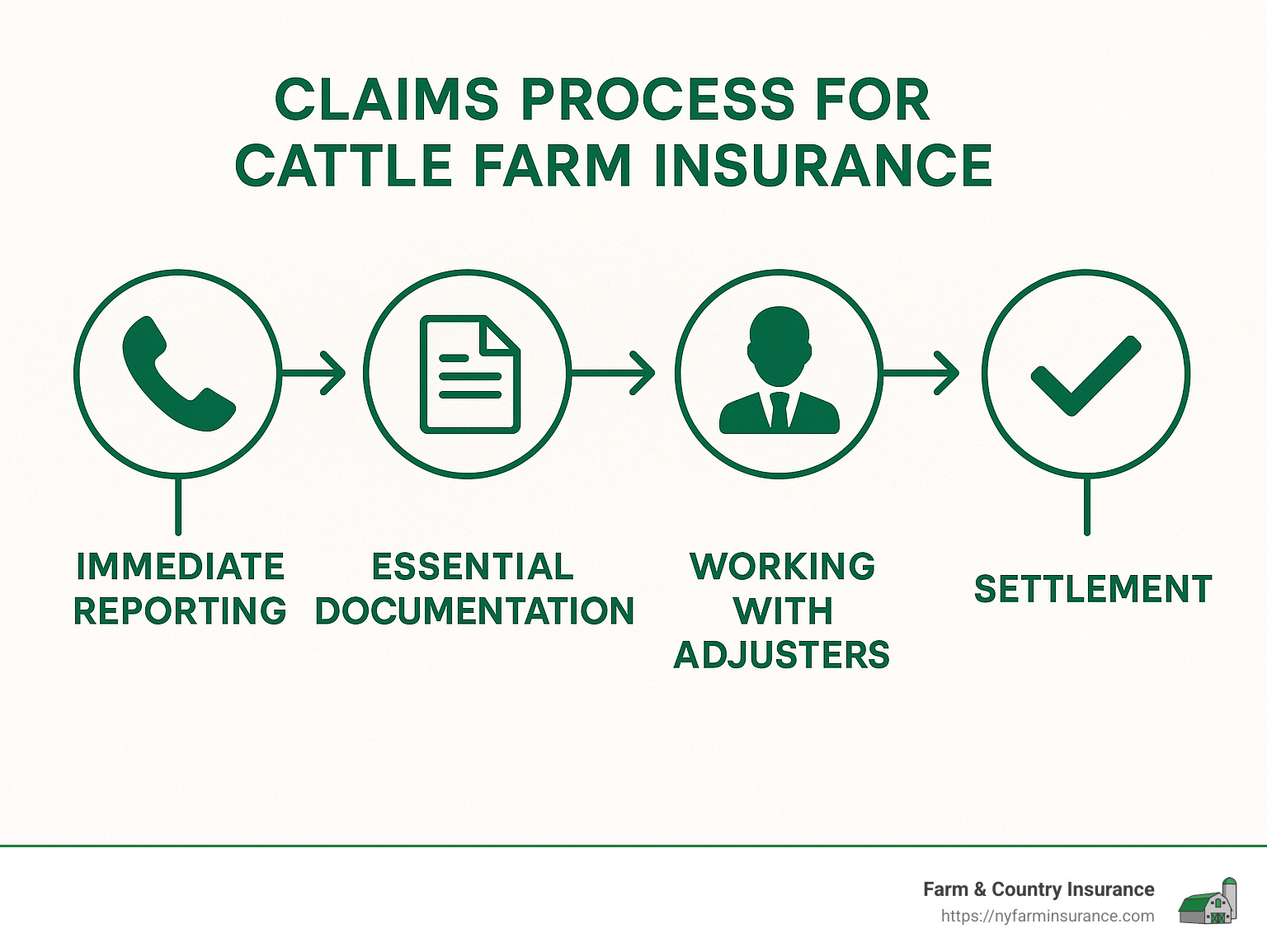
Navigating the Claims Process for Livestock Losses
When disaster strikes your cattle operation, knowing how to steer the claims process efficiently can make all the difference between a quick recovery and prolonged financial strain. At Farm & Country Insurance, we’ve guided countless New York farmers through the claims process since 1984, and we understand the unique challenges that come with livestock losses.
Reporting Losses and Documentation Requirements
The moment you find a loss is critical. Most cattle farm insurance policies require you to report losses within 24-48 hours of findy. Waiting too long can seriously jeopardize your claim, so reaching out to your insurer immediately is essential.
For our Farm & Country Insurance clients, we maintain a 24/7 claims hotline because we know that disasters don’t respect business hours. This immediate access is particularly important with livestock claims, where evidence can deteriorate quickly in New York’s variable climate.
Documentation is the backbone of a successful claim. When facing a livestock loss, you’ll need several types of evidence:
First, you’ll need proof of death or injury – photographs of deceased animals, veterinary reports, or statements from witnesses who observed the incident. Second, identification records are crucial – ear tag numbers, brands, or registration papers that clearly identify the affected animals. Third, you’ll need evidence of value – recent purchase receipts, breeding records, production history, or current market reports that establish what the animals were worth.
I remember working with a dairy farmer in Locke who experienced a devastating lightning strike in his pasture that killed several valuable Holsteins. Because he had the foresight to photograph the scene immediately, maintained detailed identification records for each animal, and had recent milk production data that established their value, we processed his claim within two weeks.
Working with Adjusters for Cattle Claims
Livestock claims often involve specialized adjusters who understand agricultural operations. These professionals become your partners in the recovery process, but knowing how to work with them effectively can streamline your claim.
When the adjuster arrives at your farm, provide full access to the loss site and any surviving animals. Be open and honest about the circumstances surrounding the loss – adjusters appreciate transparency and it builds trust in your claim. Don’t hesitate to ask questions about anything you don’t understand, whether it’s about the process, timeline, or coverage details.
At Farm & Country Insurance, we often accompany adjusters on farm visits, serving as advocates for our clients. This extra step has proven invaluable for farmers who may be unfamiliar with insurance terminology or processes. As one client told us, “Having my agent there to translate ‘insurance speak’ into plain English made a stressful situation much more manageable.”
Special Considerations for Mortality and Injury Claims
Livestock claims come with unique complexities that set them apart from other property claims. Understanding these special considerations helps you maximize your coverage.
Salvage value often comes into play with livestock losses. In some cases, deceased animals may have residual value that could affect your settlement. Your policy will specify how salvage value is handled, so reviewing these details before a loss occurs helps avoid surprises.
Partial losses are common in livestock operations. When animals are injured but not killed, comprehensive cattle farm insurance may cover veterinary expenses, decreased value of the animal, loss of production or income, and even the cost of temporary replacement animals while yours recover.
Consequential losses often accompany the primary incident. These secondary impacts can include loss of milk production following stress, decreased reproduction rates, weight loss in surviving animals, and additional labor costs required to manage the aftermath.
A beef producer in Montezuma experienced this cascading effect when a barn fire killed several animals and severely stressed his surviving herd. His comprehensive policy through Farm & Country Insurance not only covered the deceased animals but also compensated for weight loss in the survivors and the additional feed costs required to restore them to market condition.
“The initial loss was just the beginning,” he told me later. “Without coverage for those consequential losses, I would have faced thousands in additional uncovered expenses. Farm & Country Insurance made sure my policy addressed those secondary impacts that could have been just as devastating as the fire itself.”
The claims process may seem daunting, especially when you’re already dealing with the emotional and practical challenges of a livestock loss. But with proper documentation, open communication with your adjuster, and a thorough understanding of your policy’s provisions, you can steer the process successfully and get back to what matters most – running your farm.
Complementary Risk Management Strategies
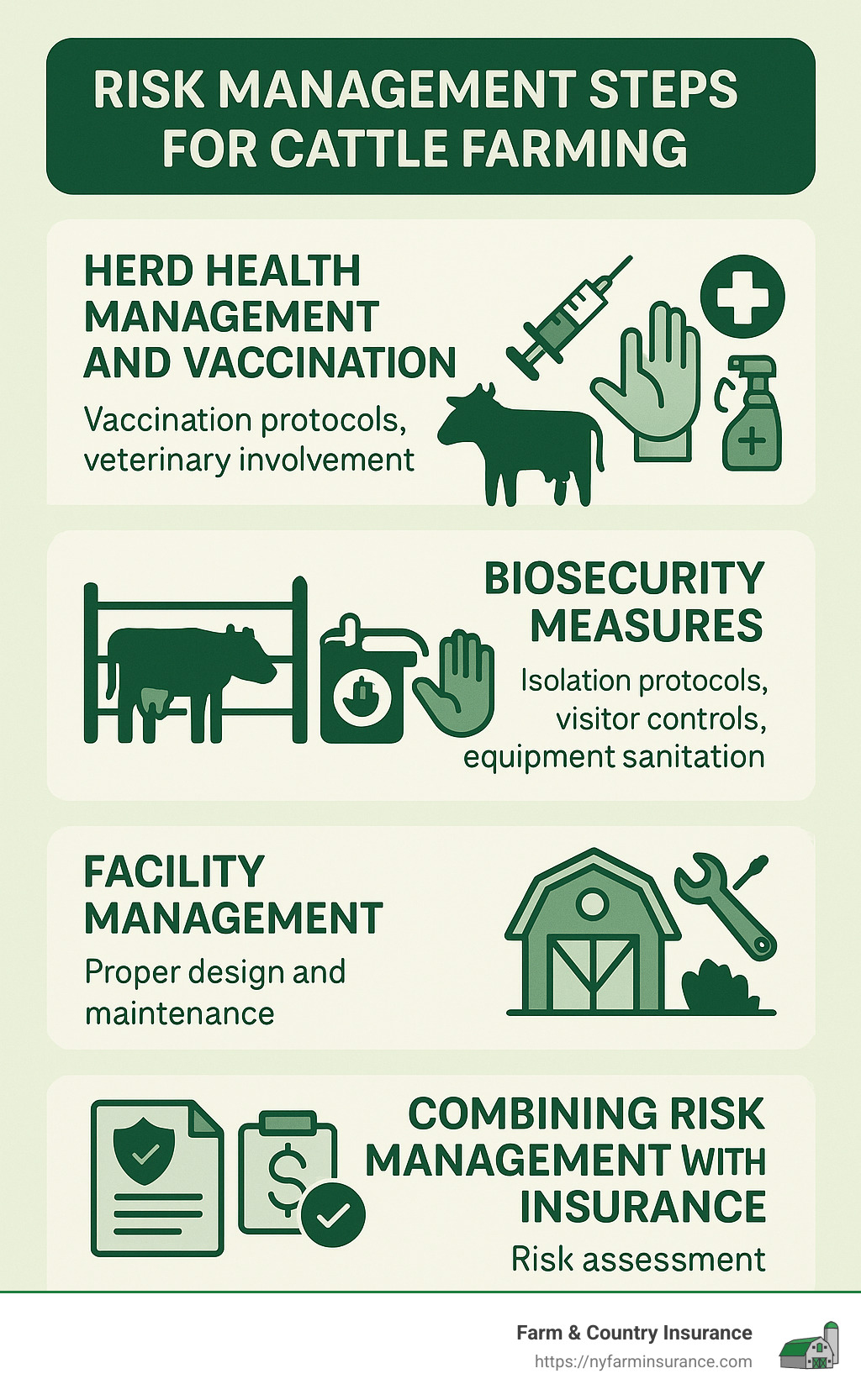
While cattle farm insurance provides essential protection against major losses, it works best when paired with smart prevention strategies. At Farm & Country Insurance, we’ve seen how farmers who combine good insurance with proactive management fare better when challenges arise.
Herd Health Management and Vaccination Programs
Your best defense against losses starts with keeping your animals healthy. A strong vaccination program isn’t just good farming—it’s good business. When respiratory problems cause nearly a quarter of all cattle deaths and digestive issues account for another 13%, preventing these conditions becomes crucial for your bottom line.
I remember visiting a dairy farm in Aurelius after they’d suffered significant losses from a respiratory outbreak. The owner was devastated, both emotionally and financially. After we helped process his claim, we worked together to develop a more rigorous vaccination schedule. Not only did his herd stay healthier, but we were able to reduce his premiums by 8% because his improved practices lowered his risk profile.
Regular veterinary check-ups catch problems early, when they’re easier and less expensive to treat. Many of our most successful clients have established relationships with veterinarians who specialize in cattle. These partnerships provide customized health protocols and expert guidance on emerging threats specific to central New York.
Proper nutrition also plays a huge role in keeping cattle healthy. Well-fed animals have stronger immune systems and resist disease better. Several farmers I work with consult with nutritionists to develop feed programs custom to each stage of production—an investment that pays dividends in reduced health problems.
Biosecurity Measures and Facility Management
Think of biosecurity as building a protective bubble around your herd. When new animals arrive at your farm, keeping them separated for at least 30 days gives time for any hidden diseases to show themselves before they can spread to your entire herd. This simple practice has saved countless New York farmers from devastating outbreaks.
Controlling who comes onto your farm matters too. A beef producer in Mentz tells visitors, “My cattle’s health is my livelihood—that’s why I ask everyone to use these boot covers.” Simple measures like providing disposable boot covers or requiring visitors to use disinfecting footbaths have prevented many disease introductions.
The design and maintenance of your facilities also significantly impact animal health. Good ventilation reduces respiratory disease, proper drainage prevents foot problems, and well-maintained equipment prevents injuries. One of our clients in Conquest redesigned his cattle handling facilities after several injuries occurred during loading. The investment paid for itself within a year through reduced losses and lower insurance premiums.
Combining Risk Management with Cattle Farm Insurance
The most successful farmers I work with take an integrated approach—they see cattle farm insurance and prevention as two sides of the same coin. They start by identifying their biggest risks, then develop targeted strategies to address them.
Keeping good records doesn’t just improve your farming—it can lower your insurance costs too. When you can show your insurer vaccination logs, treatment records, and biosecurity protocols, you demonstrate that you’re a lower risk. Many Farm & Country Insurance clients receive premium discounts for documented risk management practices.
A beef producer in Niles who’s been with us for fifteen years puts it this way: “When we had a disease challenge last year, our quick response based on our established protocols limited the damage. For the losses we couldn’t prevent, our insurance stepped in. It’s like wearing both a belt and suspenders—you’re covered either way.”
As your operation evolves, both your risk management practices and your cattle farm insurance should be reviewed regularly. What worked five years ago might not address today’s challenges. At Farm & Country Insurance, we recommend annual reviews to make sure your coverage keeps pace with your changing operation.
By combining smart prevention with comprehensive insurance, you create a safety net that can help your cattle operation weather almost any storm. That’s not just protection—it’s peace of mind.
Determining Appropriate Coverage Limits for Your Herd
Finding that sweet spot for your cattle farm insurance coverage can feel like a balancing act. Too little protection leaves your farm vulnerable when disaster strikes, while excessive coverage means you’re funneling money into premiums that could be better used elsewhere in your operation.
Assessing Your Herd’s Value
Before you can decide on coverage limits, you need to know what your cattle are actually worth. This isn’t as simple as checking a price list – it requires thoughtful consideration of several factors.
For dairy operations, the value of your cows goes well beyond just their weight. A high-producing Holstein with excellent genetics and years of productive life ahead might be worth significantly more than market average. I recently worked with a dairy farmer in Owasco who carefully assessed his 120-cow herd, establishing values ranging from $1,200 for first-calf heifers all the way up to $2,500 for his top-producing mature cows. We even set special valuations for animals with exceptional genetics that had greater breeding value.
Beef producers face different valuation considerations. Your cattle’s worth depends on their weight and condition, certainly, but also breed characteristics, age, and market conditions in your region. If you’re raising seed stock, breeding value adds another layer to the equation.
For those with show animals or premium breeding stock, valuation becomes even more nuanced. Those blue ribbons and championship banners translate to real value, as do performance records of offspring and genetic testing results. I remember helping a farmer in Scipio determine insurance values for his show cattle – we actually looked at comparable sales of similar animals, much like you would when selling a house.
Cattle markets are constantly shifting, which means your herd’s value isn’t static. At Farm & Country Insurance, we encourage our clients to reassess their valuations at least once a year, and more frequently if market conditions change dramatically.
Choosing the Right Coverage Percentage
Once you’ve established what your herd is worth, the next question is: what percentage of that value should you insure? Most cattle farm insurance policies offer flexibility, allowing coverage between 5% and 95% of total value.
This decision often comes down to your operation’s financial resilience. Could your farm absorb a partial loss without insurance coverage? A well-established operation with strong cash reserves might opt for a lower coverage percentage to save on premiums, while a newer farm with tighter margins might need more comprehensive protection.
Your lender may also have a say in this decision. If your cattle serve as collateral for loans, your financing agreements might require minimum coverage levels. I’ve seen this frequently with young farmers who’ve financed their initial herd purchase.
Personal comfort with risk plays a huge role too. Some of my clients sleep better at night knowing they have maximum coverage, even if it means paying higher premiums. Others are comfortable taking on more risk to reduce their insurance costs.
Your history of losses can provide valuable guidance here. If your farm has experienced frequent small losses, you might focus on higher deductibles with comprehensive coverage. If you’ve rarely had claims but worry about catastrophic events, higher coverage limits with larger deductibles might make more sense.
Reviewing and Adjusting Policy Limits
Cattle farm insurance isn’t something you can set up once and forget about. As your operation evolves, your coverage needs to keep pace.
I strongly recommend reviewing your coverage whenever your herd size changes significantly. This seems obvious, but you’d be surprised how many farmers forget to update their policies after expanding. A beef producer in Sempronius learned this lesson the hard way when a severe winter storm hit after he’d increased his herd by 30%. Because his coverage hadn’t been updated, he faced a substantial gap between his actual losses and his insurance payout.
“After that experience,” he told me, “I now schedule quarterly reviews with Farm & Country Insurance to ensure my coverage keeps pace with my operation. The peace of mind is well worth the small amount of time it takes.”
Major market shifts should also trigger a coverage review. When cattle prices swing dramatically up or down, your insurance needs to reflect those changes. Similarly, operational changes – like transitioning from conventional to organic production or shifting from cow-calf to finishing – create new risk profiles that require coverage adjustments.
The aftermath of a claim is also an ideal time to reassess. Did your coverage adequately protect your operation? Were there gaps that left you financially exposed? Use these experiences to fine-tune your protection.
At Farm & Country Insurance, we provide annual coverage reviews as a standard service for all our clients. However, we’re always happy to sit down more frequently when significant changes occur in your operation or the market. Your protection is our priority, and keeping your coverage aligned with your farm’s reality is essential to that mission.
Frequently Asked Questions about Cattle Farm Insurance
How Can Farmers Protect Against Market Price Volatility?
Market price fluctuations can keep even the most experienced cattle producers up at night—it’s a significant risk that standard cattle farm insurance policies typically don’t address. Fortunately, several effective strategies exist to help you weather these financial storms.
Livestock Risk Protection (LRP) offers a safety net against declining market prices. Think of it as establishing a floor price for your cattle while still allowing you to cash in if prices rise—the best of both worlds. At Farm & Country Insurance, we specialize in Livestock Risk Protection policies custom specifically to New York producers’ unique needs and market conditions.
Beyond LRP, the Livestock Gross Margin (LGM) program provides protection against losses in your gross margin—essentially the difference between what your livestock sells for and what you spent on feed. This is particularly valuable if you run a dairy operation or cattle finishing business where feed represents a major expense.
Many of our clients also incorporate forward contracting into their risk management approach. While not insurance in the traditional sense, these agreements with buyers lock in prices ahead of time, providing welcome certainty in an unpredictable market. This approach works beautifully alongside insurance that protects against physical losses.
For those comfortable with more sophisticated financial tools, futures and options allow you to hedge against price declines. I recently worked with a cattle finisher in Mentz who combines LRP coverage with a traditional cattle farm insurance policy for comprehensive protection.
“The physical insurance protects my animals while they’re here,” he told me, “and the price protection ensures they’ll be worth what I need them to be when they’re ready for market. It lets me sleep at night knowing I’m covered from both angles.”
What Government-Backed Insurance Programs are Available?
Uncle Sam offers several valuable programs designed specifically for cattle producers that can complement your private insurance coverage.
Livestock Risk Protection (LRP) remains one of the most popular government-backed options. With coverage available for feeder cattle, fed cattle, and dairy cattle, this program features attractive premium subsidies that reduce your out-of-pocket costs. What I particularly appreciate about LRP is its flexibility—you can choose from various coverage levels and endorsement periods without minimum head count requirements.
For dairy producers, Dairy Margin Coverage (DMC) provides crucial protection when the difference between milk prices and average feed costs falls below your selected coverage level. You can cover up to 5 million pounds of production history with flexible coverage levels from $4.00 to $9.50 per hundredweight. Many of our dairy clients appreciate the discounted premiums available for five-year commitments.
The Livestock Gross Margin (LGM) program offers another layer of protection by guarding against both declining livestock prices and rising feed costs. With monthly purchase opportunities and customizable coverage periods, it’s a versatile tool in your risk management toolkit.
For those unexpected disasters, the Emergency Assistance for Livestock, Honeybees, and Farm-Raised Fish Program (ELAP) provides assistance for losses due to disease, adverse weather, or other conditions that might slip through the cracks of other programs.
And don’t overlook the Livestock Indemnity Program (LIP), which offers payments for livestock deaths beyond normal mortality caused by adverse weather, disease, or even attacks by federally reintroduced wild animals.
At Farm & Country Insurance, we help producers throughout Cayuga County steer these programs, often combining them with private insurance for truly comprehensive protection. One of our clients recently told me, “I never would have figured out how to make these programs work together without your help. Now I feel like I’ve got coverage for just about anything that could happen.”
How Do I Choose the Right Insurance Policy for My Cattle Farm?
Finding the perfect cattle farm insurance policy is a bit like breeding cattle—it takes knowledge, experience, and careful attention to details. Here’s how to approach this important decision:
Start by taking a clear-eyed look at your operation’s specific risks. Where are you located? What weather patterns could affect you? Are you running a pasture-based system, a feedlot, or a dairy operation? What types of cattle do you raise, and what are they worth? Have you experienced losses in the past? How financially resilient is your operation? The answers to these questions form the foundation of your insurance strategy.
Next, familiarize yourself with available coverage types. Would your operation benefit more from individual coverage for high-value animals, blanket coverage for simplicity, or herd coverage for efficiency? Should you opt for a named peril policy that covers specific risks, or an all-risk policy with broader protection? Understanding standard exclusions and available endorsements is crucial—what’s not covered can be just as important as what is.
Don’t try to go it alone. Working with insurance professionals who understand agriculture—and cattle operations specifically—can make all the difference. At Farm & Country Insurance, our agents have been walking alongside New York farmers since 1984. We’ve seen the unique challenges of northeastern cattle production, from harsh winters to regulatory requirements.
Compare multiple options before making your decision. Insurance policies aren’t one-size-fits-all, and small differences in wording can have big implications when you need to file a claim. Take the time to compare coverage options, exclusions, and prices from different sources.
Finally, insurance isn’t a “set it and forget it” proposition. As your operation evolves, your insurance needs will change too. Schedule regular reviews of your coverage to ensure it continues to provide appropriate protection.
I recently worked with a dairy farmer in Conquest who transitioned from conventional to organic production. “The value of my herd increased substantially with the organic certification,” he noted, “and I faced new risks related to maintaining organic status. Having an agent who understood these changes was invaluable in updating my policy.”
At Farm & Country Insurance, we don’t just sell policies—we build relationships that help protect your livelihood for the long haul. After all, your cattle operation isn’t just a business—it’s your legacy.
For more information about livestock insurance options, check out this helpful resource from the USDA’s Risk Management Agency: USDA Livestock Insurance Programs.
Conclusion
Securing comprehensive cattle farm insurance is not just about protecting your animals—it’s about safeguarding your livelihood, your family’s future, and generations of hard work. As we’ve explored throughout this guide, the risks facing cattle operations are numerous and varied, from weather events and disease to market volatility and transportation hazards.
At Farm & Country Insurance, we’ve been helping New York farmers steer these risks since 1984. Our deep understanding of the agricultural landscape in Cayuga County and throughout the state allows us to craft insurance solutions that address the specific challenges you face.

Remember these key takeaways as you evaluate your cattle insurance needs:
First, understand what’s covered—and what isn’t. Standard policies typically exclude disease, old age, and natural death, which account for a significant percentage of cattle losses. Consider additional endorsements to fill these gaps.
Second, choose the right coverage structure for your operation. Individual coverage works well for high-value animals, while blanket or herd coverage may be more cost-effective for larger groups of similar-value cattle.
Third, complement insurance with risk management practices. Vaccination programs, biosecurity measures, and facility improvements can reduce both the likelihood of losses and your insurance premiums.
Fourth, regularly review and update your coverage as your operation changes and grows. Insurance should evolve with your business to ensure continued protection.
Finally, work with knowledgeable professionals who understand both insurance and agriculture. The right guidance can make all the difference when selecting coverage and navigating claims.
Whether you operate a dairy farm in Moravia, a beef operation in Scipio, or a diversified livestock business in Auburn, proper cattle farm insurance provides the foundation for long-term stability and success. It allows you to focus on what you do best—producing high-quality animals and products—with confidence that you’re protected against the unexpected.
I’ve seen how the right insurance coverage can be the difference between recovering from disaster and facing financial ruin. One of our clients in Sempronius lost nearly a dozen valuable breeding animals during an unexpected flood last spring. Because he had worked with us to create a comprehensive policy that included flood protection, he was able to replace his animals and continue operations with minimal disruption.
“I never thought it would happen to me,” he told me afterward. “But when it did, having Farm & Country Insurance in my corner made all the difference.”
We invite you to contact Farm & Country Insurance today to discuss your specific needs and explore how we can help secure your operation against the risks you face. Our team of experienced agents is ready to provide the personalized service and agricultural expertise that New York farmers have relied on for nearly four decades.
For more information about protecting your livestock operation, visit our website at Farm & Country Insurance – Livestock Insurance or call our office to schedule a comprehensive coverage review.
Your farm’s future is too important to leave to chance. Let us help you secure it with the right cattle farm insurance solution for your unique operation.