
Why Crop Adjuster Proficiency Program Certification is Essential for Agricultural Professionals
Crop adjuster proficiency program certification is the gold-standard credential for professionals who investigate and settle crop insurance claims in the United States. This specialized certification ensures adjusters meet federal standards for handling billions of dollars in agricultural insurance claims each year.
Quick Certification Overview:
- Administrator: National Crop Insurance Services (NCIS)
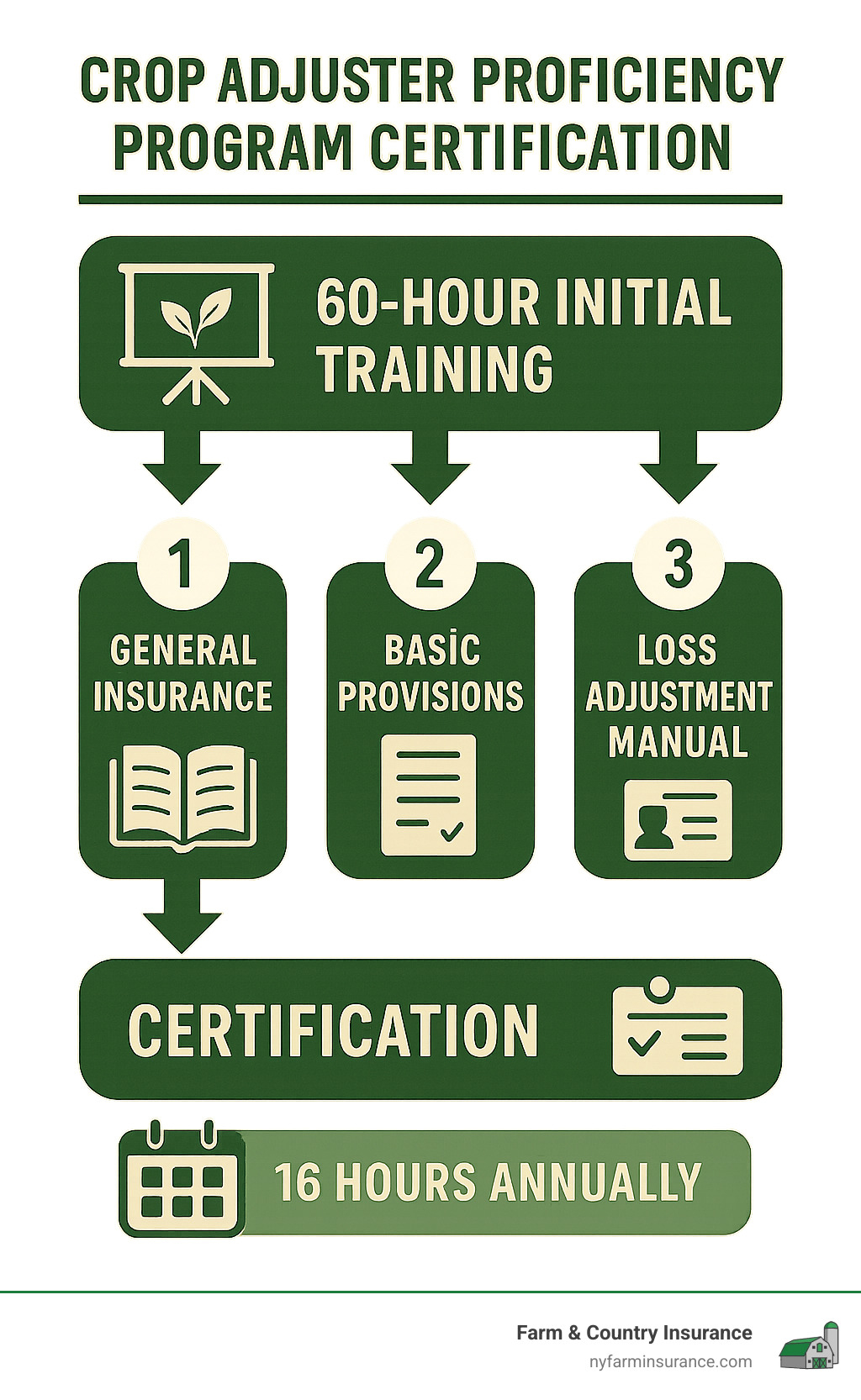
- Training Required: 60 hours initial (24 classroom minimum)
- Exams: 3 open-book, proctored tests at 80% pass rate
- Annual Renewal: 16 continuing education hours
- Federal Recognition: Only USDA Risk Management Agency approved program
- State Benefits: Exempts from Washington state crop-adjuster exam
The agricultural insurance industry faces mounting pressure from climate change, technology advances, and tight profit margins. As one industry expert noted, “Certified Crop Advisers (CCAs) are partners with farmers on the front lines of critical decisions in agriculture – the risks are high, and the pressure has increased.”
Why This Certification Matters:
The Crop Adjuster Proficiency Program (CAPP) serves as the cornerstone qualification for anyone serious about crop insurance adjustment. Whether you are starting your career or looking to advance, CAPP certification opens doors to:
- Federal crop-insurance claim-handling authority
- Improved credibility with farmers and insurance companies
- Streamlined licensing in multiple states
- Higher earning potential in agricultural insurance
I am Casey Love, founder of Farm & Country Insurance, and I have witnessed how crop adjuster proficiency program certification transforms careers in agricultural risk management. My experience helping New York farmers steer complex insurance claims has shown me the critical importance of working with properly certified professionals who understand both the technical and human sides of agricultural loss adjustment.
Understanding the Crop Adjuster Proficiency Program (CAPP)
The Crop Adjuster Proficiency Program is the only program that has earned the USDA Risk Management Agency’s stamp of approval for federal crop-insurance work. The National Crop Insurance Services (NCIS) administers all courses and exams, creating a unified approach that benefits the entire industry.

CAPP was created to solve critical industry problems: different states had different licensing requirements, some exams were outdated, and adjusters could not easily move between states. NCIS stepped up to create a unified, USDA-approved program that works everywhere.
The numbers tell the story of why this matters. Back in 1998, crop insurance covered over 180 million acres with 28 billion dollars in liability. Today’s figures are even more impressive, making professional competency absolutely crucial for maintaining industry integrity.
Why CAPP Matters for Modern Crop Adjusters
Getting your crop adjuster proficiency program certification is not just about checking a box – it is about becoming the kind of professional that farmers and insurance companies can truly rely on.
Building Trust Through Accuracy
When you are handling billions of dollars in claims each year, there is no room for guesswork. CAPP-certified adjusters learn standardized procedures that reduce errors and ensure consistent claim handling. This consistency builds producer confidence in the entire crop-insurance system.
Staying on the Right Side of Federal Requirements
The USDA Risk Management Agency requires adjusters to demonstrate proficiency through approved programs, and CAPP is your ticket to that approval. Without it, you simply cannot work on federal claims.
Becoming a Fraud-Fighting Professional
Detecting crop-insurance fraud requires serious skill. As industry experts point out, “Moral hazards are often harder to detect than overt fraud.” CAPP training teaches you to spot subtle issues that could compromise claim integrity.
Key Eligibility Requirements
Before you can start your journey toward crop adjuster proficiency program certification, you will need to meet basic requirements:
- At least 18 years old
- High-school diploma or equivalent
- Sponsorship by an Approved Insurance Provider (AIP)
- 60-hour structured initial training prerequisite
While a high-school diploma gets you in the door, having an associate’s or bachelor’s degree in agricultural business gives you a real advantage. Focus on agricultural education, animal science, crop science, math, statistics, biology, and chemistry.
At Farm & Country Insurance, we have seen how this educational foundation makes a difference when adjusters work with our farming clients across New York.
Step-By-Step Guide to Earning Your Crop Adjuster Proficiency Program Certification

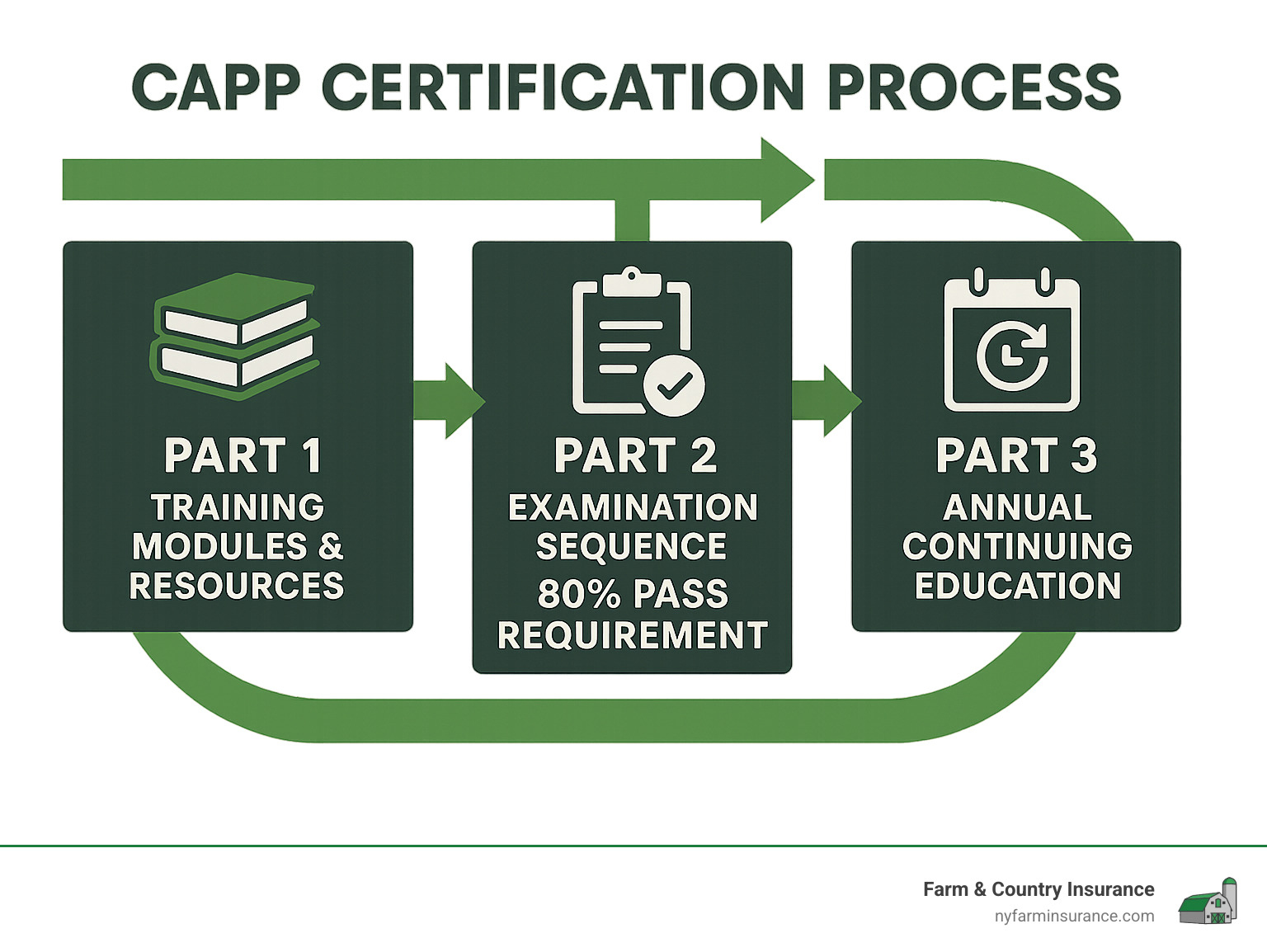
Getting your crop adjuster proficiency program certification follows a logical three-part journey. You will start with 60 hours of structured initial training, including at least 24 hours of classroom time. This foundation prepares you for three comprehensive tests, followed by annual continuing education.
Part 1 – Training & Resources
Your CAPP journey begins with comprehensive training covering everything from basic insurance principles to crop-loss assessment details. The 60-hour training requirement includes both classroom instruction and self-directed study.
The 24-hour classroom minimum is where real learning happens. You will work through complex scenarios with experienced instructors, covering insurance fundamentals, federal regulations, and crop-specific knowledge.
Your training package includes detailed study-guide PDFs that become your roadmap through certification. These guides break down everything from land description systems to privacy regulations in understandable language.
Field days represent some of the most valuable training. There is nothing like standing in an actual damaged field with an experienced adjuster, learning to spot hail damage on corn or assess drought stress in soybeans.
Many candidates find that having a mentor makes all the difference during training. Your sponsoring AIP often pairs you with a seasoned professional who can answer questions and help steer practical challenges.
For those looking to understand the broader certification landscape, you can find More info about Crop Insurance Certification to help plan your professional development path.
Part 2 – Passing the Exam Series
Once you have completed training, you will tackle the three-part exam series. These are open-book, proctored tests that focus on practical application rather than memorization. You will need to score 80% minimum on each exam.
The General Insurance exam covers foundation principles every adjuster needs. The Basic Provisions exam dives into standard crop-insurance policy terms. The Loss Adjustment Manual (LAM) exam covers specific procedures for investigating claims and determining settlements.
Each exam contains 50–60 questions and uses an online platform accessible from anywhere with reliable internet. The open-book format mirrors how you will actually work in the field – with resources at your fingertips.
If you do not pass on your first try, the 7-day retake rule gives you time to identify weak areas and study more effectively.
Part 3 – Annual Continuing Education
Earning your crop adjuster proficiency program certification is just the beginning. The agricultural industry evolves constantly, which is why CAPP requires 16 hours of continuing education annually, including at least 8 hours of classroom training.
Your continuing education includes ethics refreshers and agronomy updates that introduce new crop varieties and farming practices. The classroom requirement ensures you maintain connection with other professionals and instructors.
Your personalized certification card gets updated annually once you complete continuing-education requirements. This card serves as proof of your current certification status.
At Farm & Country Insurance, we have seen how ongoing education transforms good adjusters into great ones.
Navigating Exams, Scoring & Continuing Education
The crop adjuster proficiency program certification testing process is designed to set you up for success. Each of the three required exams builds on the previous one, creating a logical progression that mirrors how you will actually work in the field.
| Exam Component | Focus Area | Question Count | Time Limit | Pass Rate |
|---|---|---|---|---|
| General Insurance Information | Insurance principles, federal regulations | 50-60 | 2 hours | 80% |
| Basic Provisions | Standard policy terms, coverage details | 50-60 | 2 hours | 80% |
| Loss Adjustment Manual | Claim procedures, documentation | 50-60 | 2 hours | 80% |
The 80% pass rate might sound challenging, but these are open-book exams. You are demonstrating that you know where to find the right information and how to apply it correctly.
Why Open-Book Makes Sense
When you are standing in a cornfield assessing hail damage, you will have your reference materials with you. The open-book format reflects real-world conditions where knowing how to find and apply correct procedures matters more than memorization.
The online proctoring system means you can take exams from approved locations, making certification accessible whether you are in rural upstate New York or anywhere else across the country.
Study Topics You Must Master
The CAPP curriculum covers everything you need to become a competent crop adjuster. Every topic you study will directly apply to your work in the field.
Insurance Fundamentals form the foundation. You will dive deep into risk-management principles and concepts of good faith and fair dealing – the ethical backbone of our industry.
Federal Regulations and Compliance covers how the Federal Crop Insurance Act evolved and why USDA Risk Management Agency requirements ensure program integrity.
The technical procedures section is where theory meets practice. The Loss Adjustment Manual procedures become your roadmap for handling claims consistently. You will master policy provisions and interpretations.
Land description systems help you pinpoint exactly which acres suffered damage. Whether working with rectangular survey systems or metes and bounds descriptions, accurate documentation protects everyone involved.
Professional Ethics deserves special attention because your reputation depends on ethical behavior. You will learn to identify and manage conflicts of interest, maintain confidentiality requirements, and understand antitrust compliance.
Maintaining Certification Year After Year
Earning your crop adjuster proficiency program certification is just the beginning. Staying certified requires ongoing commitment through manageable annual requirements.
Every year, you will need 16 hours of continuing education, including at least 8 hours of classroom training. Your CEU logging and documentation needs to be meticulous. Keep detailed records and submit documentation by specified deadlines.
The USDA Risk Management Agency and AIP sponsors conduct regular audits of adjuster performance and certification compliance. These quality-control measures protect the integrity of the entire system.
Your certification renewal follows an annual cycle with specific deadlines. Plan ahead – waiting until the last minute creates unnecessary stress and risks your certification status.
At Farm & Country Insurance, we have seen how maintaining current certification opens doors to better opportunities and higher earnings.
State Licensing & Federal Compliance

Navigating the licensing landscape for crop adjusters can feel complex. Each state has its own rules, and crop adjuster proficiency program certification fits differently into each state’s requirements. Understanding these differences can actually work in your favor.
At Farm & Country Insurance, we have helped countless professionals understand how federal CAPP certification interacts with state licensing requirements. While the USDA Risk Management Agency controls federal crop-insurance standards, individual states still have their own requirements for who can work as an adjuster within their borders.
Washington State Fast-Track
Washington state deserves recognition for making life easier for crop adjusters. If you have crop adjuster proficiency program certification, Washington recognizes your federal training and lets you skip their state crop-adjuster exam entirely.
This exemption is a real time and money saver. Instead of studying for another exam, you can focus on helping farmers get fair claim settlements. The state’s online application process makes getting licensed straightforward and efficient.
Washington’s approach shows how states can accept federal standards while maintaining oversight. Their online portal streamlines the entire process, letting you apply for your crop-adjuster license without unnecessary delays.
How CAPP Interacts with Other States
Every state has its own approach to crop-adjuster licensing. California takes a practical approach through Insurance Code 14085(a), waiving general adjuster-exam requirements for crop adjusters who complete federal training and pass competency tests.
The concept of reciprocity becomes valuable when working across state lines. Many states recognize licenses from other states, especially for non-resident adjusters handling specific claims.
Single-loss exceptions offer another pathway. Some states allow out-of-state adjusters to handle individual claims without full state licensing, which can be perfect for catastrophic events that cross state boundaries.
Multi-state practice requires careful planning. While CAPP certification provides a strong foundation that most states respect, you will need to research each state’s specific requirements.
Consequences of Non-Compliance
Understanding the consequences of non-compliance can save your career. License suspension is just the beginning – the ripple effects can impact your livelihood for years.
Lost AIP contracts often follow licensing problems. Insurance companies cannot afford to work with adjusters who are not properly licensed, so they will quickly move to other professionals.
Indemnity claw-backs represent a serious financial risk. If federal programs determine that unlicensed adjusters handled claims, they might demand repayment of benefits already paid out.
Reputational damage might be the hardest consequence to overcome. The agricultural insurance community is tight-knit, and word travels fast about compliance problems.
Staying compliant is not just about following rules – it is about protecting your professional future and maintaining the integrity of the crop-insurance system that farmers depend on.
Career Payoffs & Professional Integrity
Earning your crop adjuster proficiency program certification opens doors to a rewarding career that makes a real difference in farmers’ lives. When you hold CAPP certification, you are a trusted professional with credentials that speak volumes.
The financial benefits are substantial. Certified adjusters typically earn around 56,000 dollars annually, but with CAPP certification you often command premium compensation because of your specialized skills and federal recognition.
Your certification travels with you. Whether working in New York’s apple orchards or Iowa’s corn fields, CAPP certification is recognized across state lines. This portability means more job opportunities and career flexibility.
Senior adjustment positions almost always require this certification, making it essential for career advancement. You will also gain access to professional networks and industry events that can accelerate your career growth.
At Farm & Country Insurance, we have seen how CAPP-certified adjusters build stronger relationships with our farming clients. There is something reassuring about knowing your adjuster has invested in proper training.
The job outlook for crop adjusters is excellent over the next five years. As climate change creates more weather-related losses and farming operations become more complex, the need for skilled adjusters continues growing. For current market insights and opportunities, explore Crop adjuster job insights.
How Certification Supports Ethical Claim Handling
CAPP certification creates a foundation of ethical practice that protects everyone involved in the claims process. When farmers face devastating crop losses, they need adjusters who handle their claims with integrity and competence.
CAPP certification ensures transparency in every claim. Certified adjusters follow standardized procedures that eliminate guesswork and personal bias. This consistency means farmers get the same professional treatment regardless of location.
Trust is everything in agriculture. Farmers work with thin margins and cannot afford mistakes in their insurance claims. When they see CAPP certification, they know their adjuster has demonstrated competency through rigorous testing.
The certification program emphasizes professional accountability at every level. Adjusters learn not just how to measure losses, but how to document findings clearly, communicate effectively with farmers, and maintain the highest ethical standards.
The result is a win-win-win situation: farmers get fair treatment, insurance companies maintain program integrity, and adjusters build reputations as trusted professionals.
Frequently Asked Questions about CAPP Certification
I get these questions all the time from folks looking into crop adjuster proficiency program certification. Let me walk you through the most common concerns.
What does the 60-hour initial training include?
The 60-hour training requirement is designed to set you up for success in the field. You will spend at least 24 hours in actual classroom settings with experienced instructors sharing real-world insights.
The remaining hours include self-study materials covering insurance principles and federal regulations. Crop science and agricultural practices make up a big chunk of the training. You will learn to recognize different types of crop damage, understand growing seasons, and identify factors affecting yield potential.
The training also covers loss-adjustment procedures and documentation – how to do the job correctly and completely. You will learn about technology tools, reporting systems, and ethical standards.
How many attempts can I make at each CAPP exam?
You are not limited to just one shot at each exam. If you do not pass on your first try, you can retake it after a seven-day waiting period. This gives you time to identify what you missed and study those areas more thoroughly.
Each exam requires an 80% passing score, which is achievable with proper preparation. These are open-book exams, so you can reference your study materials during testing. The key is knowing where to find information quickly and understanding how to apply it.
Do I need both CAPP and a state license to adjust federal crop claims?
For federal crop-insurance claims, crop adjuster proficiency program certification through CAPP is absolutely mandatory. It is the only program approved by the USDA Risk Management Agency.
State licensing is where things get complicated. Washington State makes it easy – if you have CAPP certification, you are exempt from the state exam requirements. California has its own approach under Insurance Code 14085(a), potentially waiving general adjuster-exam requirements.
If you are a salaried employee working for a company with RMA-approved programs, some states may exempt you from state licensing requirements. For non-resident adjusters, some states allow you to handle individual claims without full state licensing if you have CAPP certification.
My advice? Check the requirements in every state where you plan to work. At Farm & Country Insurance, we have helped many adjusters understand these requirements over the years.
Conclusion
Getting your crop adjuster proficiency program certification is not just about meeting requirements – it is about joining a community of professionals who truly understand what is at stake when crops fail. After nearly four decades of helping New York farmers through their toughest moments, we at Farm & Country Insurance know that proper training and genuine commitment to the agricultural community make all the difference.
The path to CAPP certification is straightforward when you break it down. You will need to meet basic eligibility requirements, complete the 60-hour initial training program, and pass the three CAPP exams with an 80% passing score. The annual 16-hour continuing-education requirement keeps you sharp and up-to-date.
Do not forget to check your state licensing requirements. If you are in Washington, your CAPP certification makes things much easier. Other states have their own requirements worth understanding.
The agricultural insurance industry desperately needs people who understand that behind every claim is a farming family whose livelihood depends on getting things right. Your crop adjuster proficiency program certification shows you take this responsibility seriously.
The investment you make in CAPP certification pays off in career advancement, credibility, and the satisfaction of helping agricultural communities recover from losses.
At Farm & Country Insurance, we have built our reputation since 1984 on understanding what New York farmers face every day. We know that professional competency in crop adjustment brings both expertise and empathy to families dealing with agricultural losses.
Ready to take the next step in your agricultural insurance career? Your CAPP certification is waiting, and the farming community needs qualified professionals who truly understand their world. For more information about comprehensive crop-insurance solutions and how proper adjustment makes all the difference, visit More info about our crop-insurance solutions at Farm & Country Insurance.