
Don’t Have a Cow over Accidental Loss with Livestock Insurance
Why Every New York Farmer Needs to Understand Insurance for Farm Animals
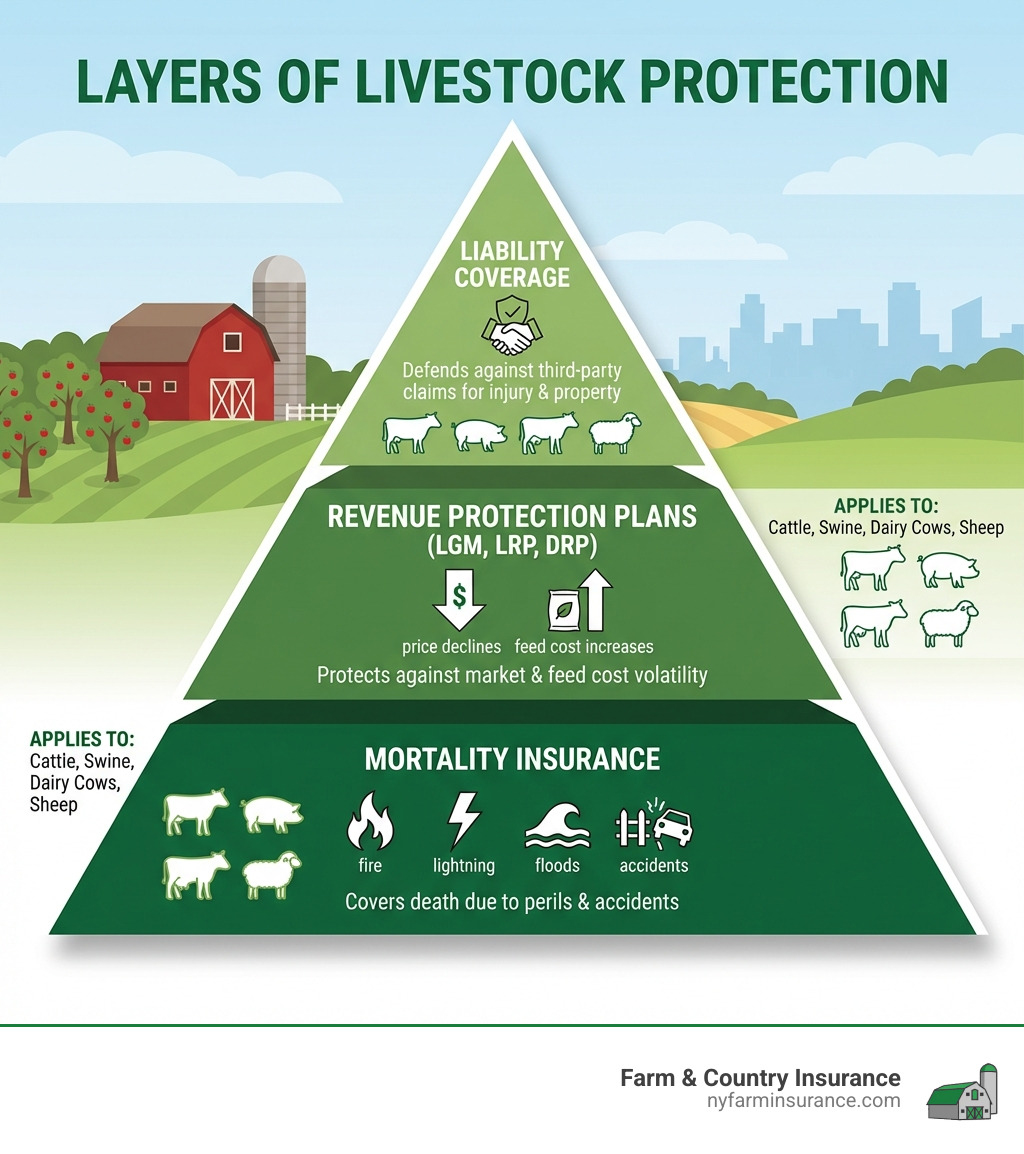
Insurance for farm animals is a broad category of coverage that protects your livestock — and your income — from unexpected losses. Here’s a quick overview of your main options:
- Mortality Insurance — Pays out if an animal dies from a covered peril (fire, lightning, flood, etc.)
- Revenue Protection — Covers income loss from falling market prices or declining milk yields
- Liability Coverage — Protects you if your animals cause injury or property damage to others
- Specialized Federal Plans — Programs like LGM, LRP, and DRP protect against price drops and margin losses
- Blanket or Herd Policies — Cover groups of animals under one policy for cost-effective protection
Your farm is more than a business. For most New York farmers, it’s a livelihood built over generations. Livestock are some of your most valuable assets — and they face real risks every single day.
A barn fire. A flash flood. A trailer accident on the way to market. Any one of these events can wipe out thousands of dollars in a matter of hours.
That’s why having the right insurance for farm animals isn’t just a smart financial move — it’s essential risk management for any serious farm operation.
I’m Casey Love, founder of Farm & Country Insurance, and I’ve spent my career helping New York farmers find the right insurance for farm animals to protect their herds, their income, and their futures. In this guide, I’ll walk you through everything you need to know to make a confident coverage decision.
Common insurance for farm animals vocab:
Understanding the Different Types of insurance for farm animals
When we talk about protecting your livelihood in places like Cayuga County or the rolling hills of the Hudson Valley, we aren’t just talking about a one-size-fits-all policy. At Farm & Country Insurance, we know that a dairy operation in Auburn has very different needs than a beef ranch in Scipio. Understanding the nuances of how does livestock insurance work is the first step toward true financial security.
Mortality Insurance
Think of this as life insurance for your animals. If a covered peril—like a lightning strike or a barn fire—causes the death of your livestock, mortality insurance steps in to help you recover the value of that animal. For high-value bulls or prize-winning horses, you might look into cattle mortality insurance specifically. This coverage ensures that a single tragic accident doesn’t derail your entire breeding program or production schedule.

Revenue Protection
While mortality insurance covers the “physical” loss of the animal, revenue protection covers the “financial” loss of your market position. This is vital for New York farmers dealing with volatile market prices. These Livestock Insurance Plans are often federally subsidized and protect you if the market price drops below a certain level or if your feed costs skyrocket, squeezing your margins.
Liability Coverage
What happens if a gate is left open and your herd wanders onto a county highway, causing an accident? Liability coverage is designed to protect your farm’s assets if your animals cause bodily injury or property damage to a third party. It’s the safety net that keeps a wandering cow from becoming a lawsuit that threatens your land.
| Feature | Mortality Insurance | Revenue Protection | Liability Insurance |
|---|---|---|---|
| Primary Goal | Asset Replacement | Income Stability | Asset Protection |
| Trigger | Death by covered peril | Market price/yield drop | Third-party injury/damage |
| Best For | High-value individuals | Commercial herds/Dairy | All farm operations |
| Coverage Type | Property | Financial/Market | Casualty/Legal |
Specialized Revenue Plans: LGM, LRP, and DRP
For many of our neighbors in New York, the biggest threat isn’t a storm—it’s the market. Federal programs offer sophisticated ways to can you insure livestock against price fluctuations.
- Livestock Gross Margin (LGM): This plan protects your “gross margin,” which is the market value of your livestock minus the feed costs. It’s particularly popular for cattle, swine, and dairy operations because it accounts for the fact that when feed prices go up, your profits go down.
- Livestock Risk Protection (LRP): If you are worried purely about a price drop, livestock risk protection is your best friend. It offers a “floor” for market prices. If the price at the end of your coverage period is lower than the price you insured, the policy pays the difference.
- Dairy Revenue Protection (DRP): This is a game-changer for New York dairy farms. It protects against a decline in quarterly revenue from milk sales. You can choose to insure based on milk components (fat and protein) or class prices.
In 2023, the DRP program showed its value across the country. Statistics indicate that the loss ratio for DRP was between 0.00 and 0.24, suggesting a stable year, yet the total liability covered reached between $1,000,000 and $1,999,999 for the specific policy brackets analyzed. For a New York dairy farmer, this means peace of mind that the milk check will stay within a predictable range, regardless of global market swings.
What Does a Standard Policy Cover?
When you secure insurance for farm animals through a standard farmowners policy, you are generally covered for “broad perils.” We often tell our clients in places like Sennett and Owasco to think of these as the “sudden and accidental” events.
Most policies provide cattle insurance coverage for:
- Fire and Lightning: The most common and devastating farm risks.
- Windstorms and Hail: Essential for our unpredictable New York seasons.
- Floods: Coverage for livestock drowned in rising waters.
- Electrocution: Often caused by downed power lines or faulty barn wiring.
- Attacks by Wild Animals: Protection against coyotes or stray dogs (though sheep are often excluded from this specific peril).
- Accidental Shootings: A real concern during hunting seasons in rural New York.
One area farmers often overlook is livestock transport insurance. Whether you are moving animals between pastures in Cayuga County or heading to a regional auction, transit accidents are a significant risk. Standard coverage often includes loading and unloading perils, as well as collisions or overturns of the transporting vehicle. Knowing what does livestock insurance cover during transit can save you from a total loss before your animals even reach their destination.
Common Exclusions in insurance for farm animals
It is just as important to know what isn’t covered. Standard insurance for farm animals is not a “maintenance” policy. You should be aware of these common exclusions:
- Disease: Most general policies do not cover death by disease. For that, you need specialized mortality endorsements.
- Old Age and Natural Causes: Insurance is for the unexpected, not the inevitable.
- Poultry: Many general farm policies exclude poultry entirely; they usually require a separate commercial poultry rider.
- Neglect: If an animal dies due to a lack of proper food, water, or shelter, the claim will be denied.
- Intentional Acts: Any loss caused by the policyholder’s own actions is never covered.
Understanding these boundaries is part of how we at Farm & Country Insurance help you build a comprehensive risk management plan.
Strategic Ways to Insure Your Herd
Every farm operation is unique, and the way you structure your insurance for farm animals should reflect that. There are three primary ways to list your animals on a policy:
- Individual Scheduling: This is for your “stars.” If you have a high-value bull, a champion equine, or expensive breeding stock, you list them individually with their ear tag number or name and a specific dollar value.
- Blanket Coverage: This is often the most convenient for mid-sized operations. You choose a total limit for all your farm personal property (which includes livestock, equipment, and tools). If a loss occurs, you are covered up to that total limit.
- Herd-Based Policies: You can insure by the “head.” For example, you might insure “100 head of beef cattle” at a set price per head. This is excellent for cattle farm insurance where individual values are similar across the group.
Whether you need farm insurance for goats in a small artisanal dairy or cattle ranch insurance for a large-scale operation, the goal is to match the coverage to the actual cash value of your animals.
Managing Newly Acquired Animals and Reporting
One of the most common questions we get at Farm & Country Insurance is: “What happens if I buy more cows tomorrow?”
Most policies offer an automatic extension for newly acquired livestock. This gives you a “grace period” (often 30 days) where the new animals are covered under your existing policy limits. However, you must report these additions to us within that window to ensure they are permanently added to the schedule. If you are growing your herd or getting into pig insurance, keeping your inventory updates current is vital to avoid being underinsured.
Choosing the Right insurance for farm animals in New York
Choosing an insurance provider isn’t just about finding the lowest premium; it’s about finding a partner who understands the dirt under your fingernails. Farm & Country Insurance has been a staple in the New York agricultural community since 1984. We don’t just sit in an office in Auburn; we visit the farms in Ledyard, Venice, and Victory.
We provide more than just a policy; we provide specialized protections that others might miss. For instance, some of our policies include protection against unfounded animal abuse allegations. In today’s world, a disgruntled neighbor or an activist could make a false claim. Our coverage can help reimburse attorney fees if you are found not guilty, protecting your reputation and your finances.
When you are looking for livestock insurance near me, you want an agent who can perform a true risk assessment. We look at your barn structures, your transit routes, and your market exposure to build a plan that fits. For more help, check out our comprehensive guide to finding livestock insurance near you.
Frequently Asked Questions about Livestock Coverage
How do I get a quote for my farm?
Getting a quote starts with an inventory. We’ll need to know the types of animals, their ages, their use (breeding vs. market), and their approximate value. You can work with specialized livestock agents who understand these metrics. We’ll also look at your existing farmowners policy to see where livestock coverage can be integrated for the best rates.
Does insurance cover animal abuse allegations?
Yes, certain specialized policies, like those we offer at Farm & Country Insurance, include legal defense for unfounded allegations. If someone accuses you of animal cruelty and you are exonerated in court, the policy can reimburse your legal fees. This is a crucial “peace of mind” feature for modern New York producers.
What is the difference between LRP and general mortality insurance?
Think of LRP as “price insurance” and mortality as “life insurance.” LRP protects your wallet from a bad market day. Mortality insurance protects your wallet from a dead animal. Many successful New York farms use both to create a complete safety net. You can learn more about this in our article on crop and livestock insurance.
Conclusion
At the end of the day, insurance for farm animals is about more than just numbers on a page—it’s about the survival of the New York family farm. Whether you are managing a historic dairy in Cayuga County or a new livestock venture in Summerhill, the risks are real, but they are manageable.
Don’t wait for a “cow-tastrophe” to happen. By combining mortality coverage, revenue protection like cattle price insurance, and a solid liability policy, you can sleep better at night knowing your legacy is protected.
Ready to secure your herd? Protect your New York dairy farm today with a team that knows New York agriculture inside and out. Give us a call at Farm & Country Insurance—we’re here to help you keep the farm running, no matter what comes across the pasture.