
Why Farm Equipment Breakdown Coverage Is Critical for Modern Agriculture
Farm equipment breakdown coverage protects farmers against sudden mechanical, electrical, and electronic failures that standard property insurance excludes. Here’s what you need to know:
Key Coverage Elements:
- Mechanical breakdowns – Engine failures, hydraulic system ruptures, transmission damage
- Electrical failures – Power surges, arcing, circuit board malfunctions
- Electronic circuitry impairment – GPS systems, precision agriculture sensors, computer controls
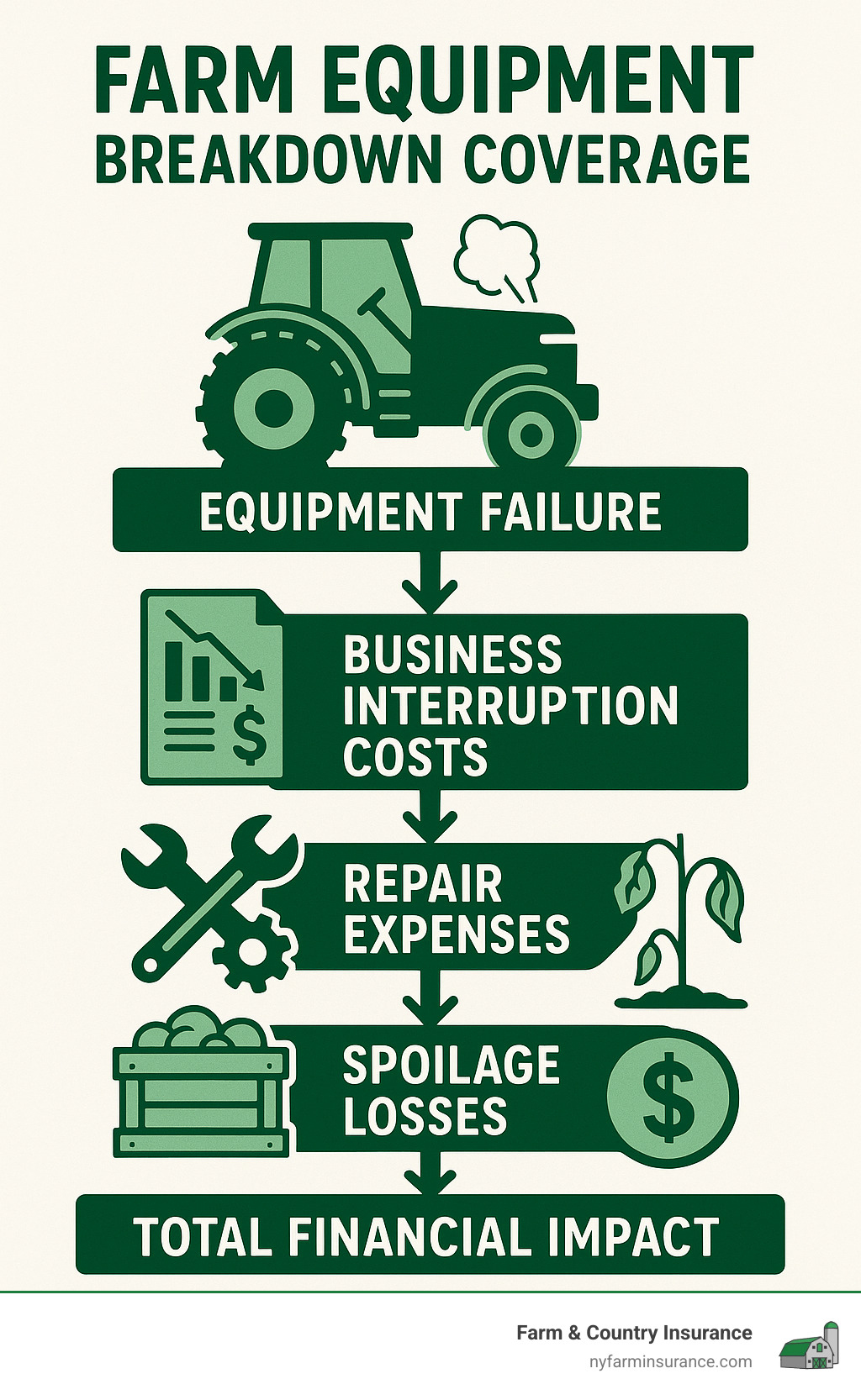
- Business interruption – Lost income during equipment downtime and repairs
- Spoilage protection – Coverage for crops or livestock affected by refrigeration/ventilation failures
- Extra expenses – Costs to expedite repairs or rent replacement equipment
Picture this scenario from the research: “It’s 5 p.m. on a Friday, your hay is cut and lined up in windrows, and torrential rain is expected Saturday morning… your equipment has other plans.” This nightmare situation highlights why equipment breakdown coverage matters so much to farmers.
The financial stakes are enormous. Research shows that equipment theft alone costs agriculture about $1 million every week, while annual repair factors range from 0.29% to 8.80% of original machine cost. Even worse, timing matters – every day of delayed planting past the optimum date can cost winter wheat farmers 1.1 bushels per acre in lost yield.
Modern farms depend heavily on sophisticated equipment that operates under harsh conditions – hot, wet, dusty, and dirty environments that increase breakdown risks. When a critical piece of machinery fails during planting or harvest, the cascading effects can devastate an entire season’s profitability.
I’m Casey Love, founder of Farm & Country Insurance, and I’ve spent years helping New York farmers protect their operations with comprehensive farm equipment breakdown coverage solutions. My experience has shown me that the right coverage can mean the difference between a manageable setback and a financial disaster.
Explore more about farm equipment breakdown coverage:

What Is Farm Equipment Breakdown Coverage?
Think of farm equipment breakdown coverage like having a specialized mechanic on standby for your farm’s heart and soul – your machinery. While your regular farm property insurance covers the “what if” scenarios like fires, storms, or theft, it leaves you hanging when your equipment decides to quit from the inside out.
This type of coverage, sometimes called boiler and machinery insurance, steps in when standard property insurance steps back. It’s designed specifically for those gut-wrenching moments when your tractor’s engine seizes during harvest, your irrigation system’s electrical components fry, or your dairy’s refrigeration compressor gives up the ghost on the hottest day of summer.
Farm equipment breakdown coverage protects against sudden, accidental internal failures – the kind that happen without warning and bring your operation to a screeching halt. We’re not talking about the gradual wear that comes with years of hard work, but those unexpected mechanical or electrical disasters that can turn a profitable season into a financial nightmare.
What makes this coverage truly valuable is how it goes beyond just fixing the broken part. It recognizes that when your equipment fails, your entire operation suffers. Lost income while you’re down, spoiled crops when refrigeration fails, and those expensive rush orders for parts or rental equipment – it covers the whole mess.
How farm equipment breakdown coverage differs from standard property insurance
Your standard farm property insurance does a great job protecting against outside threats, but it has some pretty big blind spots when it comes to equipment failures. Here’s where the two types of coverage part ways.
Property insurance says “not my problem” when your equipment breaks down internally. Those mechanical failures, electrical shorts, and steam explosions? They’re specifically excluded from most property policies. That’s exactly where breakdown coverage picks up the slack.
The depreciation game works differently too. Property insurance often pays you what your equipment is worth today – which might be a lot less than what you paid for it. Breakdown coverage can provide full replacement cost for newer equipment, typically covering machines up to eight years old at their original value.
Warranties sound great until you read the fine print. They cover parts and maybe labor, but they won’t pay for the income you lose while waiting for repairs, or the extra costs of expediting a fix during planting season. Breakdown coverage fills these gaps that warranties leave wide open.
The ripple effects of equipment failure can cost more than the repair itself. Standard property insurance rarely covers lost business income, spoiled inventory, or the premium you pay to get emergency service. Breakdown coverage specifically addresses these indirect costs that can make or break your season.
Key policy triggers that must be met
For your farm equipment breakdown coverage to kick in, specific things need to happen – and they all share one important characteristic: they need to be sudden and unexpected.
Mechanical breakdown covers the dramatic failures – when centrifugal force tears something apart, when metal cracks or ruptures, or when internal parts just give up and quit working. Picture a hydraulic line bursting under pressure or a transmission seizing up mid-field.
Electrical arcing might sound technical, but it’s basically what happens when electricity goes where it shouldn’t. This artificially generated current can fry your precision agriculture systems, damage computer controls, or knock out the electrical components that keep modern equipment running.
Steam equipment explosion applies if you have boilers, pressure vessels, or similar equipment that uses steam or pressurized fluids. When these rupture suddenly due to internal pressure, the damage can be extensive and dangerous.
Electronic circuitry impairment is increasingly important as farms become more high-tech. When microelectronics fail, GPS systems go dark, or computer controls stop responding, this trigger provides coverage for these sophisticated but fragile components.
The magic word in all these scenarios is “sudden.” If your equipment gradually wears out over months or breaks due to poor maintenance, that’s not covered. But when something fails unexpectedly and brings your operation to a halt – that’s exactly what this coverage is designed for.
Why Modern Farms Need It: Risks, Costs & Real Claims
Modern farming has become a high-stakes balancing act between sophisticated technology and Mother Nature’s unpredictability. When you’re managing hundreds of thousands of dollars in equipment under harsh conditions, the question isn’t if something will break down – it’s when and how much it will cost you.
The numbers tell a sobering story. Annual repair factors for farm equipment typically range from 2% to 4% of the original machine cost, though they can climb as high as 8.80% for heavily used equipment. That means your $500,000 combine could easily rack up $10,000 to $20,000 in normal repair costs each year. But catastrophic failures? Those can blow past these estimates in a heartbeat.
Here’s where timing becomes everything. Research shows that every day of delayed planting past the optimum date costs winter wheat farmers 1.1 bushels per acre. At $7 per bushel, that’s $7.70 per acre daily – or nearly $54 per acre for a week-long delay. If you’re farming 1,000 acres, a single week of equipment downtime during planting season just cost you $54,000 in lost revenue.
And let’s not forget about theft. Agricultural equipment theft drains about $1 million from farmers every week across the industry. When you combine theft, mechanical failures, and weather damage, the financial exposure becomes staggering.
Real-world claim snapshots and financial impact
At Farm & Country Insurance, we’ve seen how farm equipment breakdown coverage protects our clients when the unexpected happens. These real claims from our files show exactly why this coverage matters:
The GPS System That Picked the Wrong Time to Quit: During spring planting, a grain farmer’s GPS guidance system suffered a short circuit. The breakdown didn’t just stop field work – it created a domino effect of delays while replacement parts were rushed in. The final tally: $7,100 in property damage plus $250 in expedited shipping costs to get planting back on schedule.
When Gravity Works Against You: A dairy farm’s 30-horsepower electric motor failed at the top of their grain elevator. Replacing it required specialized high-lift equipment and caused significant operational delays. The claim covered $2,800 in property damage and $1,100 in business interruption while the farm scrambled to maintain feeding schedules.
The Electrical Fire That Could Have Been Worse: Electrical arcing in a poultry farm’s fuse box knocked out power to critical ventilation systems. Quick thinking and an emergency generator prevented a disaster, but repairs still cost $2,700 in property damage. Without breakdown coverage, this would have been an out-of-pocket expense.
When the Milk Cooler Gave Up: A dairy operation lost their main refrigeration compressor during peak production. The breakdown coverage handled $576 in repair costs and $187 in spoilage for milk that couldn’t be properly cooled. Every hour counted, and the coverage made sure the farm didn’t absorb the full financial hit.
Most common causes of farm equipment failures
Understanding why equipment fails helps you appreciate why farm equipment breakdown coverage has become essential for modern operations. Equipment breakdowns really cost farmers more than most people realize, and the causes fall into three distinct categories.
Normal wear and tear represents the expected decline that comes with regular use. While breakdown insurance doesn’t cover routine maintenance like replacing filters, belts, or fluids, these predictable costs help you budget for ongoing operations.
Operator error – what industry experts jokingly call “a highly technical term” for avoidable mistakes – causes a surprising number of failures. Running equipment without proper lubrication, ignoring warning signals, or pushing machinery beyond manufacturer specifications can turn minor issues into major breakdowns.
Catastrophic failure represents the sudden, unexpected breakdowns that trigger your coverage. Power surges frying electronic components, hydraulic system ruptures, bearing failures, and electrical arcing in control systems all fall into this category. These are the failures that catch you off guard and can derail your entire operation.
What makes farming particularly challenging is the environment itself. Heat, moisture, dust, and dirt accelerate all types of equipment failure. Modern precision agriculture equipment, with its sophisticated electronics and computer controls, faces even greater vulnerability to these harsh conditions. A power surge that might barely affect office equipment can completely destroy the GPS guidance system that keeps your planting on track.
The reality is that today’s farms depend on technology that’s simultaneously more capable and more fragile than ever before. That’s exactly why breakdown coverage has evolved from a nice-to-have option into an essential protection for serious farming operations.
What’s Covered – And What’s Not
When farmers ask me about farm equipment breakdown coverage, one of their first questions is always: “What exactly does this protect?” It’s a smart question because understanding coverage boundaries helps you make informed decisions about your farm’s protection.
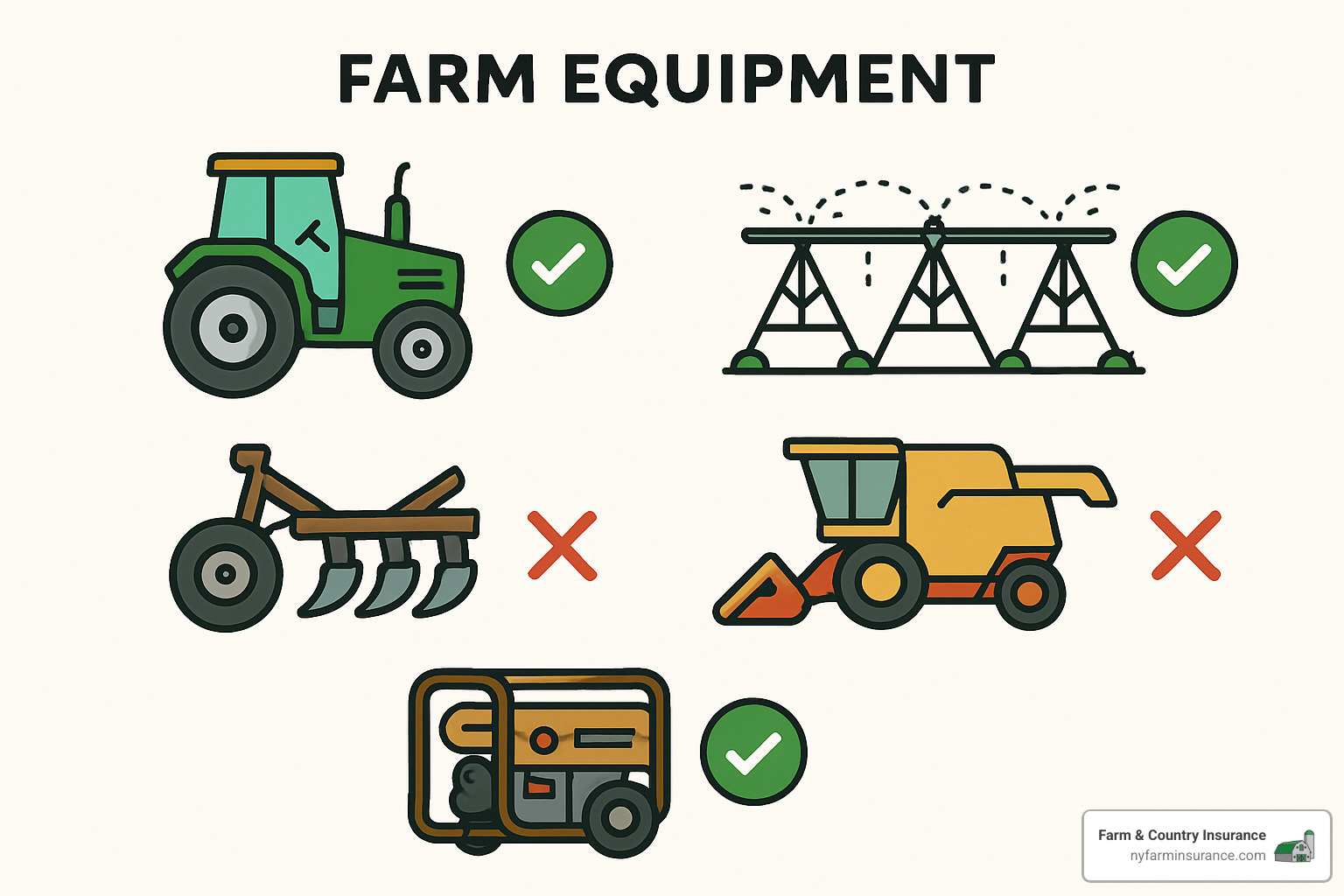
The good news is that breakdown coverage casts a pretty wide net over your essential farming equipment. Tractors and field equipment get protection, though there’s an important distinction we’ll cover shortly. Your irrigation systems – those expensive pivot motors, pumps, and control panels – are typically covered regardless of how old they are.
Processing equipment like grain dryers, elevators, conveyors, and feed mixers all qualify when they suffer sudden mechanical or electrical failures. The same goes for refrigeration and climate control systems – your milk cooling equipment, produce storage refrigeration, livestock ventilation fans, and environmental controls.
Don’t forget about your power generation equipment either. Backup generators, transformers, electrical distribution panels, and emergency power systems all fall under coverage. This protection becomes especially valuable during critical farming periods when power interruptions could spell disaster.
Modern farms increasingly rely on precision agriculture technology, and breakdown coverage keeps pace with these advances. GPS guidance systems, yield monitors, variable rate controllers, and other electronic farming aids receive protection under electronic circuitry provisions.
For dairy operations, milking machines, bulk tanks, compressors, and automated feeding systems all qualify for coverage. At Farm & Country Insurance, we’ve seen how quickly a compressor failure can disrupt an entire dairy operation – having breakdown coverage makes the difference between a manageable repair and a financial crisis.
Coverage limits vary by policy, but farm operations can typically secure protection up to $5 million. There are sublimits for specific exposures like spoilage (usually $25,000 standard, though dairy operations can often increase this to $100,000) and data restoration ($25,000).
Farm equipment breakdown coverage for stationary vs mobile gear
Here’s where things get interesting – and where many farmers find some surprising coverage gaps. The key distinction lies between stationary equipment and mobile implements, and understanding this difference can save you from unpleasant claim surprises.
Stationary equipment gets the full protection treatment. This includes anything permanently installed or designed to operate from a fixed location. Your irrigation pivot systems, grain bins with built-in dryers, milking parlor equipment, and shop tools like welders and compressors all qualify.
Semi-portable equipment often makes the cut too. Equipment that can be moved but operates from specific locations may qualify for coverage. Think portable generators, mobile grain dryers, and augers that connect to permanent systems.
Now here’s the curveball: mobile farm implements like plows, planters, cultivators, and harvesters are typically excluded from breakdown coverage. Before you panic, though, there’s an important exception that modern farmers need to know about.
While the implement itself might not be covered, the sophisticated electronic systems mounted on these implements often are. Your GPS systems, yield monitors, and precision planting controls may qualify for breakdown protection under electronic circuitry impairment coverage. It’s like having protection for the brain while the body remains uncovered.
Typical exclusions and limitations farmers should know
Nobody likes surprises when filing insurance claims, so let’s talk about what farm equipment breakdown coverage doesn’t include. Understanding these exclusions helps you manage expectations and identify where you might need additional protection.
Normal wear and tear tops the exclusion list, and for good reason. Gradual deterioration, rust, corrosion, and routine maintenance items like belts, tires, and filters aren’t covered. Insurance is designed to protect against sudden, unexpected events – not the predictable costs of keeping equipment running.
Intentional damage falls outside coverage boundaries too. This includes deliberate acts, vandalism by the insured, or damage caused by improper operation. If you run your equipment without oil or ignore warning lights, don’t expect the insurance company to pick up the repair tab.
Manufacturer defects require warranty coverage rather than breakdown insurance. Equipment recalls, design flaws, or manufacturing defects are the manufacturer’s responsibility, not your insurance company’s.
Age limitations can catch some farmers off guard. While many policies don’t have strict age caps, some insurers exclude equipment beyond a certain age. This varies significantly by insurer and equipment type, so it’s worth discussing with your agent.
Flood and environmental damage remain under property insurance rather than breakdown coverage. External water damage, earthquake, and similar perils are handled by your standard farm property policy.
Finally, consequential crop damage typically requires separate crop insurance. While spoilage of stored products may be covered under breakdown insurance, damage to growing crops in the field falls under different coverage types.
The key is working with an experienced farm insurance agent who understands these nuances. At Farm & Country Insurance, we help farmers steer these coverage distinctions to build comprehensive protection that actually works when you need it most.
How Coverage Works in Practice
When your equipment breaks down during a critical farming period, knowing how the claims process works can save you precious time and money. At Farm & Country Insurance, we’ve guided countless New York farmers through equipment breakdown claims, and I can tell you that understanding the process beforehand makes everything smoother when you’re dealing with the stress of failed machinery.
The moment something goes wrong, call your insurance carrier immediately. Most insurers offer 24/7 claim reporting, and they can often authorize emergency repairs to prevent further damage. Don’t wait until Monday morning if your irrigation pump fails on a weekend – that delay could cost you more than just the repair bill.
Once you’ve reported the claim, a qualified adjuster or equipment specialist will inspect your failed machinery. They’re looking to confirm that the breakdown falls within covered perils – sudden mechanical failure, electrical arcing, or electronic circuitry problems. The inspector will document exactly what went wrong and assess whether repair or replacement makes the most sense.
For covered claims, your insurer will typically authorize repairs by qualified technicians. They might require multiple estimates for major repairs or replacements, but remember – time is money during planting and harvest seasons. This is where expediting expense coverage becomes invaluable, helping speed up the entire process.
If the breakdown interrupts your farming operations, the business interruption calculation begins. Your insurer will look at your historical earnings and calculate lost income based on how long the equipment stays down. This coverage can be a financial lifesaver when a combine breaks during harvest or a planter fails during the narrow spring planting window.
The final settlement covers repair costs minus your deductible, plus any covered business interruption, spoilage, or extra expenses. The entire process typically takes days to weeks depending on parts availability and repair complexity – but critical timing during peak seasons often triggers that expediting coverage to speed things along.
Determining equipment value: ACV vs replacement cost
How your equipment gets valued makes a huge difference in what you’ll receive after a claim. Understanding the options helps you make smart coverage decisions that protect your operation’s financial health.
Actual Cash Value (ACV) pays your equipment’s depreciated value at the time of loss. While this coverage costs less in premiums, it can leave you significantly short when it’s time to replace that failed combine or irrigation system. A ten-year-old tractor might have lost half its value to depreciation, even though replacement costs have likely increased.
Replacement cost coverage pays the full amount to replace your damaged equipment with new, comparable machinery. Research shows this coverage typically applies to farm machinery up to eight years from the model year. It costs more upfront but provides much better protection when you actually need it.
For equipment valued over $5,000, professional appraisals every 3-5 years ensure your coverage limits keep pace with reality. The appraiser should consider both ownership costs – purchase price, interest, insurance – and operating costs like fuel, repairs, and labor to determine your true replacement needs.
Farm equipment typically has an economic life of 10-12 years for most machinery, extending to 15 years for tractors. However, well-maintained equipment often remains productive well beyond these timeframes, which is why proper valuation becomes so important.
More info about equipment valuation
Blanket vs scheduled coverage for farm machinery
Choosing between blanket and scheduled coverage affects both your premium costs and how easily you can manage your insurance as your operation grows and changes.
| Coverage Type | Blanket Coverage | Scheduled Coverage |
|---|---|---|
| Structure | Single limit covers all eligible equipment | Individual limits for specific items |
| Flexibility | Automatically covers new acquisitions | Requires reporting new equipment |
| Cost | Typically $4-$6 per $1,000 of coverage | May be lower for high-value items |
| Administration | Simpler to manage | Requires detailed inventory |
| Best For | Operations with many similar-value items | Farms with high-value specialized equipment |
Blanket coverage provides automatic protection for new equipment acquisitions and simplifies your insurance administration significantly. A single $1.5 million limit might cost approximately $4,600 annually, or about $3.06 per $1,000 of coverage. When you buy that new planter or upgrade your irrigation controls, you’re automatically covered without calling your agent first.
Scheduled coverage allows precise coverage amounts for specific pieces of equipment and can reduce costs by excluding lower-value items from your policy. High-value equipment like combines or specialized processing equipment often benefits from scheduled coverage because you can tailor the protection exactly to each machine’s value and importance.
Many successful farms use a combination approach – scheduled coverage for their most valuable equipment while maintaining blanket coverage for general farm tools and implements. This strategy provides both cost efficiency and comprehensive protection.
Farm equipment breakdown coverage endorsement workflow
Farm equipment breakdown coverage typically attaches to your existing farm policy as an endorsement rather than requiring a separate policy. This integration creates several advantages for managing your overall farm insurance program.
The breakdown endorsement integrates seamlessly with your farm property policy, sharing the same deductible structure with minimums of $500, or $1,000 for dairy and confinement operations. You won’t juggle multiple deductibles or deal with different insurance companies when filing a claim.
Your coverage limits follow your property policy structure, accommodating farm operations up to $5 million for comprehensive coverage. However, specific sublimits apply to certain exposures – spoilage coverage starts at $25,000 standard and increases to $100,000 for dairy operations, while data restoration coverage provides $25,000 for recovering lost electronic information.
Annual policy reviews become especially important with breakdown coverage because equipment values and farming operations change frequently. Major equipment purchases, new technology adoption, or operational expansions all affect your coverage needs. At Farm & Country Insurance, we recommend reviewing your equipment inventory and coverage limits every year to ensure your protection keeps pace with your investment.
The endorsement structure also means your farm equipment breakdown coverage renews automatically with your main policy, simplifying your insurance management while ensuring continuous protection for your critical farming equipment.
Choosing & Maintaining the Right Coverage Level
Getting your farm equipment breakdown coverage right starts with understanding what you actually need to protect. Think of it like buying a tractor – you wouldn’t purchase one without knowing your acreage, soil conditions, and what implements you’ll be pulling.
Start with a complete asset inventory of everything that could qualify for coverage. Walk through your operation and document all stationary equipment, semi-portable machinery, and those expensive electronic systems that make modern farming possible. Don’t forget about current values, ages, and what it would actually cost to replace each piece today – not what you paid for it five years ago.
Your risk assessment should consider the unique challenges your farm faces. Are you in an area where power outages are common? Do you deal with frequent storms that cause electrical surges? How reliable is your local power grid during peak summer months when everyone’s running air conditioning? These factors directly impact your breakdown risk.
Operational timing matters enormously in farming. A refrigeration breakdown during harvest season hits differently than the same failure in February. Dairy operations need continuous cooling, while grain farms face their highest exposure during planting and harvest windows. Consider when equipment failures would hurt most and plan accordingly.
Finally, take an honest look at your financial capacity. How much could you handle out-of-pocket for repairs and lost income without seriously damaging your operation? This helps determine appropriate deductible levels and coverage limits that make sense for your situation.
Optional add-ons & endorsements that boost protection
Standard farm equipment breakdown coverage provides solid protection, but several add-ons can significantly improve your coverage for specific situations.
Loss-of-use coverage becomes your best friend when major equipment needs extended repairs. For around $250 annually, this endorsement provides rental reimbursement so you can keep operating while your equipment sits in the shop. Try explaining to your crops why they need to wait an extra week for harvest because your combine is down.
Increased spoilage limits are essential for dairy and livestock operations. The standard $25,000 spoilage coverage might sound like a lot until your refrigeration system fails and you’re looking at a tank full of milk that can’t be sold. Dairy operations can increase this limit to $100,000 – money well spent for peace of mind.
Electronic data restoration covers the costs to recreate precision agriculture records, livestock databases, or financial information lost due to equipment failures. Modern farms generate enormous amounts of valuable data, and recreating years of yield maps or breeding records can be surprisingly expensive.
Expediting expense coverage pays those extra costs to get your operation back up quickly – overnight shipping for parts, overtime labor charges, or emergency equipment rental. When time is money, this coverage can be the difference between a minor setback and a major loss.
Service interruption protection helps when failures outside your control affect your operation. If the power company’s transformer blows and shuts down your dairy operation for two days, this coverage helps with the resulting losses.
Farm Equipment Insurance Coverage
Integrating new technology and electronic components
Today’s farms look more like technology centers than the operations our grandparents ran. All that sophisticated equipment creates new opportunities – and new breakdown exposures that need protection.
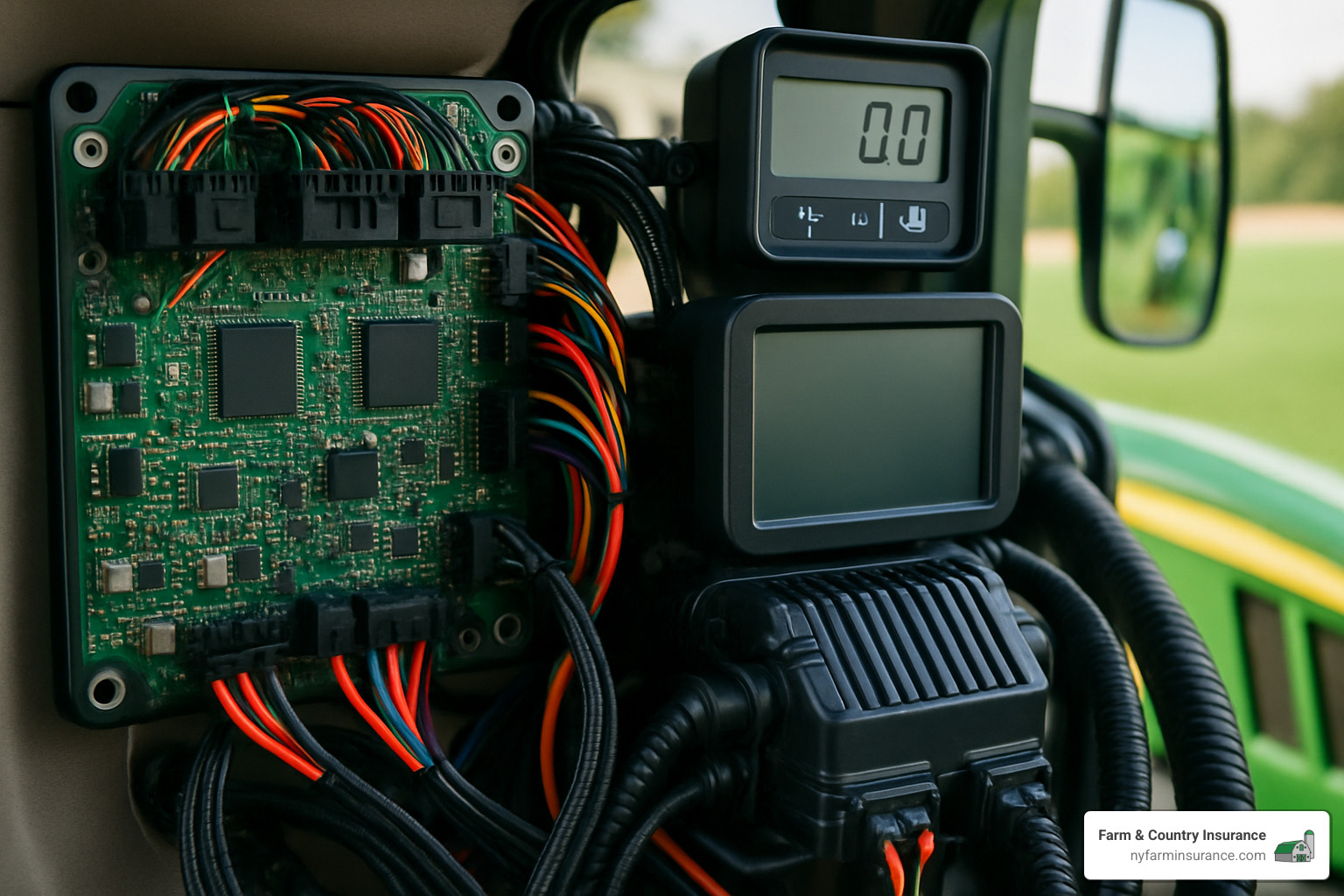
Precision agriculture systems represent some of the most valuable and vulnerable equipment on modern farms. GPS guidance systems, variable rate controllers, yield mapping equipment, and automated steering can cost tens of thousands of dollars. When they fail, you’re not just facing repair costs – you’re potentially losing the precision that makes your operation profitable.
Sensor networks throughout your operation provide incredible data but create multiple potential failure points. Soil moisture sensors, weather stations, and livestock monitoring systems all depend on electronic components that can fail suddenly from power surges or environmental damage.
Telematics and connectivity systems let you monitor equipment remotely and catch problems early. But these cellular communication modules and monitoring systems add complexity and potential breakdown exposures that older equipment never faced.
The challenge with firmware and software is that while breakdown coverage typically protects the physical computer hardware, software corruption or cyber attacks usually require separate coverage. Understanding this distinction helps avoid unpleasant surprises during claims.
Micro-electronics vulnerability has become a major concern as electronic circuitry gets more sophisticated and more integral to equipment operation. The good news is that farm equipment breakdown coverage specifically addresses failures in these microelectronics and computer controls that have become essential to modern farming.
Preventive steps to cut breakdown risk and premiums
The best breakdown coverage is the claim you never have to file. Smart maintenance and risk management practices can reduce both your breakdown frequency and insurance premiums – a win-win situation that every farmer appreciates.
Scheduled maintenance remains the foundation of equipment reliability. Follow manufacturer maintenance schedules religiously and document everything with receipts and service records. Some insurers, including Farm & Country Insurance, offer premium discounts for farms with documented preventive maintenance programs. It’s like getting paid to take good care of your equipment.
Operator training prevents many avoidable breakdowns. Make sure everyone who touches your equipment understands proper procedures, warning signals, and operating limits. Operator error contributes significantly to equipment failures, but it’s one of the most preventable causes.
Environmental protection for sensitive equipment pays dividends. Store machinery in climate-controlled buildings when possible, use moisture control systems, and maintain clean environments for electronics. Dust and moisture are electronic equipment’s worst enemies.
Parts inventory for critical components minimizes downtime when failures occur. Stock essential spare parts for your most important equipment. Quick repairs reduce business interruption and keep operations running smoothly.
Security measures like equipment tracking systems improve recovery rates and can reduce theft-related premiums. With 650,000 machines registered under security schemes, these systems have proven their worth for equipment protection.
Condition monitoring using predictive maintenance tools can identify potential failures before they become expensive problems. Vibration analysis, oil sampling, and thermal imaging help prevent catastrophic breakdowns that would otherwise trigger major insurance claims.
Frequently Asked Questions about Farm Equipment Breakdown Coverage
Does the coverage extend to leased or rented machinery?
This question comes up a lot during busy seasons when farmers rent additional equipment to get the job done. The good news is that farm equipment breakdown coverage typically extends to leased or rented machinery, though the specifics depend on your policy terms.
Most policies automatically include borrowed, rented, or leased equipment up to certain limits – usually a percentage of your total coverage. This means if you rent a combine during harvest or lease a new planter for spring work, you’re likely covered if something goes wrong mechanically.
Here’s the catch though – you need to verify this coverage before you actually need it. Don’t wait until you’re standing next to a broken rented tractor to find out whether you’re covered. A quick call to Farm & Country Insurance can confirm your policy details and prevent unpleasant surprises.
This coverage proves especially valuable for custom operators and farms that regularly rent equipment during peak seasons. Even though you don’t own the machinery, you could still face repair bills and lost productivity if it breaks down while in your care.
How much does farm equipment breakdown insurance cost and what affects the premium?
Farm equipment breakdown coverage typically costs between $4 to $6 per $1,000 of equipment value. To put this in perspective, if you have $1.5 million worth of equipment, you might pay around $4,600 annually for blanket coverage – that works out to about $3.06 per $1,000 of coverage.
Several factors influence what you’ll actually pay. Equipment age and condition matter significantly – newer, well-maintained machinery typically costs less to insure than older equipment that’s more prone to failures. Your geographic location also plays a role, as areas with frequent power outages or severe weather face higher breakdown risks.
Your farming operation type affects pricing too. Dairy operations usually pay higher rates because refrigeration failures can cause expensive spoilage losses. Meanwhile, grain operations might pay less since their equipment downtime doesn’t immediately threaten perishable products.
Maintenance practices can impact your premium as well. Farms with documented preventive maintenance programs sometimes qualify for discounts. Your claims history naturally influences rates – a track record of well-maintained equipment and few claims can work in your favor.
Optional add-ons like loss-of-use protection add roughly $250 annually to your base coverage. While this might seem like an extra expense, it can save thousands when you need rental equipment during a breakdown.
How often should I review and update my policy?
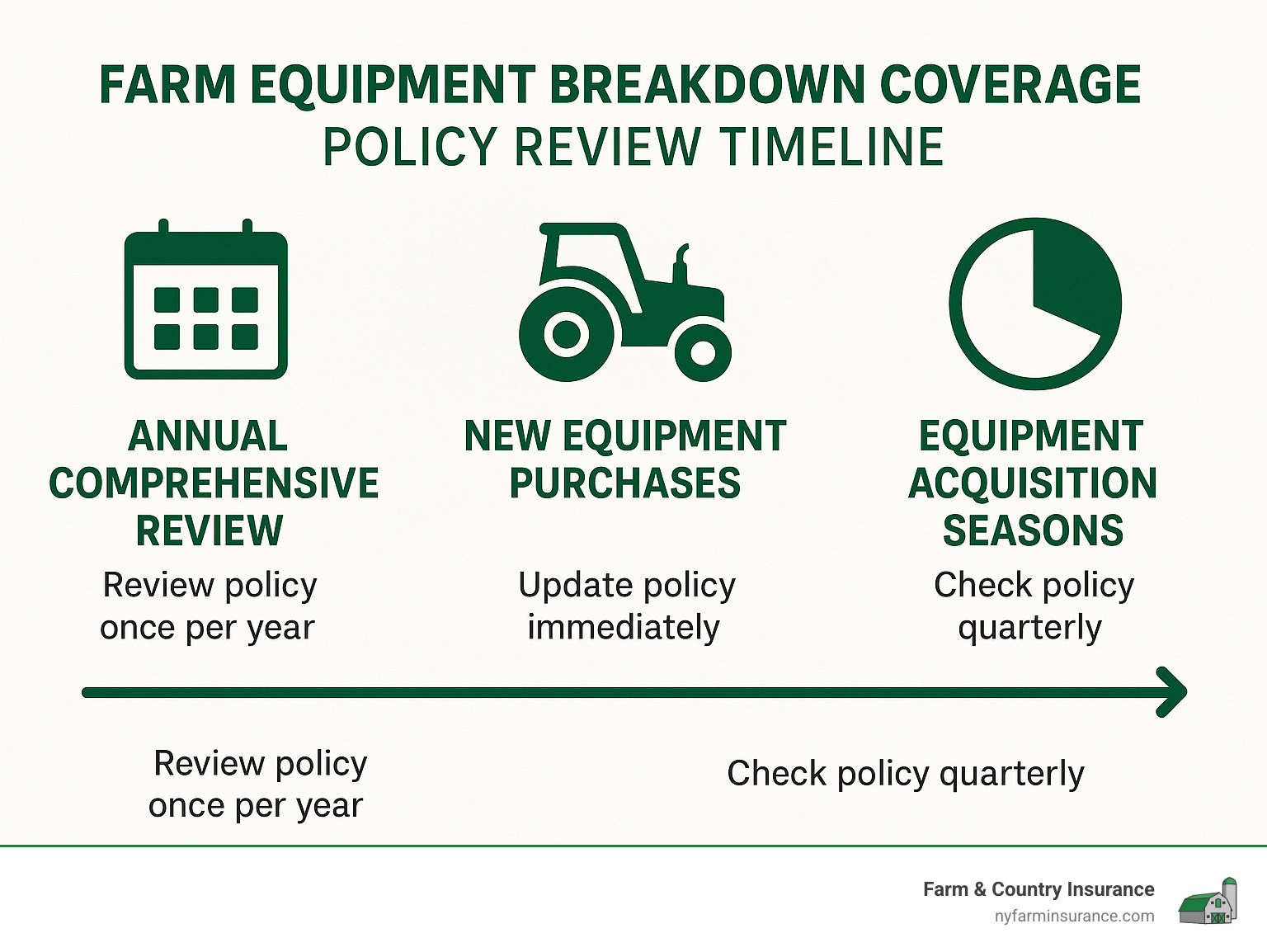
At Farm & Country Insurance, we recommend an annual review of your farm equipment breakdown coverage – ideally during your policy renewal period when everything’s fresh in your mind. But honestly, equipment purchases don’t follow insurance calendars, so updates should happen whenever your situation changes.
Immediate updates are essential when you purchase new equipment, retire old machinery, or sell existing items. Equipment values can swing dramatically due to market conditions and technological advances. That combine you bought three years ago might be worth significantly more or less today than when you first insured it.
Seasonal considerations matter too. Many farmers acquire or upgrade equipment during winter months when they have time to shop and dealers offer incentives. If you’re planning major equipment purchases, give us a heads up so we can ensure seamless coverage transitions.
Operation changes also trigger review needs. Switching from grain to dairy farming, adding livestock operations, or installing new irrigation systems all create different breakdown exposures that require coverage adjustments.
The reality is that most farmers think about insurance when they’re required to – like at loan closing or policy renewal. But a quick quarterly check during equipment acquisition seasons can prevent coverage gaps that could cost thousands if something goes wrong.
Conclusion
When your tractor breaks down in the middle of harvest season, farm equipment breakdown coverage can mean the difference between a minor inconvenience and a financial catastrophe. As we’ve explored throughout this guide, modern farming operations face unprecedented equipment complexity and exposure that standard property insurance simply can’t address.
The numbers tell a sobering story. Equipment theft alone costs agriculture about $1 million every week, while repair factors can reach up to 8.8% of a machine’s original cost annually. When you’re dealing with a $500,000 combine that fails during harvest, or a dairy refrigeration system that goes down on a hot summer day, the financial impact extends far beyond just repair costs.
At Farm & Country Insurance, we’ve been protecting New York farmers since 1984, and we’ve seen how farm equipment breakdown coverage transforms potential disasters into manageable challenges. Whether it’s a GPS system short-circuiting during planting season or a dairy compressor failing during peak production, the right coverage keeps your operation running when equipment decides to take an unscheduled break.
Your farming operation – whether you’re milking cows in Cayuga County, growing grain across our service territories, or managing fruit and vegetable operations – depends on sophisticated equipment that works harder than a farmer during harvest season. From precision agriculture systems that cost tens of thousands of dollars to basic irrigation pumps that keep crops alive, every piece of equipment represents both an investment and a potential point of failure.
The harsh reality of farming is that equipment operates in conditions that would make most machinery manufacturers cringe. Heat, moisture, dust, and constant use create the perfect storm for mechanical and electrical failures. Add in the complexity of modern farm technology – from GPS guidance systems to automated feeding equipment – and you have exposure that traditional property insurance was never designed to handle.
Farm & Country Insurance understands the unique challenges facing New York agriculture. Our comprehensive farm equipment breakdown coverage solutions protect not just your equipment, but your peace of mind. We know that when your equipment fails, it’s never at a convenient time, and we’re here to help you get back to what you do best – feeding the world.
Don’t wait until your equipment decides to go on strike during your busiest season. The cost of coverage is minimal compared to the potential losses from even a single major breakdown. Contact Farm & Country Insurance today to discuss how farm equipment breakdown coverage can protect your operation’s profitability and keep you farming through whatever challenges come your way.