
Protecting Your Farm’s Most Valuable Assets
When that $500,000 combine harvester catches fire during the busiest week of harvest, or your tractor overturns on a hillside, the impact hits more than just your equipment. Without proper coverage, you’re facing not only replacement costs but also lost productivity, missed planting windows, and the kind of financial setback that can affect your operation for years.
Farm equipment insurance carriers provide specialized coverage designed specifically for agricultural machinery and equipment against a wide range of risks. These carriers understand the unique challenges farmers face and offer policies custom to your operation’s specific needs.
I’m Casey Love, owner of Farm & Country Insurance, and after 15 years of helping New York farmers protect their operations, I’ve seen how the right insurance partnership can make all the difference when disaster strikes. As an independent agency, we work with multiple farm equipment insurance carriers to find the perfect fit for your farm’s unique equipment profile and risk exposure.
The insurance landscape for farm equipment includes several standout carriers, each with their own strengths. America’s leading farm insurers process thousands of claims annually, protecting equipment worth billions of dollars. Regional insurance providers dominate in their territories, offering specialized knowledge of local farming conditions and equipment needs.
For farms seeking specialized coverage options, some carriers offer improved endorsements to address unique agricultural needs. Others provide flexibility with distinct coverage tiers for farm equipment, allowing you to select the level of protection that makes sense for your operation. Equipment-specific insurance options offer manufacturer-endorsed coverage with lower deductibles than many standard policies.
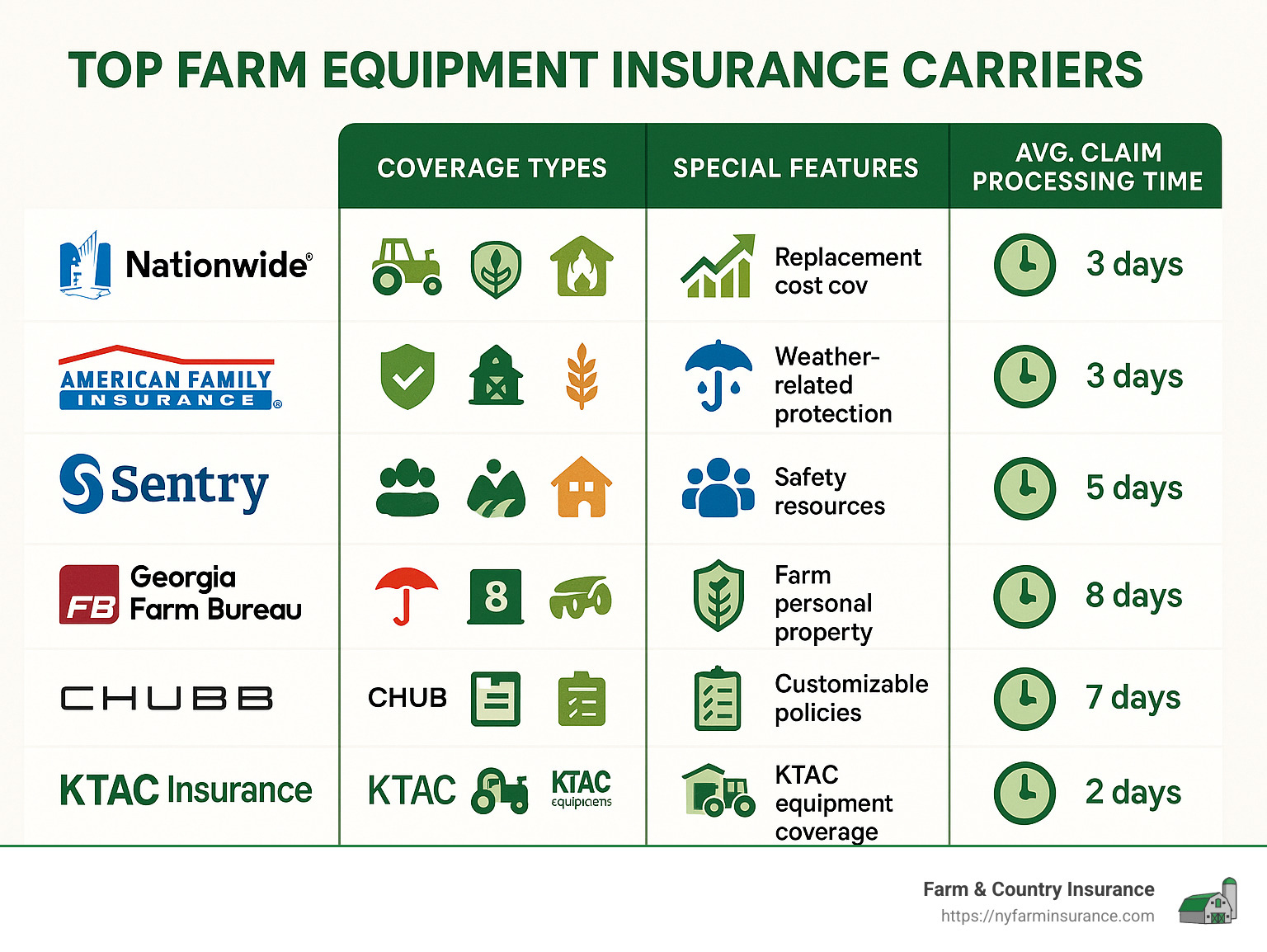
At Farm & Country Insurance, we don’t just sell policies – we build protection plans. We understand that your tractors, combines, and specialized equipment represent not just significant financial investments, but the very tools that make your livelihood possible. That’s why we take the time to understand your operation’s unique equipment profile before recommending specific farm equipment insurance carriers that align with your needs and budget.
The best carrier for your neighbor’s dairy operation might not be the ideal fit for your orchard or crop farm. We’ll help you steer the options to find coverage that truly protects what matters most to your specific agricultural enterprise.

1. What Is Farm Equipment Insurance and Why It Matters
Ever wonder what would happen if your $500,000 combine caught fire mid-harvest? Or if that new tractor you invested in tipped over on a hillside? These aren’t just hypothetical scenarios – they’re real situations our clients have faced.
Farm equipment insurance is specialized protection designed specifically for the machinery that keeps your farm running. Unlike standard property policies, this coverage understands the unique ways you use your equipment and the specific risks you face in agricultural operations.
“Farm equipment is one of a farmer’s biggest investments. Sometimes the biggest.” This statement rings especially true when you consider today’s equipment prices. A new combine harvester easily costs upwards of $500,000, while high-horsepower tractors can run $300,000 or more. These aren’t just tools – they’re the beating heart of your operation.
Asset Protection
Modern farm equipment represents a massive financial investment. When a fire destroys your combine or a windstorm damages your irrigation system, few operations can absorb that loss without insurance. Having the right coverage means you won’t have to liquidate other assets or take on debt to replace essential machinery.
I remember a client in Seneca County who lost his main tractor to an electrical fire. Without proper coverage, he would have faced a $275,000 replacement cost that might have ended his family’s farming legacy.
Business Continuity
Timing is everything in farming. When equipment breaks down during planting or harvest, every day of downtime translates to potential crop loss. Good insurance doesn’t just cover the equipment – it helps keep your operation moving with rental coverage or expedited repairs.
Farm Profits
Let’s be honest – agricultural margins aren’t what they used to be. Equipment insurance helps preserve your bottom line when the unexpected happens. The difference between a profitable year and a loss can sometimes come down to whether your insurance covered that mid-season equipment failure.
Generational Security
For family farms planning to pass assets to the next generation, protecting equipment value ensures the operation remains viable for future farmers. At Farm & Country Insurance, we’ve helped multiple generations of New York farmers keep their operations secure through smart risk management.
One of our clients in Aurelius NY faced potential disaster when lightning struck their irrigation system during a critical dry period. Their comprehensive coverage enabled them to replace it within days, saving their vegetable crop and preserving their family’s income for the year.
The right farm equipment insurance doesn’t just protect machines – it protects your livelihood, legacy, and peace of mind. And in today’s high-tech, high-cost agricultural environment, that protection has never been more important.
2. Machines That Need Protecting
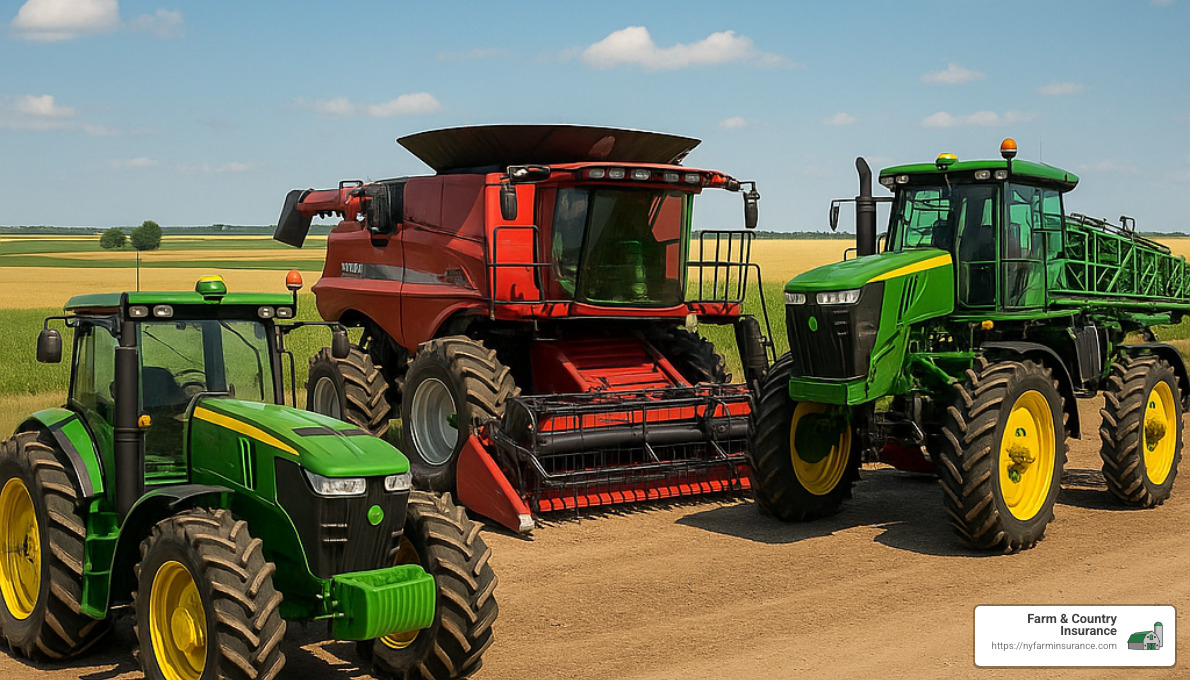
When I walk a farm with clients, I often ask them to imagine their operation without each piece of equipment we pass. That question usually brings a quick realization: modern farming simply isn’t possible without these mechanical workhorses. Let’s explore what needs protection in your equipment fleet.
Primary Equipment
Your farm’s heavy hitters deserve serious protection. Those tractors – from the utility models that handle daily chores to the massive articulated beasts pulling wide implements – represent huge investments. And what about that combine harvester that only runs a few weeks each year but determines whether your crop makes it to market? One breakdown during harvest can spell disaster.
Sprayers have evolved from simple implements to sophisticated machines with computer-controlled systems and expensive booms. Planters and seeders now feature precision technology that places each seed with GPS-guided accuracy. And don’t forget your tillage equipment – those plows, discs and cultivators that prepare your seedbed are built tougher than ever, but they’re not indestructible.
Support and Specialty Equipment
The backbone of many operations lies in their support equipment. Irrigation systems like center pivots represent substantial investments that can suffer storm damage or mechanical failure. Those GPS units and precision ag technology might be small, but replacing damaged guidance systems or yield monitors can cost thousands.
Grain carts and wagons face constant wear and tear during harvest. Your hay equipment – from balers to rakes – works under dusty, challenging conditions. And those versatile skid steers and loaders handling materials around the farmstead deserve protection too.
Often-Overlooked Items
In my years at Farm & Country Insurance, I’ve noticed farmers frequently underestimate how many assets they actually own. Portable fences and structures used for temporary livestock containment can be damaged in storms. Tools and shop equipment represent significant investments when tallied together. Various attachments for your equipment, from front-end loader buckets to PTO-driven implements, add substantial value to your fleet.
Grain handling equipment like augers and conveyors face unique risks, especially during busy seasons. Even ATVs and UTVs used primarily for farm operations need proper coverage – they’re workhorses that deserve protection just like your larger equipment.
Last summer, I helped a corn and soybean farmer near Auburn who thought his equipment fleet was worth about $800,000. After we walked his operation together and cataloged everything from his main machines down to attachments and precision ag components, we finded his actual equipment value exceeded $1.3 million. That’s a $500,000 gap that could have left him seriously underinsured!
The farms we serve across Cayuga County – from dairy operations in Fleming to crop producers in Scipio – often find they’ve underestimated their equipment values by 30% or more. When you consider everything from your main tractors down to the smallest implements, the numbers add up quickly.
More info about Farm Equipment Insurance
3. Perils and Risks Your Policy Should Tackle
When you’ve invested hundreds of thousands of dollars in farm equipment, understanding what can go wrong is just as important as knowing what your machines can do right. At Farm & Country Insurance, we’ve seen how the right coverage has saved farms from financial disaster when the unexpected strikes.
Natural Disasters and Weather Events
Mother Nature doesn’t care about your planting schedule or harvest deadlines. Your equipment insurance needs to stand up to her worst moods.
Fire can transform a $500,000 combine into a charred frame in minutes. Whether it starts from an electrical short while harvesting dry corn or spreads from a barn blaze, fire remains one of the most devastating perils to farm equipment.
Windstorm and hail damage is increasingly common across New York. Just last year, we helped a client in Scipio whose tractor cab was severely dented and windshield shattered during a sudden hailstorm that swept through the county.
Flood protection becomes crucial in low-lying areas like parts of Montezuma and Conquest. When water rises, it doesn’t just damage engines and electronics—it can carry equipment away entirely.
Lightning strikes can fry the sophisticated electronics in modern equipment instantly. One Aurelius dairy farmer finded this when lightning hit near their robotic milking system, causing $30,000 in damage to control panels.
Operational Risks
The everyday work of farming brings its own set of risks that your policy should address.
Collision and overturn incidents happen even to the most careful operators. That steep hillside that’s never been a problem before can suddenly become treacherous after heavy rain.
Glass breakage coverage (often with no deductible from quality farm equipment insurance carriers) saves you from paying out-of-pocket for that cracked cab windshield or door window.
Foreign object damage occurs when rocks, metal, or other debris enter combines, balers, or other machinery with moving parts. The resulting damage can range from bent pickup teeth to catastrophic internal failures.
Mechanical and electrical breakdowns might require additional endorsements, but this coverage can be invaluable when a computer system fails during critical fieldwork.
Human Factors
Sometimes the risk comes from people rather than nature or machinery itself.
Theft has evolved beyond stealing entire machines. Today’s thieves often target high-value components like GPS receivers and displays that can be quickly removed and resold. One grain farmer in Cato finded this after finding his tractor’s $15,000 guidance system missing one morning.
Vandalism to equipment can occur even in rural areas. From slashed tires to sugar in fuel tanks, intentional damage can sideline critical machinery during busy seasons.
Operator error coverage varies significantly between farm equipment insurance carriers. Some policies exclude damage caused by mistakes, while others recognize that even experienced operators can have momentary lapses.
Special Considerations
Borrowed or rented equipment needs protection too. When you lease that specialized harvester for a month or borrow a neighbor’s tiller, your policy should extend coverage appropriately.
Transportation damage can occur while moving machinery between fields. That low bridge or narrow farm lane can become an expensive lesson without proper coverage.
Equipment under repair at dealerships should remain protected by your policy, not left to the repair shop’s insurance, which may have limited coverage.
According to climate research, extreme precipitation events in Central New York have increased by approximately 74% since 1958, making comprehensive coverage increasingly important for operations throughout our service area.
Scientific research on flood frequency
Claims Process Snapshot
When disaster strikes, knowing what happens next can make all the difference:
Reporting Window: Don’t wait—most policies require notification within 24-72 hours. Take photos immediately, before cleanup begins.
Adjuster Visit: A specialist will inspect the damage, typically arriving within 1-5 business days depending on severity and your location.
Repair/Replacement Estimate: The adjuster will determine whether repair or replacement makes more sense and provide appropriate estimates.
Proof-of-Ownership Tips: Maintain detailed records including serial numbers, purchase dates, and values. Annual equipment inventories with photos are worth their weight in gold during claims.
Claim Resolution: Once approved, repairs begin or replacement funds are issued. Timeline varies based on equipment availability and damage complexity.
At Farm & Country Insurance, we don’t just sell policies—we stand beside you during claims. When a Fleming dairy farmer’s skid steer was damaged by a falling barn beam, we worked directly with the adjuster to ensure the hidden frame damage was properly assessed, not just the visible dents.
The right coverage from reputable farm equipment insurance carriers isn’t just about protecting machines—it’s about protecting your livelihood and the future of your farm operation.
4. Scheduled vs. Blanket Coverage—Which Fits Your Fleet?
When it comes to protecting your farm equipment, you’ll face an important choice: scheduled coverage or blanket coverage. Think of it like choosing between a detailed inventory list versus a single storage bin for all your valuables. Let’s explore which approach might work best for your operation.
Scheduled Coverage (Itemized)
Scheduled coverage is like creating a detailed catalog of your equipment collection. Each tractor, combine, and implement gets its own line item with a specific dollar amount attached to it.
This approach shines for several reasons. First, you get valuation accuracy since each machine is insured for its exact worth. You also benefit from customized protection where you can apply different deductibles to different pieces—perhaps a lower deductible on that essential tractor you can’t farm without. The clear documentation not only helps during claims but becomes a valuable farm management tool. And with targeted premium calculations, you’re only paying to insure what you actually own.
“We find scheduled coverage works particularly well for farms with a handful of high-value machines,” explains Casey Love of Farm & Country Insurance. “One of our clients in Auburn saved nearly $3,000 after a claim because they had accurately scheduled their specialized vegetable harvester at its true replacement value.”
The main drawback? You’ll need to update your policy whenever equipment changes, which means a bit more paperwork throughout the year.
Blanket Coverage
Blanket coverage takes a simpler approach—one aggregate limit covers all your equipment without listing each piece individually. It’s like having one big insurance umbrella over your entire fleet.
The beauty of blanket coverage lies in its administrative ease. There’s no need to call your agent every time you trade equipment or buy something new. You’ll appreciate the flexibility as coverage automatically extends to newly acquired equipment (typically for 30-90 days). Simplified renewal means less paperwork, and many farmers find potential cost savings, especially those with numerous smaller items.
I recently worked with a grain farmer in Scipio who switched to blanket coverage and immediately felt relief. “I was spending hours updating my policy every time I changed equipment,” he told me. “Now I can focus on farming instead of paperwork.”
The main caution with blanket coverage is ensuring you maintain adequate total limits. If you’re underinsured, coinsurance provisions might reduce your claim payment.
Comparison Table: Scheduled vs. Blanket Coverage
| Feature | Scheduled Coverage | Blanket Coverage |
|---|---|---|
| Documentation Required | Detailed list of each piece | Total value of all equipment |
| Premium Basis | Value of listed equipment | Total equipment value |
| New Equipment | Must be added to policy | Usually automatic coverage for 30-90 days |
| Claim Clarity | Clear values established | May require proving value after loss |
| Best For | High-value equipment, smaller fleets | Larger fleets with frequent changes |
| Deductible Application | Can vary by equipment type | Usually one deductible applies to all |
| Underinsurance Risk | Lower if values are accurate | Higher if total value is underestimated |
At Farm & Country Insurance, we often recommend a hybrid approach that gives you the best of both worlds. For example, a dairy operation client in Brutus NY schedules their high-value equipment (tractors, harvesters) while maintaining blanket coverage for implements and smaller items. This provides precision where it matters most and simplicity everywhere else.
One of our clients in Cato NY saved nearly $1,200 annually by moving from a fully scheduled policy to this hybrid approach—all while improving their overall protection. That’s the kind of practical solution that comes from working with an agency that truly understands farm operations.
More info about Farm Equipment Insurance Coverage
5. Farm Equipment Insurance Carriers: How to Compare Like a Pro
When it’s time to choose a farm equipment insurance carrier, looking only at the price tag is like buying a tractor based solely on its color. There’s so much more that matters! Let me walk you through how to evaluate carriers the way professional risk managers do.
Think of insurance carrier selection as similar to choosing a long-term business partner. You need someone financially sound, responsive, and who truly understands the unique rhythms and challenges of farm life.
Key Evaluation Factors
Start by examining the carrier’s financial strength through independent rating agencies like A.M. Best or Standard & Poor’s. These ratings tell you whether the company has the financial muscle to pay claims even after a widespread disaster affects multiple farms.
Claims reputation might be the most important factor of all. Talk to other farmers in your area about their experiences. Did their carrier process claims quickly during planting or harvest when time was absolutely critical? Or did they face delays that cost them productivity?
Policy flexibility matters tremendously in agriculture where no two operations are identical. The best farm equipment insurance carriers offer customizable coverage that can be custom to your specific equipment and farming practices.
Some carriers go beyond just insurance by offering valuable risk management services. These might include equipment maintenance programs, safety training, or weather alert systems that can help prevent losses before they happen.
Farm expertise is non-negotiable. I’ve seen too many farmers struggle with adjusters who don’t understand the difference between a combine and a corn head. Carriers with agricultural specialization handle everything more effectively.
Finally, don’t underestimate the importance of your local agent’s knowledge. A great agent who understands both farming and insurance becomes your advocate and translator between these two complex worlds.
National Farm Equipment Insurance Carriers
National carriers bring substantial resources and broad coverage options to the table. The leading national farm insurers offer policies with both scheduled and blanket options, and their agents typically receive specialized agricultural training that shows in their service quality.
Many established insurance providers bring decades of experience and serve millions of customers nationwide. Their farm equipment coverage can be customized for everything from your highest-value machinery down to smaller implements.
Some carriers have developed specialized endorsements that provide improved protection for things many others overlook—like higher limits for hay, electronic data protection, and accounts receivable coverage.
Others take a tiered approach with different coverage levels. This allows you to match protection to your specific operation’s needs. The best providers offer 24-hour escalated claims service that can be a lifesaver when equipment breaks down during critical periods.
Specialty Farm Equipment Insurance Carriers
Specialty carriers focus exclusively on agricultural equipment and often provide unique features you won’t find elsewhere. The best agricultural specialists process thousands of farm equipment claims annually and protect hundreds of thousands of pieces of equipment. Their specialized programs include features like single deductibles when multiple pieces are damaged in the same event—saving you thousands in a serious situation.
Some carriers have earned manufacturer endorsements by developing specialized coverage specifically for certain equipment brands. They offer lower deductibles and expedited claims processing, with protection that follows your equipment both on and off your property, including during transportation.
Other specialized providers offer interesting options like locking in insurance quotes for up to five years, providing budget stability that many farmers appreciate. They also provide options for higher liability limits on equipment coverage for those with valuable fleets.
At Farm & Country Insurance, we maintain relationships with multiple farm equipment insurance carriers so we can match each farm with its ideal coverage partner. I remember helping a grain operation in Venice NY find specialized coverage for their GPS-guided equipment that included both physical damage and data recovery protection—something their previous carrier didn’t even offer as an option.
Another success story came when we helped a fruit farm in Springport NY connect with a carrier that provided replacement cost coverage for irrigation equipment regardless of age. This proved invaluable when they faced replacing a 15-year-old system after storm damage, saving them tens of thousands of dollars.
Scientific research on equipment financing
6. Optional Add-Ons and Emerging Trends
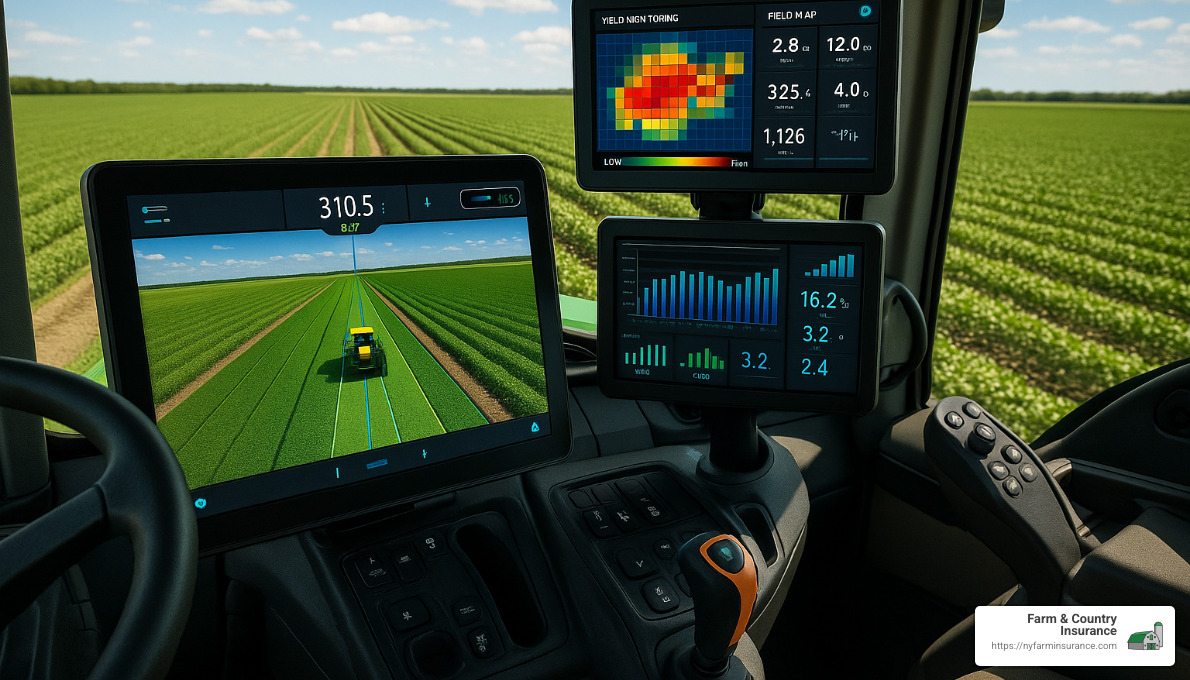
Farming has come a long way from the days of horse-drawn plows, and so has farm equipment insurance. Today’s coverage options are evolving rapidly to keep pace with technological advances and changing farm operations. Let me walk you through some valuable add-ons and emerging trends that could make a significant difference to your operation’s protection.
Improved Coverage Options
When that 5-year-old tractor gets damaged, the last thing you want to hear is that you’ll only receive its depreciated value. That’s why replacement cost coverage has become such a game-changer for many of our clients. Rather than receiving a check for what your equipment was worth (minus depreciation), this option pays to replace it with a new model of similar kind and quality. Most farm equipment insurance carriers now offer this for machinery up to 8 years old, and trust me—it’s worth every penny of the additional premium.
Equipment breakdown coverage is another essential add-on in today’s high-tech farming world. I recently helped a dairy farmer near Auburn who finded the hard way that standard policies typically exclude internal failures. When his milk cooling system suffered an electrical failure during a hot summer week, his equipment breakdown coverage saved him from losing an entire milk tank—and about $15,000 in revenue.
When planting season hits and your equipment is in the shop after a covered loss, rental reimbursement coverage becomes your best friend. This option covers rental costs while your equipment is being repaired—absolutely critical during those narrow seasonal windows when every day counts.
Don’t overlook debris removal coverage either. After a fire destroyed a client’s combine last harvest, the cleanup costs alone were nearly $5,000—an expense many farmers don’t anticipate when thinking about equipment losses.
For operations where timing is everything, loss of income/extra expense coverage provides a financial safety net when equipment damage disrupts your normal operations. This can be particularly valuable for vegetable farms with tight harvest windows or dairy operations that can’t afford downtime.
Technology and Precision Agriculture Coverage
Modern farming increasingly relies on technology that traditional insurance wasn’t designed to protect. Those expensive GPS units on your tractor roof? They’re prime targets for theft, and specialized coverage is now available to protect them specifically. One grain farmer I work with in Scipio had two GPS receivers stolen in a single night—a $15,000 loss that would have been devastating without proper coverage.
The precision ag sensors and controls that drive today’s modern operations represent significant investments that deserve protection. From yield monitors to variable rate controllers, these technologies require specialized coverage beyond standard equipment policies.
When your farm management software crashes or your yield data gets corrupted, data recovery coverage helps pay for reconstructing that valuable electronic information. This might seem minor until you’ve lost years of field-specific yield data that guides your decision-making.
As farm equipment becomes increasingly connected to the internet, cyber protection has emerged as an important consideration. Modern tractors and combines can be vulnerable to hacking, and some farm equipment insurance carriers now offer coverage specifically for digital threats to farm technology.
Emerging Insurance Trends
Insurance companies love data almost as much as farmers do these days. Many farm equipment insurance carriers now offer telematics discounts for equipment with monitoring systems that track usage patterns and maintenance. These systems can not only save you money on premiums but also help identify potential problems before they lead to costly breakdowns.
Usage-based insurance is gaining traction too, with policies that adjust premiums based on actual equipment utilization rather than charging flat annual rates. For seasonal equipment that might sit idle for months, this approach can significantly reduce insurance costs.
Some innovative farm equipment insurance carriers have begun offering parametric insurance products that automatically pay predetermined amounts when specific weather events occur, without requiring a traditional claims process. This can be particularly valuable for getting quick cash flow after weather events that might damage equipment.
Many equipment manufacturers have partnered with insurers to create manufacturer-endorsed programs that include original parts guarantees or extended warranties. These specialized policies often provide seamless integration between warranty coverage and insurance protection.
At Farm & Country Insurance, we’ve helped countless New York farmers improve their equipment protection with these specialized coverages. A dairy farm in Throop recently added equipment breakdown coverage that saved them thousands when their milking system’s control panel failed due to an electrical surge—preventing both repair costs and production losses.
For crop farmers in areas like Summerhill and Sempronius, we’ve implemented precision agriculture coverage packages that protect not just the physical components but also the software and data that drive modern farming operations. These farmers sleep better knowing their entire operation—both hardware and digital assets—is properly covered.
More info about Insurance for Farm Vehicles
Frequently Asked Questions about Farm Equipment Insurance Carriers
How are premiums calculated?
When farmers ask me about insurance costs, I always explain that several factors go into the equation. Think of your premium calculation as a recipe with multiple ingredients.
The main ingredient is your equipment value – the total worth of all those tractors, combines, and implements you’ve invested in over the years. Naturally, a $500,000 equipment fleet will cost more to insure than a $100,000 one.
Your equipment type and age also significantly impact your rates. That brand-new precision planter with all the bells and whistles will typically cost more to insure than an older model. This makes sense when you consider replacement costs.
The coverage options you select act like seasoning in our premium recipe. Adding replacement cost coverage or equipment breakdown protection will increase your premium, but also provides much better protection. Similarly, your deductible levels work inversely with your premium – higher deductibles mean lower premiums, but more out-of-pocket expense when something goes wrong.
Your claims history matters too. Just like your driving record affects your auto insurance, your equipment claims history influences your farm rates. Farmers with fewer claims typically enjoy better rates.
Where and how you store your equipment matters as well. Storage and security measures like locked machine sheds or security systems can often earn you discounts. And your geographic location plays a role too – farms in areas with higher theft rates or extreme weather patterns might see higher premiums.
Most farm equipment insurance carriers offer various discounts when you bundle multiple policies together. At Farm & Country Insurance, we’ve helped many Cayuga County farmers save 15-20% by packaging their equipment coverage with farm liability and structures coverage.
What exclusions should I watch for?
Insurance policies are as much about what they don’t cover as what they do. Understanding exclusions helps prevent unpleasant surprises when filing a claim.
Wear and tear is perhaps the most common exclusion. Just as your homeowner’s policy won’t replace an old roof that’s simply reached the end of its lifespan, your equipment policy won’t cover parts that have simply worn out from normal use.
Mechanical breakdown – those frustrating internal failures that seem to happen at the worst possible times – are typically excluded unless you specifically add equipment breakdown coverage. This is an add-on I strongly recommend for modern, technology-dependent equipment.
Damage from insects, vermin, and rodents is almost universally excluded. Those mice that chewed through your wiring? Standard policies won’t cover that damage.
Other standard exclusions include governmental action (like equipment seizure), nuclear hazards and war (standard in virtually all insurance), and intentional damage caused deliberately.
Some policies also exclude equipment used for custom work on other farms, leased equipment, or machinery used in certain high-risk activities. These exclusions can be particularly problematic if you occasionally help neighbors with harvesting or other seasonal tasks.
At Farm & Country Insurance, we take time to review these exclusions with our clients. I remember helping a vegetable farmer in Locke NY who occasionally did custom tillage work. His standard policy excluded this activity, but we were able to add an endorsement that protected his equipment during these operations – something he wouldn’t have known to ask about without our review.
Can I insure borrowed or rented equipment mid-season?
Yes! This is actually a common scenario, especially during busy seasons when equipment breakdowns can force you to borrow or rent machinery to keep operations moving.
Most farm policies include some level of automatic coverage for borrowed equipment. For example, many policies provide 10% of your total equipment coverage limit for borrowed machinery. However, this coverage is often limited in scope and duration, so it’s best to check your specific policy details.
For seasonal rentals, most farm equipment insurance carriers offer mid-term endorsements that can be added to your existing policy. These are often more cost-effective than insurance offered by rental companies. I’ve helped numerous farmers in Ira and Mentz NY quickly add coverage for rented combines and tractors when their own equipment broke down mid-harvest.
Rental companies typically offer their own insurance options, but these tend to be significantly more expensive than adding coverage to your farm policy. They’re convenient in a pinch, but not usually the most economical option.
For longer-term needs, separate inland marine policies can be written specifically for rented equipment. These standalone policies offer flexibility but may require more paperwork.
The key takeaway here? Contact your agent before borrowing or renting equipment. A quick call can ensure you’re protected and might save you considerable money compared to rental company insurance options. At Farm & Country Insurance, we pride ourselves on responding quickly to these urgent mid-season requests, often setting up coverage the same day for our farming clients.
More info about farm insurance FAQs
Conclusion
Protecting your farm equipment isn’t just about having a policy—it’s about having the right coverage from farm equipment insurance carriers who truly understand agriculture and the unique challenges that New York farmers face every day. Whether you’re running a dairy operation in Aurelius or growing vegetables in Sterling, your farm has specific equipment needs and risks that require thoughtful, customized protection.
Here at Farm & Country Insurance, we’ve been walking alongside New York’s agricultural community since 1984. Through droughts and floods, market ups and downs, we’ve built deep expertise in the risks challenging farms across Cayuga County and beyond. As an independent agency, we have the freedom to work with multiple farm equipment insurance carriers to find the perfect coverage match for your operation’s size, equipment profile, and budget.
I’ve seen how the right equipment coverage can make or break a farm’s future. Last year, one of our clients in Sempronius lost their combine to an electrical fire just days before harvest. Because we had matched them with a carrier offering replacement cost coverage and expedited claims handling, they had a rental combine in their fields within 48 hours—and their harvest proceeded with minimal disruption.
As you consider your farm’s equipment protection, remember these four essential points:
Document everything thoroughly. Take the time to inventory all equipment with photos, serial numbers, and current values. This small investment of time pays enormous dividends when you need to file a claim.
Review your coverage annually. Equipment values change, your operation evolves, and new risks emerge. Your insurance should keep pace with these changes through regular reviews.
Look beyond standard coverage. Basic policies often fall short when it comes to technology components or mechanical breakdown. Consider specialized endorsements that protect what matters most to your specific operation.
Partner with true farm specialists. Working with agents who understand the critical nature of your equipment—and how its loss impacts every aspect of your operation—makes all the difference when challenges arise.
The true value of quality farm equipment insurance reveals itself not when you’re paying premiums, but when you’re facing a significant loss. Having a carrier and agent who respond quickly, understand your operation’s unique needs, and work tirelessly to get you back up and running can transform a potential disaster into a manageable bump in the road.
We invite you to contact Farm & Country Insurance for a comprehensive review of your current farm equipment coverage. Our team has spent decades building the expertise to identify potential gaps and recommend solutions customized to your specific operation. Because in farming, having the right equipment is essential—but having the right protection for that equipment ensures your farm’s future for generations to come.