
Understanding Your Financial Safety Net in Agriculture
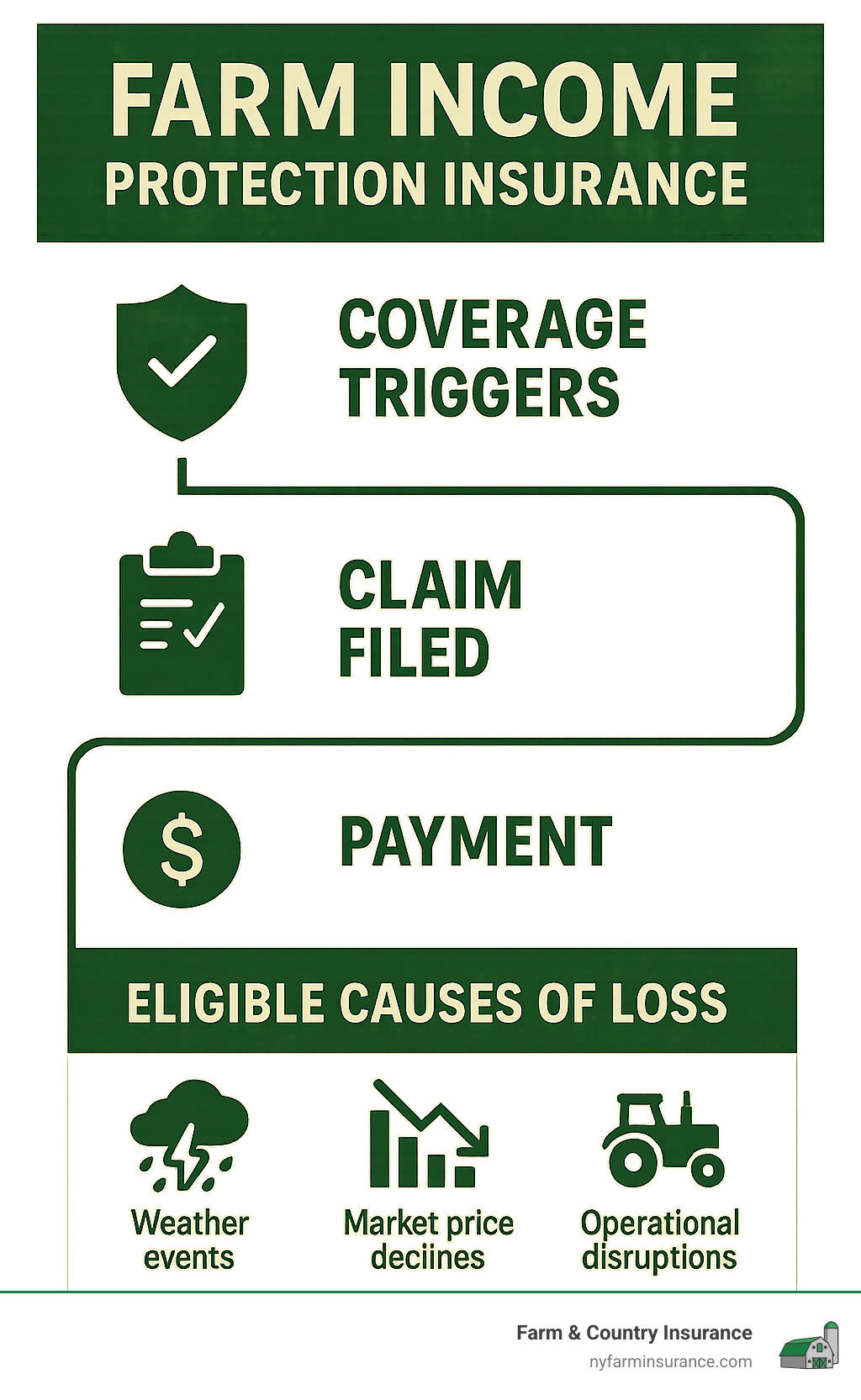
Farm income protection insurance is a specialized risk management tool that protects agricultural producers against revenue losses caused by weather events, market price declines, and operational disruptions.
Quick Farm Income Protection Insurance Guide:
* Purpose: Guarantees farm revenue rather than just crop yields
* Coverage Types: Revenue Protection (RP), Whole-Farm Revenue Protection (WFRP), Business Interruption
* Protection Against: Weather damage, price fluctuations, operational disruptions
* Coverage Levels: Typically 50-85% of expected revenue
* Maximum Coverage: Up to $17 million for WFRP policies
* Availability: All counties nationwide through certified agents
Running a farm means facing unpredictable challenges daily. A sudden hailstorm can destroy crops overnight. Market prices can plummet below production costs. Equipment breakdowns during harvest can halt operations at critical moments. These events don’t just threaten your crops or livestock—they threaten your livelihood and financial stability.
Unlike traditional crop insurance that only covers yield losses, farm income protection provides a comprehensive safety net for your operation’s revenue. This means you’re protected not just when crops fail, but also when prices fall below profitable levels or when business interruptions prevent normal operations.
As Casey Love, owner of Farm & Country Insurance, I’ve helped hundreds of New York farmers steer the complex world of farm income protection insurance, tailoring coverage to protect their unique operations against both natural disasters and market volatility while ensuring their farm legacy continues for generations.
Farm income protection insurance terms to learn:
– agricultural business insurance
– farm building insurance policy
– farm equipment breakdown coverage
Why This Guide Matters
For New York farmers, understanding farm income protection insurance isn’t just about checking a box for your business plan—it’s about ensuring your farm’s sustainability through unpredictable seasons and market conditions. Whether you operate a dairy farm in Cayuga County, manage apple orchards in Sennett, or run a diversified vegetable operation in Auburn, protecting your revenue stream is critical to your farm’s long-term viability.

Financial resilience in agriculture means having the ability to recover from setbacks without depleting your reserves or taking on excessive debt. With increasingly volatile weather patterns affecting New York’s growing seasons and market fluctuations becoming more unpredictable, having a comprehensive income protection strategy has never been more important.
What Is Farm Income Protection Insurance?
Picture this: You’ve worked hard all season, but a late frost damages your apple crop in Sennett, or milk prices suddenly drop for your dairy operation in Cayuga County. This is where farm income protection insurance steps in – not just to help you survive these setbacks, but to ensure your farm remains financially stable through them.
Farm income protection insurance is essentially your farm’s financial safety net. Unlike traditional insurance that just replaces damaged property, income protection focuses on maintaining your farm’s revenue stream when circumstances beyond your control threaten your bottom line. It guarantees a portion of your expected farm income, whether losses come from poor yields, falling prices, or both.
When you purchase this coverage, you’re establishing a revenue guarantee – typically between 50% and 85% of your expected income based on your production history and current market forecasts. If your actual revenue falls below this threshold, your policy kicks in to cover the difference.
At Farm & Country Insurance, we’ve seen how this holistic approach to coverage has helped New York farmers weather everything from destructive hailstorms to market collapses since 1984. Whether you’re running a vineyard in Ledyard or growing specialty vegetables in Brutus, your income protection needs are unique – and your coverage should be too.
How Farm Income Protection Insurance Shields Against Weather & Market Risk
The beauty of farm income protection insurance is its comprehensive approach to farm risk. It creates a financial shield against multiple threats:
When drought turns your corn fields crispy in Scipio, yield loss protection ensures you’ll still receive revenue based on your coverage level, even if your bins are half-empty at harvest.
If grain prices plummet between spring planting and fall harvest, price decline coverage compensates for the difference, protecting your bottom line even when markets crash.
When your combine breaks down mid-harvest, equipment breakdown protection can replace lost income and cover extra expenses needed to get back up and running quickly.
For livestock producers, disease outbreak safeguards can protect against revenue losses when illness affects production or triggers quarantines.
I remember working with a corn grower in Scipio who had 75% Revenue Protection coverage on an expected $200,000 crop. When drought cut his actual revenue to just $100,000, his policy covered that $50,000 gap – the difference between a devastating year and one his operation could financially survive.
Farm Income Protection Insurance vs Traditional Crop Insurance
The difference between farm income protection insurance and traditional crop insurance is like comparing a raincoat (which only keeps you dry) to an all-weather survival kit (which keeps you dry, warm, and prepared for whatever comes).
| Feature | Revenue Protection | Traditional Yield Protection |
|---|---|---|
| What’s covered | Revenue (yield × price) | Yield only |
| Price fluctuation protection | Yes | No |
| Guarantees based on | Historical yields AND current market prices | Historical yields only |
| Trigger for payment | Revenue falls below guarantee | Yield falls below guarantee |
| Best for | Operations sensitive to both yield and price risk | Operations mainly concerned with production risk |
| Diversification incentives | Higher with WFRP (premium discounts) | Limited or none |
| Coverage levels | 50-85% of expected revenue | 50-85% of expected yield |
Traditional crop insurance (Yield Protection) only pays when your production falls below your guaranteed yield level. You could have a bumper crop, but if market prices collapse, you’re on your own. In contrast, farm income protection insurance considers both your production and its market value.
I’ve watched farmers in Genoa and Locke transform their risk management approach after switching from yield-only to revenue protection. One vegetable grower told me: “I used to worry about weather OR prices. Now I just focus on growing good food, knowing my revenue is protected either way.”
This revenue focus also creates a natural incentive for diversification. Programs like Whole-Farm Revenue Protection actually reward diverse operations with premium discounts – recognizing that growing multiple crops or raising various livestock inherently reduces risk.
The Risks Covered & When Policies Trigger
Farm income protection insurance isn’t just about paperwork and premiums—it’s about sleeping better at night knowing your farm’s financial future is protected when things go sideways. Let’s talk about when these policies actually kick in to help you.

When you’re working the land in New York, you’re facing challenges from all directions. Your farm income protection insurance is designed to respond when any of these four main threats take a bite out of your revenue:
Weather Events can devastate crops overnight—whether it’s a summer drought baking your corn fields, spring hail shredding your apple blossoms, or excessive rainfall turning your fields into ponds. These natural events don’t just damage crops; they damage your bottom line.
Market Volatility can be just as devastating as any storm. You might grow the perfect crop only to find prices have collapsed at harvest time. That’s when price protection components of your policy become your financial lifeline.
Equipment Failure during critical seasons can bring operations to a screeching halt. When your combine breaks down mid-harvest or your irrigation system fails during a dry spell, the right coverage helps cover both repairs and lost income.
Business Interruption from fires, storms, or other disasters might leave your buildings damaged and your operation at a standstill. This coverage helps keep money flowing while you rebuild.
Want more comprehensive protection against multiple threats? Check out our guide on Multi-Peril Crop Insurance.
Weather-Driven Losses
New York weather can be as unpredictable as a new calf in an open gate. That’s why farm income protection insurance includes specific provisions for weather-related revenue losses.
When drought turns your soil to dust, your policy doesn’t just look at the shriveled crops—it considers the total revenue impact, including potential price increases that might partially offset yield losses. A farmer in Sennett told me last year, “That drought coverage was the difference between hanging on and selling out.”
Flood and excessive moisture protection works similarly, stepping in when waterlogged fields prevent planting, damage growing crops, or delay harvest. For many of our clients in low-lying areas of Cayuga County, this coverage has proven essential during increasingly wet springs.
Hail damage can reduce both yield and quality in minutes. Your revenue protection focuses on the bottom-line impact rather than just counting damaged plants. After a devastating hailstorm hit his orchard, an apple grower in Sodus told us, “I didn’t just lose apples—I lost my premium market. The revenue coverage recognized that difference.”
For livestock producers relying on pasture, specialized rainfall index policies use scientific precipitation indices to determine payments when rainfall falls short, affecting forage production. These policies recognize that sometimes the rain gauge tells the story before your fields do.
Market & Operational Shocks
Mother Nature isn’t the only threat to your farm’s financial health. Farm income protection insurance also shields you from market swings and operational disasters.
Price drop protection is like having a safety net when market prices fall through the floor. When that bumper crop of soybeans faces prices 30% lower than projected at planting, Revenue Protection policies can make up the difference to maintain your expected income level. One grain farmer in Brutus called this “the best feature of my entire insurance program.”
Input cost spikes can squeeze your margins even when yields are good. Margin Protection plans specifically address those scenarios where fertilizer, fuel, or feed costs suddenly skyrocket, threatening profitability despite normal production. This is particularly valuable for dairy operations where feed costs can fluctuate dramatically.
A barn fire or tornado doesn’t just damage buildings—it disrupts your entire operation. Business Interruption coverage replaces lost income during repairs and rebuilding. We saw this when a Farm & Country Insurance client in Owasco faced a devastating fire in their milking parlor. Their coverage not only helped rebuild the facility but also replaced lost milk revenue and covered the extra expense of temporarily relocating their herd.
Machinery downtime during planting or harvest can be financially devastating. When that essential equipment breaks down at the worst possible moment, the right coverage helps with both repairs and the revenue you’re losing while fields sit waiting.
For more ways to protect your farm’s financial future, take a look at our Quick Start Guide to Crop Insurance Options.
Policy Options: Choosing the Right Income Safety Net
Selecting the right farm income protection insurance feels a bit like choosing the perfect tractor – you need something that fits your specific operation and handles the conditions you face. Let’s walk through your options so you can find the coverage that works best for your farm.
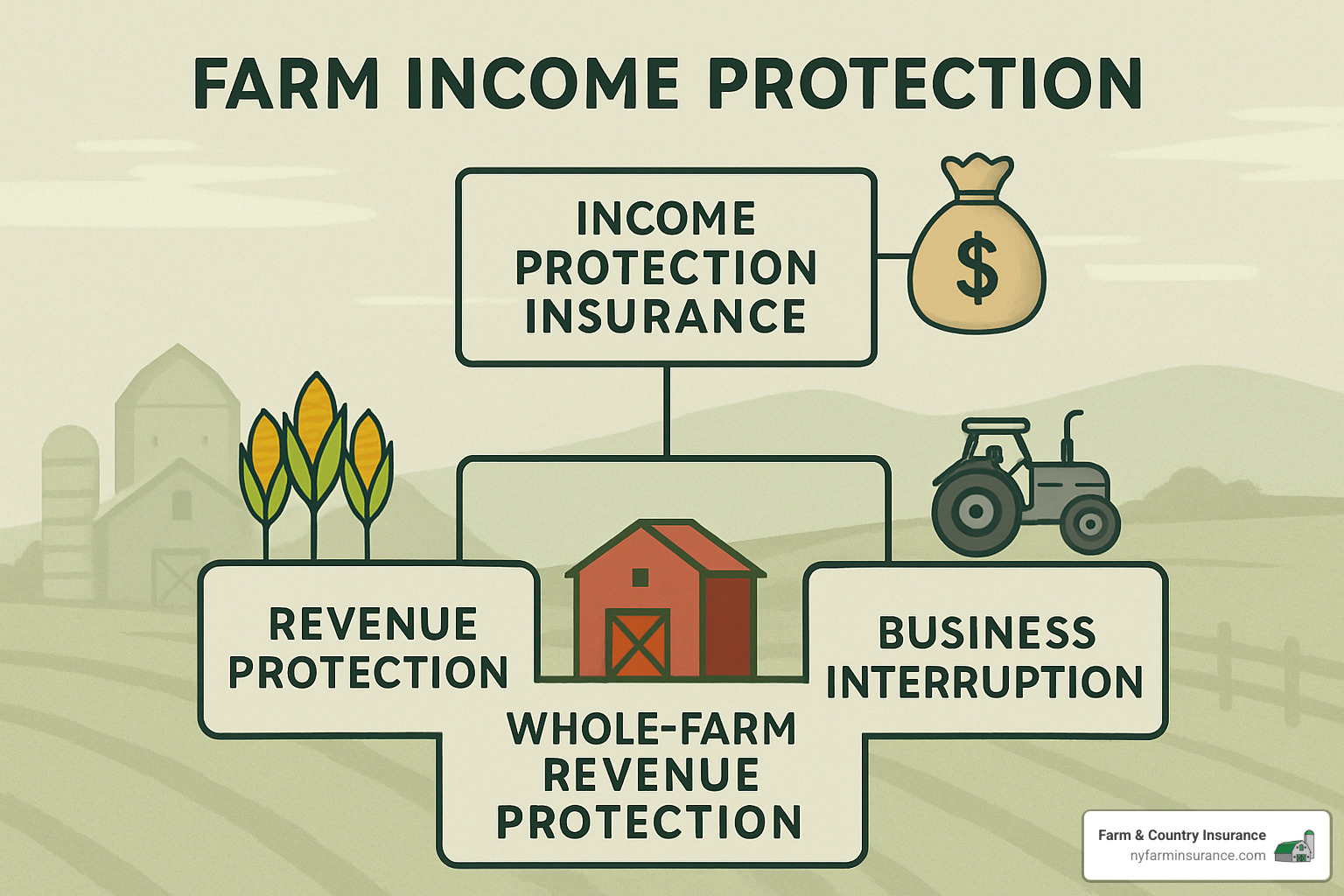
Think of farm income protection as a menu with different dishes – each designed to satisfy a particular appetite for risk management. The main options include Revenue Protection for specific crops, Whole-Farm coverage for diversified operations, Business Interruption for when disaster strikes your facilities, and specialized plans that protect against area-wide losses or shrinking profit margins.
Revenue Protection (RP)
If you’re growing corn, soybeans, wheat, or other major commodities, Revenue Protection might be your best bet. This popular option works like a financial safety net that catches you whether yields drop, prices fall, or both happen at once.
What makes RP special is its “higher-of” price feature. Let’s say drought hits Central New York and corn prices shoot up. Your RP policy adjusts your coverage upward to reflect those higher prices – protecting the value of what little crop you manage to harvest. You can choose coverage levels from 50% to 85% of your expected revenue, giving you flexibility based on your risk tolerance and budget.
I’ve watched this coverage save many grain farmers in Fleming and Venice when weather reduced their yields but the market moved in their favor. Without RP, they would’ve missed out on the financial upside of those higher prices on their remaining crop.
Whole-Farm Revenue Protection (WFRP)
If your farm looks more like a New York sampler platter than a single-dish specialty, Whole-Farm Revenue Protection might be your perfect match. This comprehensive option covers everything you produce – from apples to zucchini, beef cattle to honey – under one policy.
WFRP can cover up to $17 million in farm revenue and rewards diversity with better premium subsidies. Growing five or more commodities? You could qualify for a premium subsidy as high as 80%. For smaller operations, the Micro Farm option simplifies things for farms with revenue under $350,000.
One of our clients in Summerhill runs a 120-acre operation with vegetables, maple syrup, and a small dairy herd. WFRP gives them seamless protection across all enterprises without having to juggle multiple policies. Working with a certified crop insurance salesperson is essential for navigating the application process, but the comprehensive coverage makes it worthwhile for diversified farms.
Business Interruption & Ag Earnings
While crop policies protect what you grow, Business Interruption coverage protects your income when disaster strikes your farm buildings or equipment. Think of it as paycheck protection for your farm.
When fire, wind, or other disasters damage your facilities, this coverage helps with ongoing expenses like mortgage payments, employee wages, and taxes while you rebuild. It also covers extra costs like renting temporary facilities or equipment to keep your operation running.
This protection proved invaluable for a dairy farmer in Throop after windstorm damage to their free-stall barn. Their policy not only helped rebuild but also replaced lost milk income and covered the extra expense of housing cattle at neighboring farms during repairs. For operations with significant infrastructure – like dairy farms in Cato and Conquest – this coverage can mean the difference between a temporary setback and financial disaster.
Area Risk & Margin Plans
Sometimes, individual farm-level coverage isn’t the best fit. Area Risk Protection Insurance bases payments on county-wide results rather than your specific farm. If the entire county experiences poor yields or revenue, you receive a payment – even if your farm performed better than average. This option often comes with lower premiums and less paperwork.
Margin Protection takes a different approach by focusing on your operating margin – the difference between your revenue and input costs. Available for corn, rice, soybeans, and wheat in select counties, it protects against unexpected squeezes from rising costs or falling prices. Many farmers layer this coverage with other policies for comprehensive protection.
These options work well as complementary pieces in your risk management puzzle, particularly for farms whose production typically follows county trends.
Specialized Coverage for Small & Organic Farms
Small farms, organic producers, and direct marketers have unique needs that standard policies don’t always address. Fortunately, several specialized farm income protection insurance options can help.
The Micro Farm Program offers a simplified version of WFRP for farms with revenue under $350,000. With reduced recordkeeping requirements and availability in all counties nationwide, it makes revenue protection accessible for small-scale, diversified operations.
For organic producers, many crops now have organic price elections that reflect the premium value of certified organic production. This means your revenue guarantee accounts for the higher market prices your organic crops command.
Direct marketers also benefit from specialized tools that simplify documenting revenue from farmers markets, CSAs, and farm stands. These tools make it easier to verify income and qualify for revenue-based coverage.
A small organic vegetable farm in Ledyard used these specialized options to protect their income stream despite their non-traditional marketing approach. Rather than being forced into a one-size-fits-all policy, they found coverage custom to their unique operation.
Want to learn more about protecting your small farm operation? Check out our guide to Small Farm Business Insurance.
At Farm & Country Insurance, we’ve helped hundreds of New York farmers steer these options since 1984. We understand that each farm has its own unique risk profile, and we’re committed to finding the right income protection solution for your operation.
Costs, Documentation & Decision Checklist
Understanding the costs, documentation requirements, and decision factors for farm income protection insurance is essential for making informed coverage choices.

Budgeting for Premiums & Deductibles
When I sit down with farmers across New York to discuss farm income protection insurance, their first question is usually about cost. The truth is, there’s no one-size-fits-all answer.
Your premium costs will depend on several key factors. Are you choosing Revenue Protection for your corn fields in Cato, or Whole-Farm Revenue Protection for your diversified operation in Ledyard? The policy type makes a big difference. Your coverage level (that 50-85% range) significantly impacts your premium too—higher protection naturally costs more.
The good news? Federal subsidies take a big bite out of what you’ll actually pay. These subsidies range from 50% to 80% of the premium cost, with higher subsidies available for farmers who diversify their operations. It’s the government’s way of saying “thank you” for not putting all your eggs in one basket.
Let me give you a real-world example: For a 200-acre corn operation in Cayuga County choosing a 75% Revenue Protection policy, you might pay between $15-25 per acre after subsidies. Bump that coverage to 85%, and you’re looking at $25-40 per acre.
Your coverage level essentially determines your deductible. With 75% coverage, you’re self-insuring the first 25% of losses. At Farm & Country Insurance, we help our clients find that sweet spot between premium costs and coverage that matches their farm’s financial resilience and comfort with risk.
Recordkeeping & Eligibility Requirements
I won’t sugarcoat it—the paperwork side of farm income protection insurance can feel overwhelming. But good records aren’t just for insurance—they’re the backbone of any successful farm business.
For most policies, you’ll need five consecutive years of Schedule F tax forms (or equivalent). You’ll also need production records that break down yields by crop, field, and year. Sales receipts, marketing records, inventory reports, and planting records round out the basic requirements.
If you’re applying for Whole-Farm Revenue Protection, the documentation gets more detailed. You’ll need a Whole-Farm History Report showing five years of revenue, a Farm Operation Report detailing your production plans, and various worksheets covering expenses, inventory, and accounts.
For those of you selling directly to consumers, keep detailed records of your farmers market sales, CSA memberships, and daily market stand receipts. These direct-market records are increasingly accepted by insurance providers, though they need to be consistent and thorough.
At Farm & Country Insurance, we’ve helped hundreds of New York farmers organize their paperwork for successful applications. Sometimes it’s just a matter of putting existing records into the right format. Other times, we help farmers establish new recordkeeping systems that serve both their insurance needs and their overall business management.
Claim Process & Timelines
When disaster strikes, knowing how to steer the claims process can make all the difference in how quickly you receive your payment. The clock starts ticking the moment you find a potential loss.
First things first: notify your agent within 72 hours of finding the problem. Miss this window, and you might jeopardize your claim. At Farm & Country Insurance, we make this easy with 24/7 claim reporting options.
Once you’ve filed your notice of loss, start gathering documentation. For crop losses, this means yield records and evidence of damage. For revenue losses, you’ll need sales receipts and marketing records showing the shortfall.
An adjuster will work with you to assess the damage and calculate your loss. For WFRP claims, you’ll need to complete your tax return for the policy year before finalizing your claim—which means there can be a waiting period between loss and payment.
After submitting your formal claim (within 60 days of tax filing for WFRP), you should receive payment within about 30 days. Business Interruption claims require documentation of both your pre-loss income and ongoing expenses during the interruption period.
The most common pitfalls we see? Missing that critical 72-hour notification window, inadequate documentation, and failure to report changes in production plans or marketing strategies. A quick call to your Farm & Country Insurance agent can help you avoid these mistakes and ensure your claim proceeds smoothly.
For more details about claims and other frequently asked questions, check out our Farm Insurance FAQs.
Frequently Asked Questions about Farm Income Protection Insurance
How do I decide between RP and WFRP?
Choosing between Revenue Protection and Whole-Farm Revenue Protection often feels like standing at a crossroads on your farm – both paths offer protection, but which one fits your operation best?
Consider RP if you’re primarily growing mainstream crops like corn, soybeans, or wheat. It’s the simpler option with more straightforward paperwork, perfect if you’re focusing on just a few major commodities. Many farmers appreciate that RP also protects you when prices increase during the growing season – a feature that can be particularly valuable during volatile market years.
Consider WFRP if your farm looks more like a patchwork quilt of diversity. If you’re growing specialty crops alongside livestock, or selling through farmers markets and CSAs, WFRP might be your better match. It wraps your entire farm operation under one protective blanket, covering everything from your heirloom tomatoes to your grass-fed beef.
Many of our clients across Sennett and Springport actually take a “best of both worlds” approach. They’ll use RP to cover their bread-and-butter crops while adding WFRP to protect their overall farm revenue, including those specialty crops that make their operation unique. At Farm & Country Insurance, we’ve found this combination strategy often provides the most comprehensive safety net.
What extra paperwork do diversified or direct-market farms need?
Let’s face it – paperwork isn’t why any of us got into farming. But for diversified and direct-market farms, good documentation is as essential as good soil.
If you’re running a diversified farm, you’ll need to keep your records sorted by commodity. This means tracking production and sales separately for each crop or product. You’ll also need to document your different marketing channels and the prices you receive through each one. For specialty crops, be prepared to show evidence of your production practices, especially if you’re claiming premium prices for organic or specialty products.
Direct marketers face their own documentation challenges. Those Saturday mornings at the farmers market aren’t just about connecting with customers – they’re also opportunities to create the paper trail your insurance needs. Daily sales logs from markets, farm stands, and CSAs form the backbone of your documentation. Customer lists, subscription records, and clear price lists all help establish the value of what you’re insuring.
The good news? The USDA offers specialized recordkeeping tools designed specifically for direct marketers applying for WFRP. Our agents at Farm & Country Insurance can help you access these templates and set up systems that make documentation less of a chore and more of a useful business practice.
How soon after a loss will I receive payment?
When disaster strikes your farm, waiting for insurance payments can feel like watching paint dry – except with a lot more financial stress. Here’s what to expect with farm income protection insurance timelines:
For Revenue Protection policies, the timeline follows your harvest schedule. Since these policies protect your revenue, final calculations can’t happen until after harvest completion when both your yield and the harvest price are known. Once your claim is finalized, payments typically arrive within 30 days. If you’ve experienced a significant loss, you might qualify for partial payments earlier.
Whole-Farm Revenue Protection follows a longer timeline because it’s tied to your tax year. You’ll need to complete your tax filing before finalizing your claim, which means patience is required. From the time of loss to payment, the process might stretch several months, with payment arriving about 30 days after claim determination.
Business Interruption coverage often provides faster initial relief. You might see your first payment within weeks of a covered event like a barn fire or windstorm damage. For longer interruptions, payments may continue periodically until your operations are back to normal.
The golden rule for faster claims? Notify us immediately (within 72 hours of finding a potential loss) and keep thorough records. At Farm & Country Insurance, we’ve guided countless New York farmers through the claims process since 1984, and we’ve learned that prompt notification and solid documentation are your best allies in receiving timely payments when you need them most.
Conclusion
When the skies darken with approaching storms or market prices begin to wobble, farm income protection insurance becomes more than just another policy—it becomes your farm’s financial lifeline. In today’s world where weather patterns grow increasingly unpredictable and markets swing with global events beyond your control, protecting your revenue stream is just as crucial as insuring your tractors and barns.
I’ve walked countless farm properties across New York state, from multi-generation dairy operations in Cayuga County to innovative vegetable farms in Brutus, and I’ve seen how the right income protection strategy transforms anxiety into confidence. Even when facing a devastating hailstorm or sudden price collapse, farmers with proper coverage can focus on recovery rather than financial survival.
At Farm & Country Insurance, we’ve spent nearly four decades helping New York’s agricultural community build financial resilience. We understand that your Montezuma berry farm faces different challenges than your neighbor’s grain operation, which is why we never offer one-size-fits-all solutions. Your farm’s unique characteristics—its crops, marketing channels, equipment, and history—all inform the farm income protection insurance strategy we’ll help you develop.
Take a moment to consider your operation’s vulnerability. Could your farm withstand a 30% drop in production? What about a 20% fall in market prices? Or both happening simultaneously? If these scenarios make you uncomfortable, it’s time to review your coverage options.
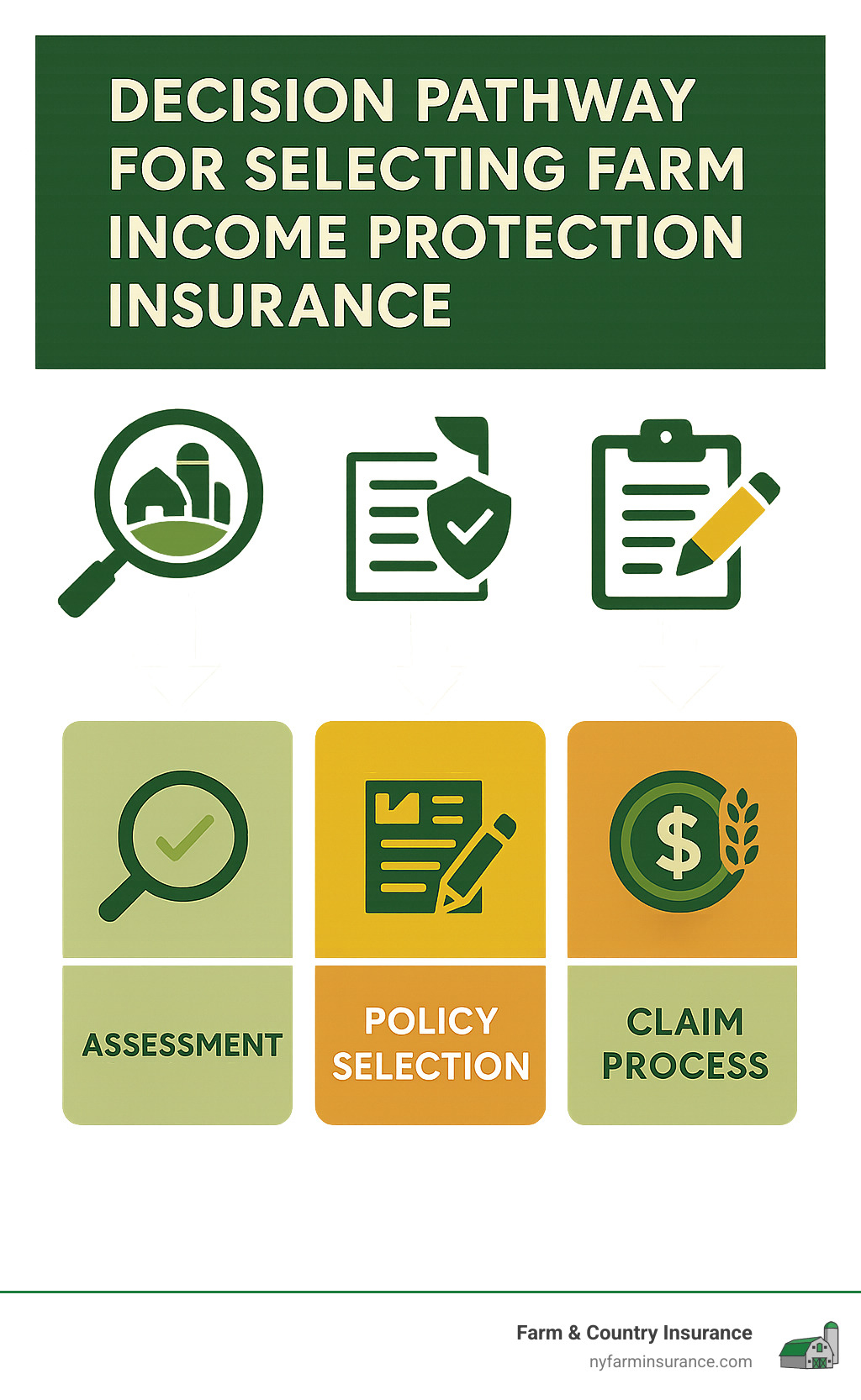
The ideal time to evaluate your farm income protection insurance needs isn’t after disaster strikes—it’s before you plant your first seed of the season. Our team at Farm & Country Insurance can guide you through a comprehensive risk assessment that identifies your operation’s specific vulnerabilities and builds protection that gives you peace of mind to focus on what you do best: farming.
For dairy producers facing unique challenges in today’s market, we’ve developed specialized solutions outlined in our guide to custom dairy farm coverage. These custom approaches address the specific revenue risks that make dairy farming particularly challenging in today’s environment.
When you implement thoughtful income protection, you’re not just safeguarding this year’s bottom line—you’re protecting your farm’s legacy for the next generation. You’re ensuring that one bad season doesn’t derail decades of hard work and careful stewardship.
The farmers who sleep soundest aren’t the ones who’ve never faced disaster—they’re the ones who know they’re prepared when it inevitably comes. Let’s make sure you’re among them.