
Safeguarding Your Livelihood: What is Farm Owner Insurance?
Farming is more than a job; it’s a way of life fraught with unique risks. From unpredictable weather to complex machinery, your livelihood faces daily challenges. This is where farm owner insurance steps in.
It’s a specialized policy protecting your home, land, equipment, and business.
- Farm owner insurance is a comprehensive policy for those who live and work on their farm.
- It blends homeowners coverage for your dwelling and personal property with specialized protection for farm assets and operations.
- This includes coverage for farm buildings, machinery, livestock, crops, and essential liability protection for your farming operations.
I’m Casey Love, owner of Farm & Country Insurance. My agency specializes exclusively in farm owner insurance, and my mission is to provide custom solutions that protect the livelihood, assets, and legacy of local farmers.

Farm owner insurance word list:
What is Farm Owner Insurance and Why Is It Crucial?
Unlike standard home or business insurance, farm owner insurance is a unique hybrid policy. It’s crafted to cover the complex needs of a working farm, acting as a robust safety net when the unexpected happens.
This specialized coverage is crucial because farming is inherently risky. Farmers face challenges from weather, accidents, and liability claims that can lead to significant financial loss without proper protection.
Consider the value of your assets. A combine harvester can cost over $300,000. A data breach could cost an average of $158,000. These aren’t minor inconveniences; they are existential threats to your farm that insurance can mitigate.

Farm owner insurance provides financial protection against these risks, securing your investment in your land, animals, equipment, and future.
For more detailed information on comprehensive farm and ranch coverage, you can explore our resources on More info about Farm and Ranch Insurance Coverage.

How Farm Owner Insurance Differs from Standard Policies
A common misconception is that a standard homeowners or commercial business policy is sufficient for a farm. These policies fall short in covering the intricate world of farming.
Let’s break down the differences:
| Feature | Standard Homeowners Insurance | Commercial Farm Insurance | Farm Owner Insurance |
|---|---|---|---|
| Primary Focus | Residential dwelling & personal belongings | Business operations & commercial assets | Blends residential & farm business needs |
| Business Exclusions | Often excludes or severely limits business activities (e.g., revenue, equipment) | Full business coverage, but not residential | Integrates home & farm business activities |
| Farm Structures | Limited or no coverage for barns, silos, outbuildings | Covers farm structures, but not home | Comprehensive coverage for both home & farm structures |
| Farm Equipment | Excludes specialized farm machinery (tractors, tillers, etc.) | Covers commercial equipment, but may be excessive for smaller farms | Specific coverage for all farm equipment, large or small |
| Livestock Coverage | Generally no coverage for livestock | Covers livestock as commercial assets | Covers livestock as integral farm assets |
| Farm Liability | Personal liability, but excludes farming-related incidents | Commercial liability for farm operations | Comprehensive liability for both personal & farm activities |
| Cost | Lower, but insufficient for farms | Higher, potentially excessive for smaller farms | Custom, cost-effective for combined needs |
Standard homeowners policies often have “business pursuit” exclusions, meaning any income-generating activity on your farm may not be covered. This critical gap leaves you exposed to risks like livestock causing damage to a neighbor’s property or a visitor getting injured, which require specialized farm liability. To understand more about why homeowners insurance often falls short for hobby farms, read our guide on More info about Homeowners Insurance for Hobby Farms.
Conversely, a purely commercial farm policy can be too expensive and extensive for farms that are also a primary residence. It lacks the residential coverage that farm owner insurance integrates. We specialize in tailoring policies to fit your unique situation, ensuring you’re fully protected without paying for unnecessary coverage. For more on commercial farm insurance in New York, visit More info about Commercial Farm Insurance NY.
Who Needs This Specialized Coverage?
Farm owner insurance is versatile, designed for anyone living on a property with agricultural activities, regardless of scale.
Hobby Farms: Even if you engage in small-scale agriculture for personal enjoyment (a hobby farm), you face risks beyond what a standard homeowners policy covers. Selling produce at a farmers market, for instance, is a business activity requiring specialized protection. Standard policies often exclude or limit coverage for farming activities, especially if any income is generated. For an in-depth look at this, check out our guide on More info about Hobby Farm Insurance.
Commercial Farms: For both small-scale and large commercial farms that are a primary source of income, farm owner insurance is indispensable. Your livelihood is tied to your land, equipment, and produce, and each type of farm—be it dairy, grain, or fruit—has distinct risks requiring specific coverage.
At Farm & Country Insurance, we understand the unique landscape of New York farms, including:
Whether you’re cultivating a few acres or managing a multi-generational operation, we know your farm is more than a business; it’s your home and passion.
Core Coverages Included in a Farm Owner Insurance Policy
A solid farm owner insurance policy is a package of coverages working together to protect your assets from unexpected problems. Let’s review the core components that form the backbone of your farm’s safety.
Property Protection: Your Home and Farm Structures
This coverage protects your entire property, not just your home.
Dwelling Coverage protects your farmhouse from damages like fire, wind, and hail. It covers the structure and can include additional living expenses if you need to relocate during repairs.
Personal Property coverage, similar to a standard home policy, protects your belongings inside the farmhouse, such as furniture, electronics, and clothing.
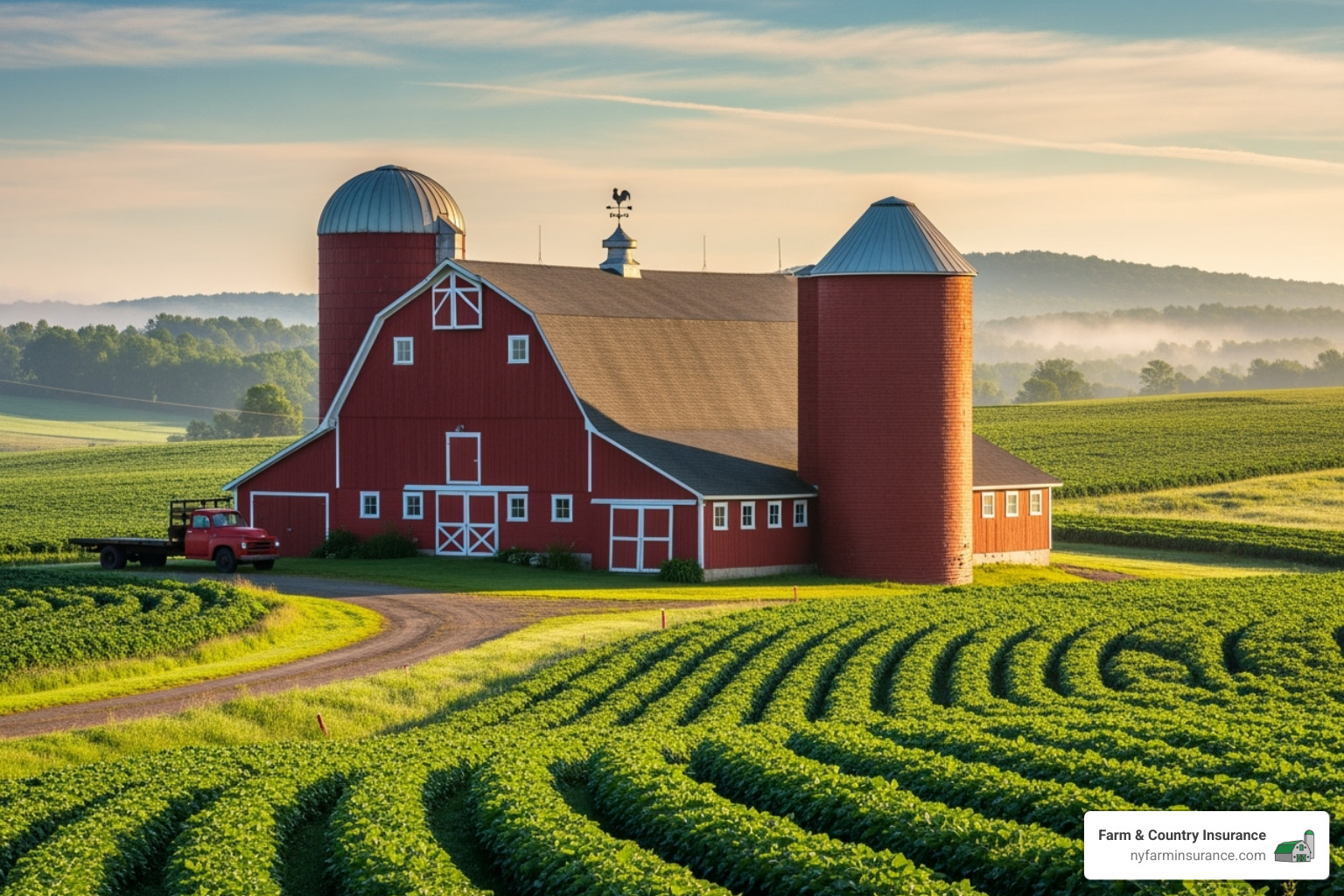
Farm Outbuildings and Structures coverage is a key feature, extending protection to crucial buildings like barns, silos, sheds, and fences. Losing a barn can be a devastating blow, and we at Farm & Country Insurance understand these structures are essential to your daily operations. For more on protecting these essential structures, check out our guide on More info about Barn Insurance New York.
Coverage for Farm Personal Property
Your farm also relies on equipment, livestock, and products that need protection.
Machinery and Equipment coverage protects your vital tools, from tractors and combines to irrigation systems. Since this equipment is expensive and difficult to replace, this coverage provides funds for repair or replacement if it’s damaged or stolen. For more details, explore More info about Farm Equipment Insurance.
Livestock coverage protects your investment in your animals against losses from perils like accidents, theft, or natural disasters. It can sometimes help with veterinary bills as well.
Farm Products coverage protects assets like harvested crops stored on-site, along with supplies such as feed, seed, and fertilizers. This helps mitigate the financial impact of a loss, such as a barn fire destroying your harvest. For more on protecting your vital assets, visit More info about Crop and Livestock Insurance.
Essential Farm Liability Coverage
Farming involves interactions with people and the environment, creating significant liability risks.
Premises Liability protects you if someone is injured on your property, covering medical costs and legal fees from incidents like a visitor falling near your barn.
Operations Liability covers claims arising from your farming activities, such as livestock damaging a neighbor’s property or spray drift affecting an adjacent field.
Product Liability is crucial if you sell farm products like milk, eggs, or vegetables. It protects you if a consumer claims your product caused illness, which is especially important for those selling at farmers markets. Learn more about this crucial protection at More info about Farm Product Liability Insurance.
Limited Pollution Liability offers protection for sudden and accidental pollution events, like a pesticide spill or manure contamination. This can be a common and costly risk in farming. For more complete information, see More info about Farm Pollution Liability Coverage.
Customizing Your Policy: Additional Coverage Options
Core coverages provide a strong foundation, but every farm is unique. A dairy farm in Cayuga County has different needs than a fruit farm near Auburn. Customizing your farm owner insurance with additional coverages, or endorsements, is crucial. Endorsements tailor your policy to your specific risks, ensuring comprehensive protection without unnecessary costs. Farm & Country Insurance can help guide these choices.

Key Endorsements for Your Farm Owner Insurance
While your core policy covers common risks, endorsements address the specific “what ifs” of your operation. Here are some key additional coverages we often recommend to New York farmers:
Equipment Breakdown Coverage: Modern farm machinery is complex, with electrical, mechanical, and computer systems like GPS. This endorsement protects against losses from the electrical or mechanical breakdown of your equipment, ensuring an unexpected failure doesn’t halt your productivity. Learn more about this vital protection at More info about Farm Equipment Breakdown Coverage.
Business Interruption (Farm and Ranch Operations Interruption Coverage): If a covered event like a fire damages your dairy barn and halts milk production, your income stops. This coverage replaces lost income and covers ongoing expenses while your operations are suspended, which is critical for maintaining cash flow during recovery. Understand how this can protect your livelihood by visiting More info about Farm Income Protection Insurance.
Crop Insurance: While your policy covers harvested crops, Crop Insurance protects crops still in the field. It covers yield losses from natural disasters like drought, flood, or hail. Often federally subsidized, it can be a lifesaver when weather is uncooperative. For a deeper dive into how this works, read More info about How Does Crop Insurance Work?.
Workers’ Compensation: If you have employees, even seasonal hands, Workers’ Compensation is typically required by New York law. It provides medical and wage benefits for employees injured on the job, protecting your business from lawsuits. It’s wise to discuss your specific situation with Farm & Country Insurance, as even family members may need coverage.
Cyber Liability: Farms increasingly rely on digital systems for managing records and data, creating cyber risks. A data breach can be costly, averaging around $158,000 for small businesses. Cyber Liability coverage helps with costs from data breaches, such as notification, credit monitoring, and legal fees, protecting your farm’s digital operations.
Umbrella Liability: An Umbrella Liability policy provides an extra layer of protection when a major accident exceeds your primary policy’s limits. It can offer millions in additional coverage, which is especially important for farms with agritourism activities like corn mazes or U-pick orchards that increase public liability exposure. It provides peace of mind for large, unexpected claims.
At Farm & Country Insurance, we are experts at combining these endorsements with your core policy to build a robust safety net for your unique operation.
Choosing the Right Policy and Understanding Costs
Navigating farm owner insurance can seem confusing, but with the right guidance, it’s a rewarding process. At Farm & Country Insurance, our goal is to empower you to make informed decisions, ensuring you get the best value and protection. Choosing insurance should feel like securing your future, not solving a puzzle.
For an even wider perspective on farm insurance, Cornell Small Farms offers a comprehensive and helpful A guide to farm insurance from Cornell Small Farms.
Factors That Influence the Cost of Your Farm Owner Insurance
The cost of farm owner insurance is not one-size-fits-all; it varies based on your farm’s unique characteristics. While a small farm policy might start around $1,500 per year, this figure can change significantly.
Here are the main factors that affect your premium:
- Farm size and property value: Larger acreage and more valuable buildings increase the cost of insurance, as there is more to protect.
- Type of operation: Different farms (dairy, grain, agritourism) have different risks. Public-facing operations like corn mazes require more liability coverage, increasing the premium.
- Location: Regional risks like severe weather, crime rates, and proximity to a fire department influence your premium.
- Value of equipment and livestock: The higher the value of your machinery and animals, the higher your premium will be.
- Claims history: A history of frequent claims can increase your premiums, while a clean record may lower them.
- Coverage limits and deductibles: Higher coverage limits increase premiums, while higher deductibles (the amount you pay out-of-pocket) can lower them. For example, increasing a deductible from $1,000 to $2,500 could save you 15-20% annually.
How to Select the Best Farm Owner Insurance Policy
Selecting the right policy means getting the protection you need without overpaying.
First, conduct a thorough risk assessment. Walk your property to identify hazards like an unfenced pond or old wiring. Create a detailed inventory of your assets, especially high-value equipment, with photos and receipts to help with potential claims.
Next, understand your needs. Consider your current operations and future plans, such as expansion or adding agritourism. Your policy should evolve with your farm.
Perhaps the most crucial step is to work with a specialist. An agent who understands agriculture can help identify risks and tailor a policy to fit your farm. At Farm & Country Insurance, our team has specialized in helping New York farmers since 1984. We understand your challenges and can help you steer your options. To learn more about how specialists can help, read about More info about Farm Insurance Brokers.
It’s vital to compare quotes and coverage. Look beyond the price to compare coverage details, limits, exclusions, and the insurer’s claims service. A custom policy provides the best protection, even if it’s not the cheapest option.
Finally, regularly review your policy. Review your coverage annually or after any significant change—like buying new equipment or expanding operations—to ensure it still meets your needs.
Frequently Asked Questions about Farm Insurance
Here are answers to some of the most common questions we receive from New York farmers at Farm & Country Insurance:
Is farm owner insurance legally required in New York?
While New York State does not have a law mandating farm owner insurance for all farms, it is a practical necessity. If you have a mortgage, your lender will require property insurance to protect their investment. More importantly, it’s common-sense protection against catastrophic financial loss from an incident like a fire, storm, or liability lawsuit.
However, New York law does require workers’ compensation insurance if you have employees and your cash payroll exceeded $1,200 in the previous year. This is separate from your farm owner policy but is a critical legal requirement.
Can I cover my small hobby farm with my homeowner’s policy?
In most cases, no. A standard homeowner’s policy is insufficient for a hobby farm, even with minimal income. These policies typically have “business pursuit” exclusions, meaning any income-generating activity could lead to a denied claim. Furthermore, they don’t adequately cover farm-specific assets like barns, tractors, or livestock. They also lack the specialized farm liability needed for incidents like a wandering animal causing an accident.
To properly protect your assets and cover your unique risks, specialized hobby farm insurance is necessary to bridge the gap left by standard homeowners policies.
How much does farm insurance typically cost?
The cost of farm owner insurance varies widely as it is a custom product. For small farm businesses, policies often start around $1,500 per year, but this is just a baseline. Your premium is influenced by many factors, including your farm’s size, property and equipment value, type of operation (dairy, grain, agritourism), claims history, and location in New York. A large operation with expensive machinery will cost more to insure than a small hobby farm.
The best way to determine your cost is to get a personalized quote. At Farm & Country Insurance, we assess your specific needs to tailor a policy that provides the right protection without unnecessary expense.
Conclusion: Securing Your Farm’s Future
Farming is a calling that requires heart, soul, and countless hours. This rewarding but unpredictable life deserves solid protection.
Farm owner insurance is a vital investment in safeguarding everything you’ve built—your home, land, equipment, and family legacy. It’s a specialized tool designed to shield you from the unique risks of farming.
At Farm & Country Insurance, we understand New York farming. Since 1984, we have created custom insurance solutions for dairy, grain, fruit, and vegetable farms, and other agribusinesses across Cayuga County, Auburn, and the state. Our agricultural roots mean we understand your daily risks and offer comprehensive coverage and risk management services that make a difference.
We provide the expert guidance needed to assess your risks and build a custom farm owner insurance policy that fits your operation perfectly. Don’t leave your hard-earned livelihood to chance.
Ready to take the next step? Learn more about our comprehensive Farm Homeowners Insurance policies today. Let Farm & Country Insurance help you secure your farm’s tomorrow, starting now.