
Why Farm Product Liability Matters to Your Operation
Farm product liability insurance protects agricultural producers from financial losses if their products cause illness, injury, or property damage to consumers or other third parties. This specialized coverage is essential for any farm that sells products directly to consumers or through distributors.
| Farm Product Liability Insurance at a Glance |
|---|
| Covers: Bodily injury, property damage, and legal defense costs from claims related to your farm products |
| Typical Limits: $500,000-$2 million (many farmers’ markets require minimum $500,000) |
| Cost: Starting around $299/year for basic coverage |
| Who Needs It: Any farm selling raw or processed agricultural products |
| Not Covered: Employee injuries, intentional acts, regulatory fines |
If you’re a farmer who sells produce at markets, supplies restaurants, or produces value-added goods like jams or cider, you face unique liability exposures. A simple foodborne illness outbreak could lead to devastating medical claims, legal fees, and court judgments that standard farm policies might not fully cover.
The risks increase significantly when you process your farm products. While unprocessed produce like apples typically falls under your general farm liability policy, products like apple cider often require additional commercial liability endorsements or specialized product liability coverage.
Many farmers mistakenly believe their farm owner’s policy provides adequate protection, or that good relationships with customers eliminate lawsuit risk. Unfortunately, in today’s litigious environment, even the most careful producer can face claims that threaten their financial stability.
I’m Casey Love, founder of Farm & Country Insurance, specializing in providing comprehensive farm product liability insurance solutions for agricultural operations throughout New York State. With over 15 years of experience protecting farms of all sizes, I’ve seen how the right liability coverage can save a farm business from devastating financial losses.

Important farm product liability insurance terms:
– farm bureau business liability insurance
– farm homeowners insurance
– small farm business insurance
Understanding Farm Product Liability Insurance


When you spend months carefully tending crops or creating value-added products from your harvest, the last thing you want to think about is someone getting sick from your food. Yet for farmers who sell directly to consumers, this reality requires proper protection.
What is Farm Product Liability Insurance?
Farm product liability insurance provides crucial financial protection when something goes wrong with products you’ve grown or made. Think of it as a safety net that catches you when a customer claims your farm products caused them harm.
This specialized coverage steps in to handle the costs of lawsuits, medical payments, and court judgments that might otherwise devastate your farm business. Whether it’s a customer who claims food poisoning from your tomatoes or someone who finds a foreign object in your homemade salsa, this insurance has your back.
Sarah, a berry farmer from Columbia County, learned this firsthand: “I never thought I’d face a lawsuit over my blueberries. When a customer claimed they got sick after eating them, I panicked. Thankfully, my farm product liability insurance covered my legal defense costs, which ran over $15,000—even though we eventually proved the illness came from another source.”
The coverage typically includes bodily injury claims (like foodborne illness), property damage your products might cause, and perhaps most importantly, the legal defense costs to protect your reputation and business.
How Farm Product Liability Insurance Fits Into Your Overall Risk Plan
Many farmers assume their regular farm policy covers everything, but that’s rarely the case. Your farm insurance protection actually works in layers:
Your basic premises liability covers accidents that happen on your property—like a customer slipping in your farm store. Meanwhile, product liability specifically addresses issues with the food or goods you sell, whether at farmers markets, to restaurants, or through CSAs.
For many small farms, a general liability policy might include some product coverage for unprocessed items. But as soon as you start making jams, baked goods, or cider, you’ll likely need additional protection through a commercial liability endorsement or standalone policy.
The experts at Farm & Country Insurance often recommend an umbrella layer of protection that sits above your other policies, providing extra coverage when a major claim exceeds your base policy limits. For farms with substantial direct sales, this extra layer can mean the difference between weathering a claim and losing the farm.
Understanding how these pieces fit together isn’t just insurance jargon—it’s about creating a safety net that matches your specific farm operation. A dairy that bottles milk needs different protection than an orchard selling fresh apples, and both differ from a farm making value-added products.
At Farm & Country Insurance, we’ve seen too many New York farmers find gaps in their coverage only after facing a claim. The right farm product liability insurance gives you peace of mind to focus on what you do best—growing and creating quality farm products—while knowing you’re protected if something goes wrong.
Why Farmers & Ranchers Need Product Liability Coverage

The farming world isn’t what it used to be. As more farms bypass traditional distribution channels to sell directly to consumers and create value-added products, their exposure to liability has grown significantly. According to recent outbreak statistics, foodborne illness claims linked to local food producers have risen by nearly 25% in the last decade.
Mandatory Requirements for Markets and Buyers
I’ve seen the shift across New York state—venues and buyers increasingly view farm product liability insurance as non-negotiable.
Most farmers markets now require vendors to carry at least $500,000 in product liability coverage. They’ll also want to be listed as an additional insured on your policy. I remember helping a young couple who grew heirloom tomatoes in the Finger Lakes region. They were excited about their first market day until they realized they couldn’t set up without proper insurance documentation.
Restaurants have become equally cautious. Chefs who proudly feature local farms on their menus also need to protect their businesses. Most now request proof of insurance before establishing a purchasing relationship. Similarly, grocery stores and specialty retailers typically require vendors to maintain $1-2 million in liability coverage before they’ll stock your products.
Even CSA programs, with their close farmer-consumer relationships, face significant liability exposure. As one CSA operator in Seneca County told me, “I thought our members were like family—until one threatened legal action after claiming our greens made their child sick.”
Common Claims Examples
Real-world scenarios help illustrate why this protection matters so deeply. A spinach grower in Central New York faced multiple claims after consumers became ill from contaminated produce. Despite following all recommended safety protocols from the Produce Safety Alliance training program, the investigation and legal defense costs alone exceeded $75,000.
In another case, a small farm producing homemade jam didn’t properly label a potential allergen. When a customer suffered a severe allergic reaction, the resulting medical bills and settlement approached $120,000—an amount that would have bankrupted the operation without proper farm product liability insurance.
Physical contamination claims can be equally devastating. One Farm & Country Insurance client faced allegations of glass fragments in their homemade salsa. Though ultimately proven unfounded, the legal defense costs were substantial. Another farm producing both nut products and other goods faced serious claims when a customer with severe allergies suffered a reaction due to cross-contamination.
The financial reality is sobering. Even a relatively minor foodborne illness outbreak linked to your farm could result in medical expense claims from multiple consumers, legal defense costs quickly exceeding $50,000, and potential settlements in the hundreds of thousands—not to mention the damage to your farm’s reputation and future sales.
At Farm & Country Insurance, we’ve guided countless New York farms through these challenging situations. The right farm product liability insurance doesn’t just cover claims—it often provides valuable risk management guidance to help prevent issues before they occur. After all, the best claim is the one that never happens.
What Exactly Is Covered? Products, Risks & Limits

When it comes to protecting your farm business, knowing exactly what your farm product liability insurance covers can mean the difference between financial security and devastating loss. Not all farm products carry the same risk level, and your coverage needs will vary significantly depending on what you’re growing and selling.
Raw Produce Coverage
If you’re primarily selling fruits and vegetables straight from the field to your customers, you’re in a relatively favorable position insurance-wise. Most standard farm owner’s policies include some basic protection for unprocessed agricultural products.
“I remember when the Matthews family from Skaneateles thought they were fully covered for their u-pick apple operation,” shares Casey from Farm & Country Insurance. “Their basic farm policy did provide some protection, but we helped them understand that their high volume of visitors required higher limits.”
Your basic farm liability typically covers claims arising from raw, unprocessed items like:
Fresh fruits and vegetables picked and sold in their natural state typically fall under your general farm liability coverage. Whether it’s tomatoes at your farm stand or lettuce at the farmers market, these items usually represent your lowest liability risk.
Unprocessed grains and seeds similarly enjoy coverage under standard farm policies, though bulk sales may require additional consideration.
Raw honey that’s simply extracted and bottled (not heated or significantly processed) often remains under your basic farm coverage umbrella.
Shell eggs sold in their natural state typically receive coverage under standard farm liability, though proper handling and refrigeration are essential.
However, even with these “simpler” products, many farmers find their standard policy limits are woefully inadequate given today’s litigation environment. A single claim can quickly exceed basic coverage limits.
Farm Product Liability Insurance for Value-Added & Processed Goods
The moment you start processing your farm products, your liability exposure increases dramatically – and most standard farm policies won’t provide adequate protection.
Jane, a berry farmer in Ontario County, learned this lesson the hard way. “We started making jam from our berries and selling it at markets. We had no idea our regular farm insurance wouldn’t cover these products until our agent at Farm & Country Insurance pointed it out. Thankfully, we got proper coverage before we had any issues.”
Processed products that typically require specialized farm product liability insurance include:
Cider, juice, or wine introduces significant food safety considerations and almost always requires commercial liability endorsements or standalone product liability policies. The fermentation process in wine and hard cider adds another layer of complexity.
Jams, jellies, and preserves involve cooking, canning, and potential botulism risks that standard farm policies typically exclude.
Baked goods made with your farm ingredients face similar exclusions and require commercial coverage to protect against allergen and contamination claims.
Cheese and dairy products carry particularly high risk profiles due to potential pathogens and typically require robust specialized coverage.
Meat products represent some of the highest liability exposures and demand comprehensive product liability coverage with appropriate limits.
Additional Endorsements & Extensions
For many modern farm operations, basic product liability coverage is just the beginning. Depending on your operation’s specific activities, you might need these additional protections:
Product recall insurance can be a financial lifesaver if you ever need to pull products from the market due to contamination or defects. The Simmons family, who operate a small canning operation in Cayuga County, told us: “When we had to recall a batch of pickles due to improper pH levels, our product recall coverage saved us thousands in notification costs and replacement expenses.”
Pollution liability provides crucial protection for farms using pesticides, fertilizers, or other chemicals that could potentially cause damage beyond your property lines.
Cyber liability has become essential for farms with online sales platforms or customer databases. Even small operations collecting payment information face significant exposure if that data is compromised.
Inland marine coverage protects your products while they’re in transit to markets, restaurants, or other sales venues – a commonly overlooked exposure until something goes wrong.
At Farm & Country Insurance, we’ve seen how the right combination of these coverages can provide comprehensive protection for farms of all sizes throughout New York. The key is understanding exactly what you’re selling, how it’s processed, and where your specific liability exposures lie.
Learn more about your overall protection needs through our guide to Farm Liability Insurance.
Buying the Right Policy: Limits, Premiums & Application Checklist
Securing appropriate farm product liability insurance requires understanding how coverage limits work, what factors affect your premiums, and what information insurers need to provide an accurate quote.
How Much Coverage Do You Need?
Coverage limits should be based on your specific operation, but there are some general guidelines:
- Minimum recommended coverage: $500,000 per occurrence/$1 million aggregate
- For significant direct sales: $1 million per occurrence/$2 million aggregate
- For value-added or processed products: $1-2 million per occurrence/$2-4 million aggregate
- For wholesale to retailers/restaurants: Often require $1-2 million minimum
Many farmers also add umbrella liability policies that extend coverage limits by an additional $1-5 million above their base policies.
“When we started selling our maple products to a regional grocery chain, they required $2 million in coverage,” explains a maple producer from Moravia. “We were able to meet this requirement by adding a $1 million umbrella policy on top of our existing coverage.”
What Information Insurers Ask For
When applying for farm product liability insurance, be prepared to provide:
- Detailed product descriptions: What you grow and sell, including processing methods
- Annual sales figures: Actual or projected gross sales by product category
- Years in production: How long you’ve been growing/producing each item
- Claims history: Any past incidents or claims
- Food safety certifications: GAPs (Good Agricultural Practices) certification, HACCP plans, etc.
- Distribution channels: Where and how you sell (direct, wholesale, etc.)
- Processing facilities: Information about on-farm processing or co-packing arrangements
Being thorough and honest during the application process ensures you receive appropriate coverage. Estimating sales conservatively on the high end is recommended to ensure adequate protection throughout your policy period.
Tips to Keep Premiums Manageable
While farm product liability insurance is essential, there are ways to manage costs:
- Implement and document food safety protocols: Many insurers offer discounts for farms with formal safety plans
- Maintain detailed production records: Batch coding and traceability systems can reduce risk and premiums
- Consider higher deductibles: If you have cash reserves, a higher deductible can lower premiums
- Bundle policies: Combining multiple coverages with one insurer often results in discounts
- Invest in food safety training: Programs like the Produce Safety Alliance training can reduce your risk profile
“After completing GAPs certification and implementing a comprehensive food safety plan, we saw our insurance premiums decrease by nearly 15%,” reports a vegetable grower from Sennett. “The investment in safety paid for itself through reduced insurance costs and increased buyer confidence.”
At Farm & Country Insurance, we work with farms throughout New York to identify the most cost-effective coverage options while ensuring adequate protection.
Exclusions, Gaps & Related Policies to Watch
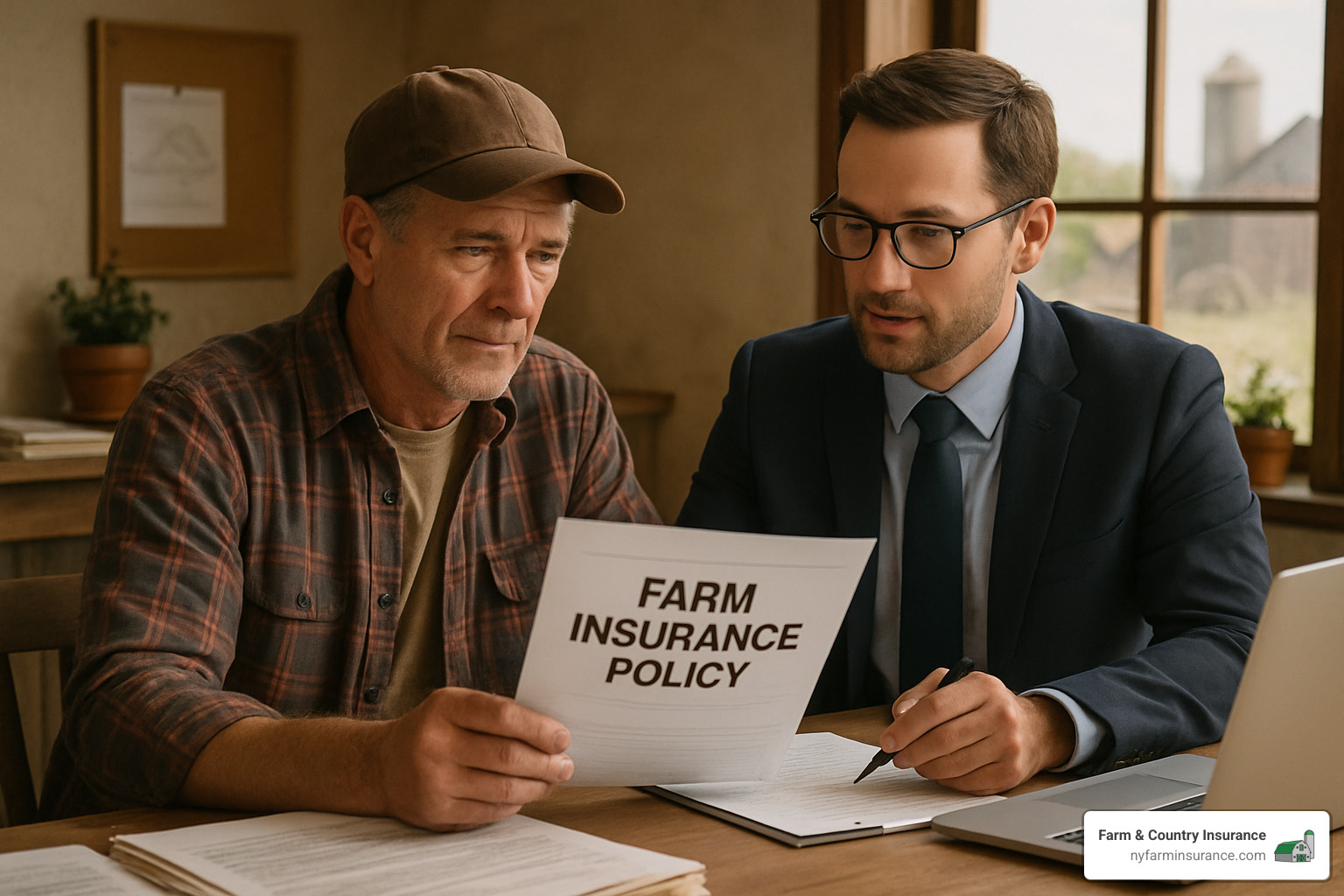
Knowing what your farm product liability insurance doesn’t cover might save your farm one day. Even the most comprehensive policies have limitations that could leave you exposed if you’re not careful.
When Farm Product Liability Insurance Won’t Pay
I remember visiting a small farm in Scipio that had a painful learning experience. They’d been making delicious jams for years when they decided to branch out into hot sauce. Business was booming until a contamination issue arose. When they filed a claim, they were shocked to find their insurance wouldn’t cover it – they’d never updated their policy to include the new product line.
Your farm product liability insurance typically won’t cover several important scenarios:
When you deliberately misrepresent your products or ingredients, no policy will help you. Regulatory fines from the FDA or USDA come out of your pocket, not your insurer’s. If your delivery driver has an accident, that’s a job for commercial auto coverage, not product liability. And of course, if claims exceed your policy limits, you’re responsible for the difference.
“The most common mistake I see,” explains a Farm & Country Insurance agent, “is farms not keeping their product lists updated with their insurer. That new value-added product you’re so proud of? If it’s not listed on your policy, it’s not covered.”
Employee injuries are another common misunderstanding. If your farmhand cuts themselves while processing apples, that’s a workers’ compensation issue, not a product liability concern.
The Role of Product Recall Insurance
Picture this: You find a potential contamination in yesterday’s batch of apple cider. Now you need to pull product from twenty stores and notify hundreds of customers. Who pays for all that?
Product recall insurance complements your farm product liability insurance by covering the actual recall process. While liability insurance handles damages from harm already caused, recall coverage takes care of notification costs, product retrieval expenses, safe disposal of recalled items, and even lost income during the recall period.
A producer from Fleming shared a sobering story: “When a neighboring farm had to recall their apple cider, the costs nearly bankrupted them. Beyond the lost product value, they had to pay for public notifications, store retrievals, and then watched their sales plummet for months afterward. Their product recall insurance literally saved their farm.”
For anyone making processed foods or selling wholesale, recall coverage isn’t a luxury – it’s essential protection against a potentially farm-ending event.
Umbrella & Pollution Liability Backstops
Think of umbrella liability as your farm’s financial safety net. If you have $1 million in farm product liability insurance and a $2 million umbrella, you effectively have $3 million in total protection. It’s often surprisingly affordable too – one of the most cost-effective ways to increase your coverage.
Pollution liability deserves special attention for New York farms. With our state’s strict environmental regulations and many farms situated near important water resources, accidental chemical releases can create massive liability.
A Farm & Country Insurance representative shared a cautionary tale: “A farm in Ledyard experienced a pesticide drift incident that damaged neighboring organic crops. Their standard farm policy would have denied the claim completely, but their pollution liability coverage addressed the resulting damages, which ran into the tens of thousands.”
This specialized coverage protects you when chemicals accidentally release during application, storage, or transportation – scenarios that standard policies explicitly exclude.
For comprehensive protection, consider how Agricultural Business Insurance can provide additional layers of security beyond your basic farm coverage. Many farmers find that combining these policies creates a safety net that lets them sleep soundly at night, knowing their livelihood is protected from life’s unpredictable challenges.
Frequently Asked Questions about Farm Product Liability Insurance
Is farm product liability insurance required at farmers markets?
Yes, most farmers markets now require vendors to carry farm product liability insurance with minimum limits of $500,000. Markets typically also want to be listed as an “additional insured” on your policy, which protects them if they’re named in a lawsuit involving your products.
I remember talking with a small vegetable farmer from just outside Auburn who was initially overwhelmed by the paperwork. “When we first started selling at farmers markets around the Finger Lakes, each market seemed to have its own set of requirements,” she told me. “Farm & Country Insurance helped us steer everything and provided all the certificates we needed, which made the whole process much less stressful.”
If you sell at multiple markets like many of our clients do, keep a running list of all locations that need insurance certificates and share this with your agent at renewal time. This simple step can save you a lot of headaches when market season begins.
How are premiums calculated for small diversified farms?
When it comes to farm product liability insurance, your premium isn’t just a random number. Insurers look at several key factors:
Your gross annual sales serve as the primary basis for your premium – higher sales generally mean higher premiums. The types of products you sell matter tremendously, with raw produce typically costing less to insure than processed foods like jams or cider. Your sales channels (whether you sell directly to consumers or wholesale to stores) affect your risk profile, while any previous claims will naturally increase what you pay. Many farmers don’t realize that documented food safety protocols can actually help reduce premiums, and established farms with years of claims-free history often receive better rates.
For small diversified farms growing dozens of different crops, there’s good news. Insurance companies typically group similar products together rather than requiring you to list and price every single variety of tomato or pepper you grow.
A farmer from Summerhill who works with us put it well: “Growing over 40 different crops, I was worried about the paperwork nightmare of insuring everything individually. Farm & Country Insurance made it simple by categorizing our products logically and focusing on our overall approach to risk management instead of creating an itemized list of every seed we plant.”
Do I need separate coverage if I use a co-packer?
If you’re working with a co-packer to create value-added products like jams, sauces, or cider, you absolutely still need your own farm product liability insurance. While your co-packer should carry their own liability coverage, their policy primarily protects their operation, not your brand or products.
When using co-packers, verify their insurance coverage by requesting a certificate of insurance, but don’t stop there. Maintain your own comprehensive product liability policy, as your products ultimately remain your responsibility regardless of who processes them. Create clear written agreements that specify exactly who’s responsible for various aspects of production, from ingredients to packaging. And seriously consider adding product recall coverage, which becomes even more important when you don’t directly control the manufacturing process.
One of our clients who produces specialty fruit preserves using a regional co-packer learned this lesson the hard way. “I assumed I was fully covered under the facility’s insurance,” she explained. “I was shocked to find their policy would only cover manufacturing defects, not any issues related to my recipe or the ingredients I provided.”
Always be upfront with your insurance provider about any co-packing arrangements to ensure there are no coverage gaps. At Farm & Country Insurance, we’ve seen too many farmers find these gaps only after a claim occurs.
For more detailed information about protecting your small farm operation, check out our guide to Small Farm Business Insurance.
Conclusion
Protecting your farm with proper farm product liability insurance is not just about compliance with market requirements or buyer demands—it’s about safeguarding the operation you’ve worked so hard to build. A single claim could threaten your farm’s financial stability without adequate coverage.
At Farm & Country Insurance, we’ve specialized in providing custom farm insurance solutions throughout New York since 1984. Our deep understanding of the unique risks faced by dairy, grain, fruit, and vegetable farms, as well as agribusinesses, allows us to develop comprehensive coverage packages that address your specific needs.
Whether you’re a small-scale producer selling at local farmers markets or a larger operation with wholesale distribution, we can help you steer the complexities of farm product liability insurance and ensure your farm is properly protected.
Our experienced agents understand the unique challenges faced by New York farmers and can guide you through the process of securing appropriate coverage. We work with multiple insurance carriers to find the best combination of coverage and value for your operation.
As your farm evolves—adding new products, expanding sales channels, or increasing production—your insurance needs will change too. Regular policy reviews are essential to maintaining adequate protection.
Contact Farm & Country Insurance today to schedule a comprehensive review of your farm’s liability exposures and insurance needs. Our team is ready to help you protect what matters most—your farm, your family, and your future.