
Why Your Tractor is More Than Just a Machine
When you’re looking at farm tractor insurance cost, you need to know the basics fast. Here’s what most New York farmers pay:
Quick Cost Guide:
- Basic liability coverage: $75-$500 per year
- Full coverage (comprehensive + collision): $250-$2,000+ annually
- Rule of thumb: $5-$7 per $1,000 of tractor value
- Example: A $30,000 tractor costs roughly $150-$210 per year to insure
Your tractor isn’t just equipment – it’s the backbone of your farm operation. Whether you’re running a dairy farm in the Finger Lakes or growing crops across Western New York, that machine represents a massive investment that keeps your business moving.
The numbers tell the story. Tractors range from $25,000 for compact models to $150,000+ for large commercial units. Tractor rollovers account for 44% of work-related deaths on farms, making proper insurance coverage about more than just protecting your wallet – it’s about protecting lives and livelihoods.
But here’s what most farmers don’t realize: your homeowner’s policy probably won’t cover tractors over 25-30 horsepower. And if you’re using that tractor for commercial farming or taking it off your property, you’re likely looking at serious coverage gaps.
I’m Casey Love, owner of Farm & Country Insurance, and I’ve spent years helping New York farmers steer farm tractor insurance cost decisions that protect their operations without breaking their budgets. After working with hundreds of farming families across our state, I’ve learned that the right coverage comes down to understanding your specific risks and finding the sweet spot between protection and affordability.
Farm tractor insurance cost vocab explained:

Understanding Your Coverage Options: From Basic Liability to All-Risk Protection
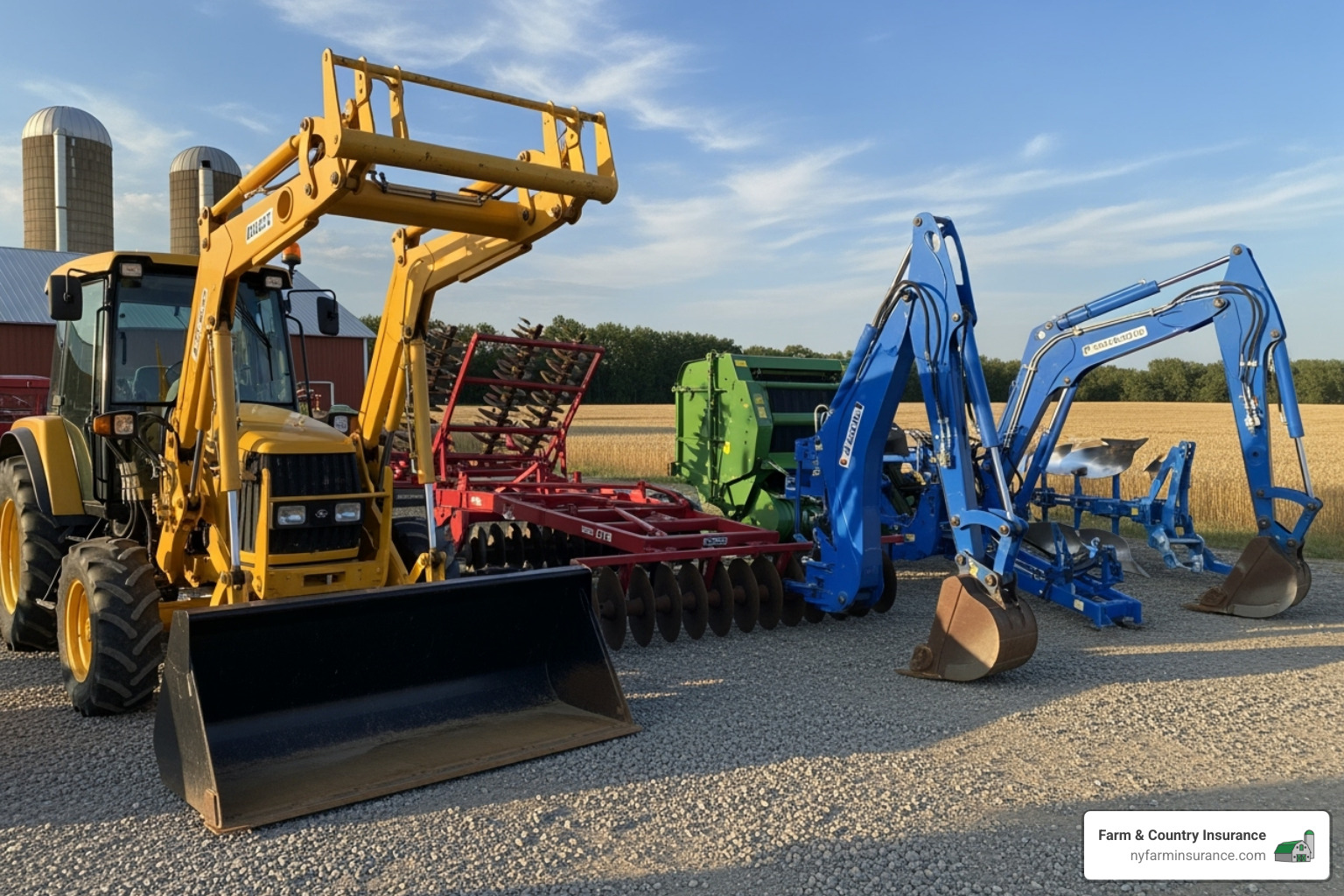
Think of farm tractor insurance cost as an investment in sleeping soundly at night. When you’re protecting a $50,000 piece of equipment that’s essential to your livelihood, you want coverage that actually works when you need it most.
At Farm & Country Insurance, we’ve been building custom policies for New York farmers since 1984. Whether you’re running a dairy operation in the Finger Lakes or growing vegetables near Syracuse, we understand that your tractor isn’t just machinery – it’s the heartbeat of your farm. That’s why we don’t believe in cookie-cutter policies.
Building the right policy is like assembling a good toolkit. You need the basics that every farmer requires, plus the specialized pieces that fit your unique operation. For a complete picture of how we protect all your farm vehicles, check out our guide on Insurance for Farm Vehicles.
Core Coverage Types Explained
Every solid tractor insurance policy starts with two main pillars: liability insurance and physical damage coverage. Think of liability as protecting everyone else, while physical damage protects your investment.
Liability insurance is your legal shield. When your tractor causes bodily injury to someone – maybe a hydraulic line fails and hurts a worker, or you’re involved in a road accident – this coverage handles medical bills and legal fees. The property damage portion kicks in when your tractor damages someone else’s fence, vehicle, or building. Trust me, those lawsuits can get expensive fast.
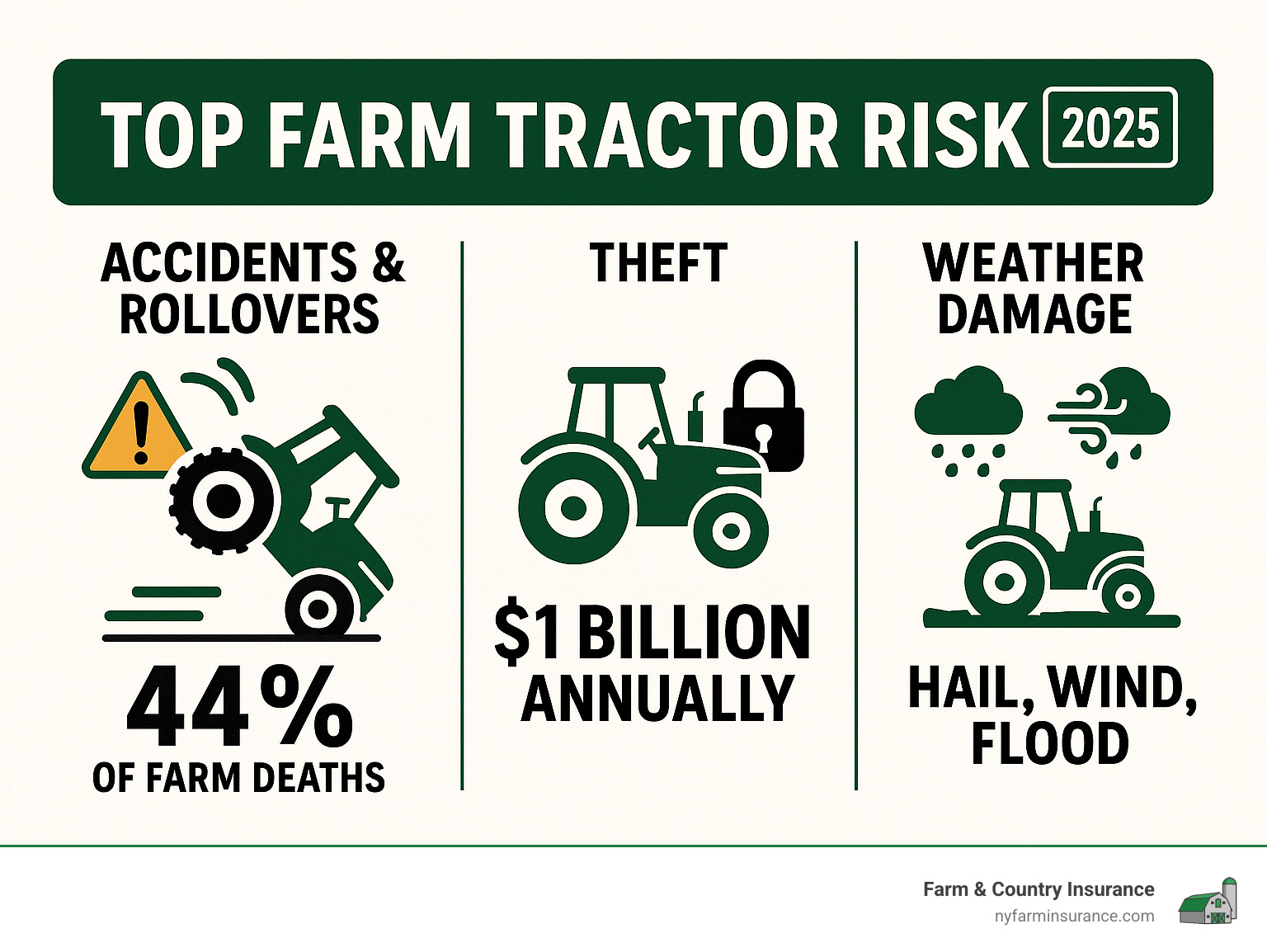
Physical damage coverage comes in two flavors. Comprehensive coverage is what I call the “everything else” protection – fire, theft, vandalism, hail, wind, and falling trees. Given that equipment theft costs farmers over $1 billion annually, this isn’t optional in my book. Collision coverage handles the damage when your tractor hits something or rolls over. Since tractor rollovers account for 44% of farm-related deaths, this coverage can literally be a lifesaver.
We also provide coverage for movable equipment beyond just your tractor. Your sprayer, planter, and other essential machinery need protection too. For more details on how liability fits into your overall farm protection, read our comprehensive guide on Farm Liability Insurance.
Specialized and Add-On Coverages
Here’s where we really customize your policy to fit like a well-worn pair of work boots. No two farms are identical, so your farm tractor insurance cost should reflect your specific needs.
Blanket coverage gives you one big umbrella limit for all your equipment. It’s perfect if you’re constantly buying, selling, or trading machinery. No need to call us every time you add a new piece – you’re automatically covered up to your limit.
Scheduled coverage is the opposite approach. We list each valuable piece individually with its own coverage amount. This works great for expensive attachments like that new backhoe or precision planter that cost as much as a small tractor.
Speaking of attachments and implements, don’t assume they’re automatically covered under your tractor policy. That loader, mower, or GPS unit can represent thousands of dollars of investment. We make sure they’re properly protected.
Loss of use coverage is a farm-saver during critical seasons. When your tractor breaks down during planting or harvest, this coverage helps replace lost income or pays for rental equipment. Rental reimbursement specifically covers the cost of that replacement tractor while yours is in the shop.
Medical payments coverage takes care of medical expenses when someone gets hurt on or around your tractor, regardless of who’s at fault. It’s especially valuable for family farms where kids and relatives are often helping out.
For a deeper dive into all these coverage options, visit our detailed page on Farm Equipment Insurance Coverage. We’ll help you build a policy that protects your operation without wasting money on coverage you don’t need.
The Real Farm Tractor Insurance Cost: What to Expect
Let’s talk numbers. When New York farmers ask me about farm tractor insurance cost, they want straight answers, not insurance-speak. After working with farming families across our state for decades, I can tell you that premium calculation doesn’t have to be a mystery, and understanding average costs helps you budget smartly for protecting your investment.
The reality is, there’s no magic number that fits every farm. Your farm tractor insurance cost depends on your specific situation. But I can give you the framework we use to help farmers understand what they’re looking at.
Breaking Down the Farm Tractor Insurance Cost
Here’s the rule of thumb that’s served our clients well: expect to pay about $5-$7 for every $1,000 of your tractor’s value each year. Let me show you how this works with a real example calculation.
Say you’ve got a $30,000 tractor. Using our rule, you’re looking at an annual premium range of $150-$210 for solid coverage. I’ve seen clients pay as little as $120 per year for a $30,000 replacement value policy, and others invest around $240 annually for comprehensive coverage that includes all their attachments.
Now, if you’re only looking at liability-only coverage, you might pay as low as $75 per year. But here’s where it gets interesting – full coverage that includes comprehensive and collision protection typically runs $250-$2,000+ annually, depending on your tractor’s value and the coverage limits you choose.
The difference between basic and comprehensive coverage is usually much smaller than the protection gap it creates. That’s why at Farm & Country Insurance, we focus on finding that sweet spot where your farm tractor insurance cost gives you real peace of mind without breaking your budget. For more insights on protecting your farm’s essential machinery, check out our guide to Agricultural Equipment Insurance.
Key Factors That Drive Your Farm Tractor Insurance Cost
Ever wonder why your neighbor’s premium is different from yours? It comes down to several key factors that insurers use to calculate risk.
Tractor value and age typically have the biggest impact on your premium. A shiny new $150,000 tractor costs more to insure than a well-maintained $25,000 compact model, simply because replacement costs are higher. But don’t assume older means cheaper – vintage tractors often need specialized “agreed value” policies that account for their collector appeal.
Horsepower matters more than you might think. That 300-horsepower beast in your barn carries more risk than a 75-horsepower compact tractor. More power means greater potential for damage and higher replacement costs.
How you use your tractor – hobby versus commercial farming – significantly affects your rates. A compact tractor that occasionally mows your hobby farm’s fields presents different risks than a commercial unit running 12-hour days during harvest season. The more intensive the usage, the higher the potential exposure.
Your New York farm location plays a role too. Some areas see more equipment theft or severe weather, which can nudge premiums up slightly. Having worked with farmers from the Finger Lakes to Western New York, we understand these local nuances and factor them into our recommendations.
Storage security can actually save you money. Keep your tractor in a locked barn versus an open field, and insurers notice. Add GPS tracking or engine immobilizers, and you might see rate reductions of 5-15%.
Your operator experience and claims history matter tremendously. A clean safety record with years of experience typically earns better rates. Frequent claims or accidents? Expect to pay more.
The deductible amount you choose directly impacts your premium. Jump from a $250 deductible to $500, and you typically save 15-25%. Go to $1,000, and savings can reach 30-40%. Just make sure you can comfortably handle that out-of-pocket expense if you need to file a claim.
Finally, your coverage limits – the maximum your policy pays for a covered loss – create a natural balance. Higher limits mean better protection but also higher premiums. We help you find the right balance between protecting your assets and managing your farm tractor insurance cost.
Common Questions and Misconceptions Debunked

After decades of helping New York farmers protect their operations, I’ve noticed the same questions come up time and again. There’s a lot of confusion out there about farm tractor insurance cost and what’s actually required versus what’s smart protection. Let me clear up the most common misconceptions I hear when farmers visit our office.
The truth is, insurance rules for farm equipment aren’t as straightforward as they are for your pickup truck. State laws, policy limits, and smart savings strategies all play a role in getting the right coverage at the right price. Let’s explore the questions that keep farmers up at night.
Is Farm Tractor Insurance Mandatory in New York?
Here’s where things get interesting – and a bit complicated. The short answer is “it depends,” which I know isn’t what you want to hear when you’re trying to budget for next year.
For on-property use, New York doesn’t require you to insure your tractor. If that machine never leaves your farm boundaries, there’s no state law forcing you to carry coverage. But here’s the thing – just because you’re not legally required to have it doesn’t mean you should skip it.
Public road use changes everything. The moment you drive that tractor onto a public road – even just to cross from one field to another or head to the equipment dealer – New York state law kicks in. You’ll need liability coverage, and operating without it can hit you with fines ranging from $500 to $5,000. I’ve seen farmers face license suspension, vehicle impoundment, and even criminal charges for operating uninsured equipment on public roads.
Lender requirements add another layer. If you’ve financed your tractor, your lender will absolutely require comprehensive and collision coverage until you pay off that loan. They’re protecting their investment, and you should too.
Even when it’s not mandatory, I strongly recommend carrying adequate protection. A single accident can easily result in claims exceeding $100,000, and medical expenses from tractor-related injuries often climb just as high. The farm tractor insurance cost is tiny compared to the financial devastation of being unprotected.
Can I Just Use My Homeowner’s Insurance?
This is probably the biggest misconception I encounter, and it’s one that can cost farmers everything. Your homeowner’s policy might throw you a bone with some limited equipment coverage, but relying on it for your farm tractor is like trying to hay in a thunderstorm – it might work, but you’re probably going to get soaked.
Horsepower caps are the first problem. Most homeowner’s policies draw the line at 25-30 horsepower. If you’re running anything bigger – which most commercial farming operations are – you’re looking at zero coverage. That 75-horsepower workhorse that cost you $45,000? Your homeowner’s policy won’t touch it.
On-property restrictions create another trap. Homeowner’s coverage typically only applies while your equipment sits on your insured property. Take that tractor across the road to help a neighbor, and you’re suddenly unprotected. I can’t tell you how many farmers have learned this lesson the hard way.
Commercial use exclusions are the final nail in the coffin. If you’re using your tractor for any business farming activities, your homeowner’s policy will almost certainly exclude coverage. These policies are designed for weekend warriors, not working farms.
The coverage gaps in homeowner’s policies are significant. They often don’t cover rollovers – a leading cause of farm fatalities. Plus, filing a claim on your homeowner’s policy can spike your rates by 10-35% for three years running. For comprehensive farm protection that actually works, check out our Farm Policy Insurance options.
How Can I Save Money on My Premiums?
Every farmer wants to know how to trim their farm tractor insurance cost without cutting corners on protection. The good news is there are plenty of smart strategies that insurance companies actually reward.
Bundling your policies with Farm & Country Insurance is usually the easiest way to save. When you combine your tractor coverage with your other farm, home, or auto policies, we regularly see farmers save 15-25%. It simplifies your life and opens up significant discounts.
Higher deductibles can slash your annual premiums if you can handle a larger out-of-pocket expense during a claim. Just make sure you choose an amount you can actually afford during a tight cash period.
Safety training courses do double duty – they make you a safer operator and often save you more money than the course costs. Many insurers offer meaningful discounts for completing recognized tractor safety programs.
Anti-theft devices like GPS tracking systems, engine immobilizers, or even just secure storage in a locked building can reduce your rates by 5-15%. Insurance companies love proactive loss prevention.
Good driving records pay off over time. A clean record free of accidents or violations demonstrates responsible operation and typically leads to lower premiums. Annual payment instead of monthly installments often comes with a discount too.
Regular policy reviews help ensure you’re not overpaying as your operation evolves. Seasonal adjustments can reduce premiums by 20-40% during inactive periods while maintaining essential coverage for theft and fire. We generally don’t recommend complete cancellation, as it leaves you exposed and can lead to higher rates when you need to reinstate coverage.
The key is finding that sweet spot between adequate protection and manageable costs – something we’ve been helping New York farmers achieve since 1984.
Frequently Asked Questions about Tractor Insurance
What’s the biggest risk tractor insurance protects against?
The biggest risk your tractor insurance shields you from isn’t just one thing – it’s devastating financial loss that can hit from multiple directions. When we talk about farm tractor insurance cost, we’re really talking about protecting yourself from losses that could be far more expensive than any premium you’ll ever pay.
Your tractor represents a massive investment, often $30,000 to $150,000 or more. If it’s stolen, destroyed by fire, damaged in a hailstorm, or totaled in a collision, you’re looking at replacement costs that can cripple a farm operation. But the financial risk goes even deeper than the machine itself.
Liability lawsuits are the silent killer that many farmers don’t see coming. If your tractor causes injury to someone else or damages their property, you could face medical expenses and legal fees that quickly climb past $100,000. We’ve worked with too many farming families across New York who learned this lesson the hard way.
Here’s a sobering fact: Tractor rollovers account for 44% of work-related deaths on farms. Beyond the tragic human cost, the financial aftermath of such accidents – including potential wrongful death lawsuits, medical expenses, and equipment replacement – can destroy a family farm. This is exactly why comprehensive coverage that includes both liability protection and collision coverage for rollovers isn’t optional – it’s essential.
The bottom line? Your insurance protects against the kind of high replacement costs and rollover accidents that can end farming operations overnight. It’s about keeping your farm running when life throws you a curveball.
Does insurance cover my tractor’s attachments too?
Yes, your attachments are absolutely covered – but only if you set up your policy correctly. Your loaders, backhoes, mowers, planters, and other implements often represent as much value as the tractor itself, sometimes more.
At Farm & Country Insurance, we make sure these crucial pieces are protected through two main approaches. Scheduled coverage works like creating an itemized list where each valuable attachment gets its own specific coverage limit. This is perfect for expensive implements like that new GPS-guided planter or heavy-duty loader. You get replacement value protection for each piece, so there’s no guesswork if something happens.
Blanket coverage takes a different approach, providing a single limit that covers all your farm equipment under one umbrella. This works well when you have multiple smaller attachments or a mixed collection of implements that would be tedious to list individually.
The key is making sure everything’s properly documented. We’ve seen farmers with perfectly insured tractors find their $15,000 loader wasn’t covered because it wasn’t specifically included in the policy. Don’t let that be you – we’ll walk through your entire setup to ensure every piece that makes your operation run is protected.
How is insuring a vintage tractor different from a new one?
Insuring your vintage tractor is like the difference between protecting a family heirloom and covering a work truck – they both matter, but for very different reasons. At Farm & Country Insurance, we understand that your restored 1950s Farmall needs different protection than your GPS-equipped modern machine.
The biggest difference comes down to how we determine value. New tractors get insured for replacement cost – basically what it would cost to buy an equivalent new model today. But vintage tractors follow actual cash value (ACV) or, better yet, agreed value policies.
With an agreed value policy, we work together before any claim happens to determine exactly what your classic equipment is worth. We consider its condition, rarity, restoration quality, and current market demand. If something happens, you get that agreed-upon amount – no arguments about depreciation or market fluctuations.
This matters because classic equipment often appreciates rather than depreciates. That perfectly maintained 1960s tractor might be worth more today than when it rolled off the assembly line. Standard depreciation schedules don’t account for this reality.
Parts availability also plays a role in coverage decisions. Vintage tractors might need specialized parts that are harder to find and more expensive to source. Professional appraisals become crucial for establishing proper coverage limits, especially for rare models or completely restored machines.
Whether you’re using that vintage tractor for light farm work, parades, or just keeping it as a piece of agricultural history, we’ll make sure it gets the specialized protection it deserves.
Securing the Right Protection for Your Farm’s Workhorse
Your farm tractor represents so much more than steel, hydraulics, and horsepower. It’s the heartbeat of your operation, a crucial investment that keeps your livelihood moving forward, and an essential partner in your business continuity. Understanding farm tractor insurance cost and navigating the coverage landscape isn’t just about finding the lowest premium – it’s about making a smart investment that protects your farm’s future.
Throughout this guide, we’ve covered the key points that matter most to New York farmers. We’ve explored why proper tractor insurance is absolutely vital, walked through the various coverage options from basic liability to comprehensive protection, and given you realistic expectations about what you’ll pay. We’ve also cleared up those persistent misconceptions about relying on homeowner’s policies and shown you practical ways to manage costs without sacrificing protection.
The peace of mind that comes with proper coverage is invaluable. When severe weather rolls across Central New York or when unexpected accidents happen, you’ll rest easier knowing your operation can bounce back. That farm tractor insurance cost becomes an investment in your farm’s resilience and your family’s financial security.
At Farm & Country Insurance, we’ve been partners with New York’s agricultural community since 1984. We’re not just insurance agents who happen to work with farms – we’re specialists who understand the unique challenges facing dairy operations in Cayuga County, grain farmers throughout the Finger Lakes region, and agribusinesses from Auburn to beyond. Our deep agricultural expertise means we know the difference between a manure spreader and a seed drill, and we understand why your vintage Farmall needs different coverage than your GPS-equipped modern tractor.
We’ve seen how the right coverage protects families when disaster strikes, and we’ve watched farmers avoid financial ruin because they made smart insurance decisions. That’s why we’re committed to providing custom solutions that actually work when you need them most.
Don’t leave your farm’s workhorse exposed to unnecessary risks. The cost of being underinsured far exceeds the investment in proper protection. Let Farm & Country Insurance help you steer these important decisions so you can focus on what you do best – growing your operation and feeding our communities.
Ready to secure real protection for your farm’s backbone? Contact Farm & Country Insurance today and find how our New York agriculture expertise translates into coverage that delivers when it matters most. Get a quote for your Farm Equipment Insurance and take the first step toward complete peace of mind.