
Protecting Your Farm’s Mobile Assets
Farmers commercial truck insurance is specialized coverage designed to protect agricultural vehicles used for business operations on and off the farm. Whether you’re hauling livestock, transporting crops to market, or moving equipment between fields, having the right insurance is essential for your operation’s financial security.
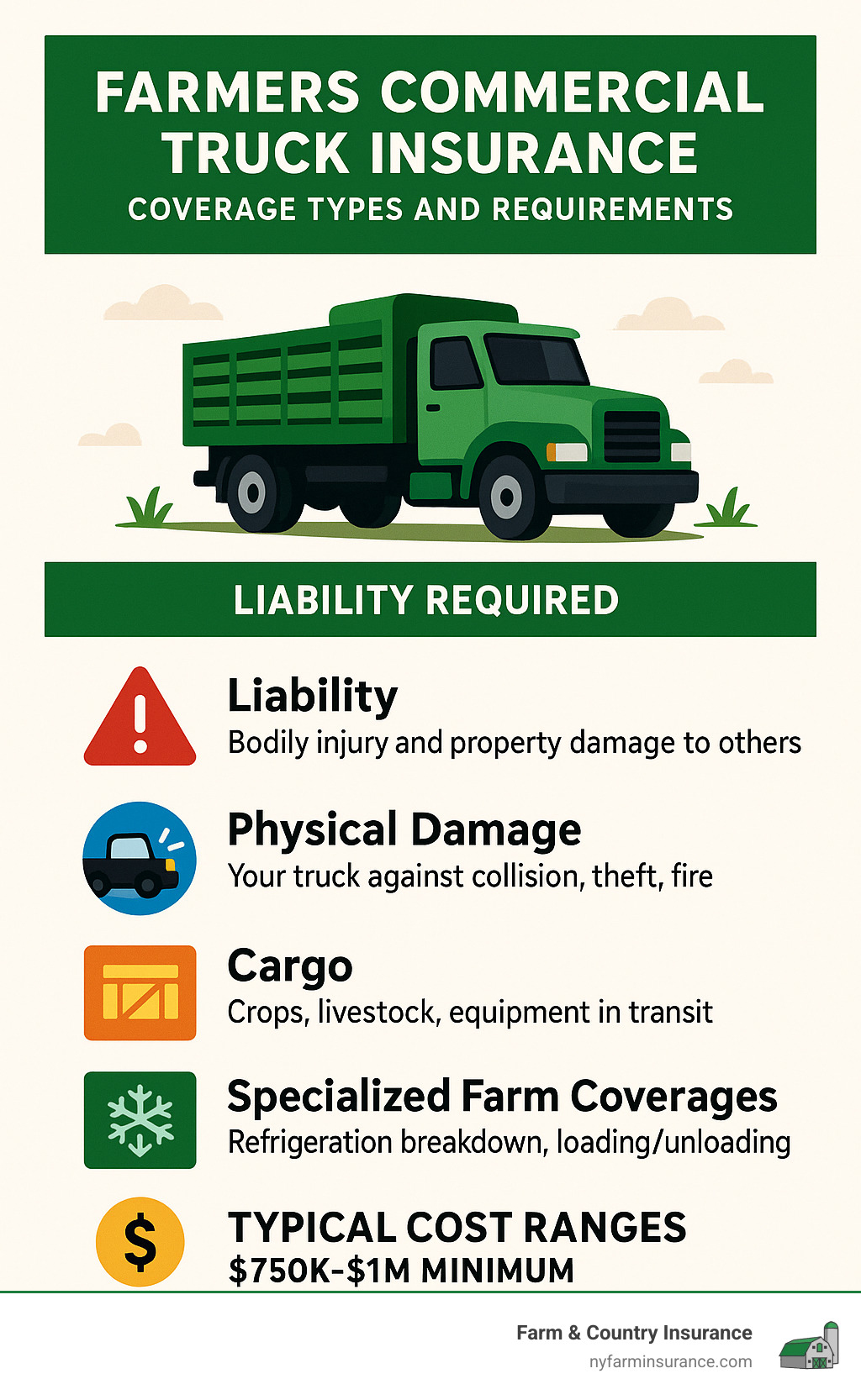
Quick Answer: Farmers Commercial Truck Insurance Basics
| Coverage Type | What It Protects | Typical Cost Range |
|---|---|---|
| Liability | Bodily injury and property damage to others | $750,000-$1M minimum recommended |
| Physical Damage | Your truck against collision, theft, fire | Based on vehicle value |
| Cargo | Crops, livestock, equipment in transit | $25,000-$100,000+ |
| Specialized Farm Coverages | Refrigeration breakdown, loading/unloading | Additional endorsements |
Farm trucks face unique risks that personal auto policies simply don’t cover. When your livelihood depends on these vehicles, proper commercial coverage becomes not just a regulatory requirement but a business necessity.
For many farmers, finding the right balance between comprehensive protection and affordable premiums can be challenging. The good news is that insurance providers like Farm & Country Insurance specialize in agricultural operations and understand the seasonal nature of farm transportation needs.
“Your farm truck is essential to daily operations—hauling supplies, towing livestock, or selling produce—so proper insurance safeguards your business from loss or liability.”
I’m Casey Love, owner of NY Farm Insurance Company and an expert in farmers commercial truck insurance with over 15 years of experience helping agricultural operations protect their mobile assets. Having grown up in a farming community, I understand the unique challenges farmers face when insuring their commercial vehicles.
Farmers commercial truck insurance terminology:
– do farm trucks need insurance
– farm truck insurance

What Is Farmers Commercial Truck Insurance?
Farmers commercial truck insurance is the agriculture world’s answer to the unique vehicle risks that farms face every day. It’s not just regular auto insurance with a different name—it’s a specialized shield designed to protect the trucks and vehicles that keep your farm running, whether they’re hauling your prized cattle to auction, delivering fresh produce to market, or moving equipment between your fields.
When your livelihood depends on these vehicles, personal auto insurance simply falls short. Your family sedan and your grain truck live in two different worlds, and their insurance needs to reflect that reality.
The stakes are high for agricultural transportation. In 2021 alone, over 500,000 large truck accidents occurred across the United States. For farm operations that depend on their trucks, proper coverage isn’t just a good idea—it’s essential protection for your business’s survival.
How farmers commercial truck insurance protects ag operations
At its heart, farmers commercial truck insurance wraps your agricultural vehicles in layers of protection that ordinary policies don’t provide.
Think of liability coverage as your first line of defense, protecting you if one of your farm trucks causes injury or property damage to others. Without adequate coverage, one serious accident could put your entire operation at financial risk.
Physical damage coverage steps in when your own vehicles take a hit, covering repairs or replacement after accidents, theft, or other covered events. For many farmers, their trucks represent significant investments that need proper protection.
Cargo coverage—often overlooked but critically important—protects what you’re hauling, whether it’s this season’s harvest, livestock headed to market, or expensive equipment. And when your vehicle is out of commission, business interruption coverage helps keep your farm financially afloat during repairs.
For New York farmers, these protections are especially crucial given our challenging weather conditions and the seasonal intensity of agricultural work. Farm & Country Insurance understands these regional challenges and builds policies with these realities in mind.
The Federal Motor Carrier Safety Administration doesn’t leave these matters to chance—they mandate minimum liability coverage for commercial vehicles. For most agricultural operations, this minimum sits at $750,000, though many prudent farm operators opt for higher limits to sleep better at night.
Personal vs. Commercial vs. Farm-Use Policies
Understanding the differences between these policy types can save you from costly coverage gaps:
Your personal auto policy is designed for your family car, not your farm truck. It typically excludes business use, offers no protection for transported goods, won’t cover employees driving your vehicles, and carries lower liability limits than a farm operation needs.
A standard commercial auto policy addresses business use with higher liability limits and employee driver coverage, but it often lacks understanding of farming’s unique seasonal patterns and specialized risks.
A proper farm-use policy offers the best of both worlds—it provides the robust coverage of commercial insurance while understanding agricultural realities like seasonal usage patterns and farm-specific risks like livestock transport or crop hauling, often at more competitive rates.
I’ve seen the consequences of coverage confusion firsthand. One Farm & Country Insurance client learned the hard way after his claim was denied: “I thought my personal policy would cover my pickup since I sometimes use it for personal errands. I was shocked when they denied my claim after an accident while hauling feed.”
For the many farmers whose trucks pull double-duty for both personal and farm purposes, there’s good news. A properly structured farmers commercial truck insurance policy can address both uses, eliminating dangerous coverage gaps while avoiding the expense of duplicate premiums.
The right insurance isn’t just about compliance—it’s about protecting the vehicles that keep your farm moving forward through every season.
Vehicles and Operations Covered on the Farm
Farm operations use a wide variety of vehicles, each with specific insurance needs. Farmers commercial truck insurance can cover virtually any vehicle used in agricultural operations, including:
- Pickup trucks: Used for general farm tasks, hauling small equipment, and transportation
- Grain haulers: Specialized trucks for transporting harvested crops to market or storage
- Livestock trailers: For safely moving animals between pastures or to market
- Flatbed trucks: Used for hauling equipment, hay bales, and other large items
- Refrigerated vehicles: For transporting perishable products
- Utility vehicles: Service-body trucks used for maintenance and repairs
- Semi-trucks and trailers: For larger operations that transport goods over longer distances
Each of these vehicle types presents unique risk profiles that must be addressed in a comprehensive farmers commercial truck insurance policy. For example, livestock trailers require specialized coverage for the animals being transported, while refrigerated vehicles need protection against mechanical breakdown that could lead to spoilage.
Farm & Country Insurance has extensive experience insuring the full spectrum of farm vehicles used throughout New York’s diverse agricultural regions, from the dairy farms of Cayuga County to the fruit and vegetable operations in the Finger Lakes region.
Eligibility Checklist for farmers commercial truck insurance
To determine if your vehicles require farmers commercial truck insurance, consider these factors:
- Vehicle ownership: Is the vehicle owned by the farm business or an individual?
- Primary use: Is the vehicle used primarily for farm operations?
- Gross vehicle weight rating (GVWR): Vehicles over 10,000 pounds typically require commercial insurance
- Interstate commerce: Do you transport goods across state lines?
- Distance traveled: Local use vs. long-distance hauling
- Type of cargo: Livestock, crops, hazardous materials (fertilizers, pesticides)
- Driver status: Owner, family member, or hired employee
Vehicles that meet these criteria generally require proper commercial coverage rather than personal auto insurance. Additionally, if you hire non-owned vehicles or if employees use their personal vehicles for farm business, you’ll need hired and non-owned auto coverage.
As one Farm & Country Insurance client noted, “We never realized our standard policy didn’t cover employees using their own trucks for farm errands until our agent reviewed our coverage. That small addition to our policy saved us from a potentially devastating claim when an employee had an accident while picking up parts.”
For more detailed information about specific coverage needs for your farm vehicles, visit our Farm Truck Insurance resource page.
Costs, Discounts & Smart Savings
When it comes to farmers commercial truck insurance, understanding what drives your premium costs can help you make smarter coverage decisions. Farm operations face unique challenges with their commercial vehicles, and knowing how to manage these costs is crucial to maintaining profitability.
The price of your farm truck insurance isn’t pulled from thin air—it’s calculated based on several key factors that reflect your operation’s risk profile. Think of your premium as a reflection of your farm’s transportation footprint and safety record.
Typical Price Ranges & What Drives Them
Most farms can expect to pay between $1,200 and $2,400 per truck annually for commercial coverage, though this range can vary significantly based on several factors. At Farm & Country Insurance, we’ve seen premiums both lower and higher depending on the specific circumstances of each agricultural operation.
Your premium is influenced by:
Vehicle type and value – A new $85,000 diesel pickup costs more to insure than an older farm truck simply because replacement costs are higher. Similarly, specialized vehicles like refrigerated trucks or livestock haulers typically command higher premiums due to their increased value and specialized components.
Coverage limits and deductibles – Opting for higher liability limits provides better protection but increases your premium. Similarly, choosing a $500 deductible instead of $1,000 will raise your rates but reduce your out-of-pocket expenses after a claim.
Territory and operating radius – Farms that transport goods across state lines face different regulatory requirements and risk exposures than those operating locally. Your location matters too—rural farm areas typically have lower premiums than urban zones with higher traffic density and accident rates.
Driver experience and records – Experienced farm drivers with clean MVRs (Motor Vehicle Records) can significantly reduce your insurance costs. One speeding ticket might not hurt much, but multiple violations or a serious offense like DUI can dramatically increase premiums.
| Profile Factor | Lower Premium | Higher Premium |
|---|---|---|
| Driver History | Clean records, experienced | Multiple violations, young drivers |
| Vehicle Type | Standard farm pickup | Specialized equipment, newer models |
| Coverage Limits | State minimums | $1M+ liability coverage |
| Operating Radius | Local only (0-50 miles) | Interstate operations (300+ miles) |
| Claims History | No recent claims | Multiple recent claims |
As one Farm & Country Insurance client from Seneca County shared: “After working with my agent to understand what was driving our costs, we implemented a simple driver safety program and saw our renewal premium drop by nearly 15% the following year.”
12 Proven Ways to Lower Your Bill
Smart farmers know that insurance isn’t just an expense—it’s a risk management tool that should be optimized. Here are practical ways to reduce your farmers commercial truck insurance costs without sacrificing important coverage:
Bundle your policies with the same carrier to earn multi-policy discounts. Combining your farm property, liability, and commercial auto coverage with Farm & Country Insurance often results in savings of 10-15%.
Implement safety programs for anyone who drives your farm vehicles. Documented safety training not only reduces accidents but can qualify you for premium discounts.
Pay your premium in full rather than monthly to avoid installment fees. Many carriers offer discounts of 5-7% for annual payments.
Consider usage-based insurance options like Progressive’s Snapshot ProView, which uses telematics to monitor driving habits and reward safe driving with lower premiums.
Increase your deductibles if you have the financial reserves to handle a larger out-of-pocket expense after a claim. Moving from a $500 to $1,000 deductible can save 10-15% on physical damage premiums.
Review your coverage limits annually to ensure they align with your current needs. Don’t overinsure older vehicles with comprehensive and collision if their value has significantly depreciated.
Ask about farm-specific discounts for seasonal vehicles that aren’t used year-round. Many insurers offer reduced rates for vehicles that are only used during planting or harvest seasons.
Maintain good credit, as most insurers use credit-based insurance scores as a rating factor. Paying bills on time and reducing debt can improve your insurance score over time.
Install anti-theft devices and GPS tracking systems in your farm vehicles. These not only help recover stolen equipment but can qualify for security discounts.
Request loss runs from your current insurer before shopping around. A clean claims history can be leveraged for better rates with a new carrier.
Consider group discounts through farm bureaus or agricultural associations, which often negotiate preferred rates for members.
Schedule an annual review with your Farm & Country Insurance agent to identify new discount opportunities and ensure your coverage still matches your operation’s needs.
“We saved nearly $3,000 last year after implementing just a few of these strategies,” notes a Farm & Country Insurance client from Wyoming County. “Our agent walked us through each option and helped us understand which would have the biggest impact for our specific operation.”
By being proactive about managing your insurance costs, you can maintain comprehensive protection for your farm vehicles while keeping premiums affordable. At Farm & Country Insurance, we’re committed to helping New York farmers find that perfect balance between protection and price.
Costs, Discounts & Smart Savings
When it comes to protecting your farm vehicles, finding that sweet spot between robust coverage and manageable costs is like finding the perfect planting window – timing matters. Farmers commercial truck insurance doesn’t have to break the bank if you know what drives costs and how to trim them without sacrificing protection.
Typical Price Ranges & What Drives Them
Most farm operations can expect to pay between $1,200 and $2,400 annually per truck for commercial coverage. The good news? Agricultural vehicles often qualify for more favorable rates than standard commercial trucks thanks to their typically seasonal use and lower annual mileage.
I’ve worked with hundreds of New York farmers who were initially shocked by commercial insurance quotes until we helped them understand what factors were driving their premiums.
Your costs will largely depend on a unique mix of risk factors that insurers evaluate:
| Factor | Lower Risk (Lower Premium) | Higher Risk (Higher Premium) |
|---|---|---|
| Driver Experience | Experienced farm operators with clean records | New or young drivers with violations |
| Vehicle Type | Standard farm pickup trucks | Heavy-duty trucks, specialized equipment |
| Coverage Limits | Statutory minimums | High liability limits with low deductibles |
| Territory/Location | Rural farm areas | Urban delivery routes |
| Cargo Type | Standard crops | Livestock, refrigerated goods, hazardous materials |
| Claims History | Clean record | Recent or frequent claims |
| Annual Mileage | Local farm use only | Long-distance hauling |
One of our clients in Tompkins County was pleasantly surprised when we explained how their operation’s characteristics affected their rates: “I thought all commercial truck insurance was expensive, but Farm & Country Insurance showed me how our seasonal use pattern and rural-only routes qualified us for significantly lower premiums.”
12 Proven Ways to Lower Your Bill
Smart farmers know that insurance isn’t just another bill – it’s protection for your livelihood. Here are battle-tested strategies that have helped our farm clients save without compromising coverage:
Bundle and save. Combining your farmers commercial truck insurance with farm property, liability, and other coverages typically saves 10-15%. It’s like buying seed in bulk – the more you commit, the better the price.
Accept safety programs. Documented driver training and regular safety meetings aren’t just good practice – they can translate directly to premium reductions. One dairy farm client reduced their rates by 12% after implementing and documenting a formal driver safety program.
Consider higher deductibles. Just like deciding how much risk to take with early planting, choosing a $1,000 deductible instead of $500 can trim 10-20% off your premium. Just be sure you have the cash reserves to cover that deductible if needed.
Pay in full when possible. Many farmers find that paying annually instead of monthly saves 5-10% – that’s like getting almost a month free.
Use your farm memberships. Organizations like Farm Bureau often provide member discounts that can make a meaningful difference in your insurance costs.
Keep those driving records clean. Nothing drives up premiums faster than accidents and violations. At Farm & Country Insurance, we’ve seen premiums double after serious infractions.
Look into usage-based options. Programs like Snapshot ProView use telematics to monitor actual driving habits and can reward safe operators with substantial savings.
Right-size your fleet coverage. That silage truck that only runs during harvest? Consider seasonal coverage rather than year-round protection.
Security pays off. GPS tracking and anti-theft devices often qualify for discounts while providing peace of mind.
Review vehicle values annually. That 2010 farm truck probably doesn’t need the same physical damage coverage limits it did five years ago. Regular value adjustments prevent overpaying.
Maintain solid credit. Like it or not, many insurers use credit-based insurance scores as a rating factor. Keeping your farm’s finances in good order can pay off in lower premiums.
Request loss runs and review regularly. Your claims history follows you, so knowing what insurers see is important. Annual reviews with your agent can identify new saving opportunities as your operation evolves.
A vegetable farmer from Cayuga County shared: “Farm & Country Insurance noticed we were primarily using our delivery trucks on farm property rather than highways. That simple distinction saved us nearly 15% while keeping all the coverage we needed.”
The best part about working with an agency that truly understands agriculture? They know which questions to ask to uncover these savings opportunities. General insurance agents often miss these farm-specific details that can make a significant difference in your premium.
Filing Claims & Keeping the Wheels Turning
When accidents happen, the claims process can make all the difference between a minor interruption and a major disruption to your farm operations. Farmers commercial truck insurance should not only provide financial protection but also a smooth, efficient claims experience.

Farm & Country Insurance understands that time is critical in agricultural operations. When your truck sits idle during planting, harvest, or market season, every hour counts against your bottom line. That’s why we’ve developed a streamlined claims process specifically designed for farm operations – because we know the difference between city time and farm time.
Step-by-Step Claim Roadmap
Should you ever need to file a claim on your farmers commercial truck insurance policy, here’s your roadmap to getting back on the field as quickly as possible:
At the accident scene, safety comes first – check for injuries and call for medical help if needed. Once everyone’s safe, exchange information with other parties, snap plenty of photos (damage, road conditions, signage), and collect contact details from any witnesses. For significant accidents, always file a police report – it’ll save headaches later.
Next, give Farm & Country Insurance a call on our 24/7 claims hotline. One of our farm-savvy representatives will collect your policy information and accident details, then guide you through immediate next steps. We know that in farming, timing is everything, so we don’t waste yours with unnecessary paperwork.
Documentation might seem tedious, but it’s your best friend during a claim. Complete claim forms thoroughly, submit all those photos you took, and if mechanical failure was involved, having maintenance records handy can speed things up considerably. For cargo claims – whether it’s livestock, produce, or equipment – include inventory documentation and proof of value.
Within 24-48 hours, an adjuster familiar with agricultural equipment will assess the damage. Unlike general insurance adjusters, ours know the difference between a combine and a cultivator, and they understand what farm equipment is worth beyond book value.
When it comes to repairs, you can choose from our network of repair shops that actually understand farm equipment. We’ll also discuss rental options to keep your operation running – because we know that during harvest, a truck sitting in the shop might as well be a hole in your pocket.
As one Farm & Country Insurance client from Brutus told us after filing a claim: “When our delivery truck was damaged during harvest, I was worried about getting crops to market. Not only did they process our claim quickly, but they also helped arrange a temporary rental that kept our deliveries on schedule. That level of understanding about farm operations makes all the difference.”
For settlement and resolution, we’ll walk you through any offers, explain deductibles and depreciation in plain English, and discuss how the claim might affect your premium. If another party was at fault, our subrogation team will pursue recovery – potentially getting your deductible reimbursed and keeping your rates stable.
Farm & Country Insurance offers several features that make the claims process particularly smooth for agricultural operations:
Our mobile claims app lets you submit claims and photos directly from the field – no need to drive to town. We work with farm equipment specialists who understand the true value of agricultural vehicles, not just their bluebook price. Our relationships with farm equipment suppliers help expedite parts sourcing, and we prioritize claims during critical harvest seasons. Perhaps most importantly, we focus on downtime mitigation, helping you find rental equipment to maintain operations when your vehicles are being repaired.
We understand that in farming, timing is everything – a broken-down truck during harvest isn’t just an inconvenience, it’s a potential financial disaster. That’s why our claims process is designed not just to fix your vehicle, but to keep your operation moving forward without missing a beat.
Choosing a Provider & Staying Compliant
Finding the right insurance company for your farmers commercial truck insurance is just as crucial as selecting appropriate coverage limits. The best insurance partner understands the unique rhythm of farm life, has solid financial backing, and provides excellent service when you need it most.
Farm & Country Insurance has specialized in agricultural insurance since 1984, giving us a deep understanding of the unique challenges New York farmers face. We know that farming doesn’t follow a 9-to-5 schedule, and neither should your insurance support.
“When we had a truck accident during harvest, our agent answered our call at 8 PM and had an adjuster out the next morning,” shares a dairy farmer from Tompkins County. “That kind of responsiveness makes all the difference when you’re racing against weather and time.”
Due-Diligence Checklist Before You Sign
Before committing to any farmers commercial truck insurance policy, take time to evaluate potential providers thoroughly. The right insurer becomes a partner in protecting your operation, not just a vendor selling a policy.
Look for financial strength by checking the company’s AM Best rating (aim for A or better). This rating reflects an insurer’s ability to pay claims even during major catastrophes or economic downturns. During the challenging farm economy of 2019-2020, Farm & Country Insurance maintained its claims-paying ability without interruption.
Agricultural expertise matters tremendously. Does your agent know the difference between a grain truck and a silage wagon? Can they discuss the unique risks of livestock transport? At Farm & Country Insurance, our agents grow up in farming communities and understand the seasonal patterns of agricultural transportation.
Policy customization should be standard, not an exception. Your operation is unique, and your coverage should reflect that. We offer specialized endorsements for everything from refrigerated cargo breakdown to custom harvesting operations.
Claims service quality becomes apparent only when you need it most. Ask about claims satisfaction ratings and whether adjusters understand agricultural vehicles. Our claims team includes former equipment operators who can accurately assess farm vehicle damage.
Loss control services add significant value beyond the policy itself. Farm & Country Insurance offers farm safety programs, driver training resources, and risk assessment visits to help prevent claims before they happen.
Regulatory compliance assistance is increasingly important as transportation rules become more complex. We help with DOT filings, certificates of insurance, and staying current with Federal Motor Carrier Insurance requirements so you can focus on farming, not paperwork.
Carefully review policy language and exclusions before signing. Are seasonal use limitations clearly explained? Are there exclusions that might affect your specific operation? Our agents take time to review these details in plain language.
Customer support quality varies dramatically between insurers. At Farm & Country Insurance, we maintain local offices throughout New York’s agricultural regions, offering personalized service while also providing modern digital tools for policy management.
The renewal process also reveals much about an insurer’s commitment to farmers. Do they review your coverage annually to account for equipment changes and operational shifts? Our annual policy reviews have helped countless farm operations avoid coverage gaps as their businesses evolved.
“What impressed me most was how our agent anticipated needs I hadn’t even considered,” explains a crop farmer from Seneca County. “When we added a refrigerated truck for our new farm market deliveries, they immediately suggested specialized breakdown coverage I wouldn’t have known to ask for.”
For more comprehensive information about protecting your entire operation beyond vehicles, visit our detailed Farm Liability Insurance resource page.
When you choose Farm & Country Insurance for your farmers commercial truck insurance, you’re partnering with a company that has protected New York’s agricultural community through drought years, market downturns, and changing regulations for nearly four decades. We understand that your trucks aren’t just vehicles—they’re essential links in your farm’s success.
Frequently Asked Questions about Farmers Commercial Truck Insurance
Do farm trucks really need commercial insurance?
Yes, farm trucks typically need commercial insurance when they’re used for business purposes. While some personal auto policies might offer limited coverage for occasional farm use, any regular business activities—like hauling crops to market, transporting livestock, or moving equipment between properties—generally require commercial coverage.
The risks of inadequate coverage are substantial and potentially devastating to your farm operation. Personal auto policies typically exclude business-related liability claims, coverage for employees driving the vehicle, protection for cargo or equipment being transported, and the higher liability limits needed for commercial operations.
I remember one Farm & Country Insurance client who learned this lesson the hard way: “I thought my personal policy would cover my farm truck since it was just a pickup. After a significant accident while hauling produce to the farmers market, I finded my personal policy excluded business use. The $20,000 in damages came straight from my pocket.”
For farm operations in New York, farmers commercial truck insurance isn’t just a recommendation—it’s essential protection for your livelihood and the future of your farm.
What are the minimum coverage limits for my state?
In New York State, commercial vehicles must carry minimum liability limits of $25,000 for bodily injury per person, $50,000 for bodily injury per accident, and $10,000 for property damage. But let’s be honest—these minimums are rarely sufficient for actual farm operations.
The Federal Motor Carrier Safety Administration (FMCSA) sets higher requirements for interstate commerce: $750,000 for general freight, $1,000,000 for hazardous materials (including many agricultural chemicals), and $5,000,000 for certain hazardous substances.
At Farm & Country Insurance, we typically recommend much higher limits than these minimums. For most agricultural operations in New York, we suggest at least $1,000,000 in combined single limit liability, matching umbrella coverage of $1-5 million depending on your operation’s size, and cargo coverage appropriate to the highest value load you typically transport.
These higher limits provide crucial protection against today’s escalating medical costs and legal settlements, which can quickly exceed minimum requirements and threaten the financial stability of your farm.
Can I insure both personal and farm use on one policy?
Yes, dual-use vehicles can be insured on a single policy, but it needs to be a commercial policy with appropriate endorsements. Many farmers use their trucks for both personal transportation and farm business—taking the kids to school in the morning and hauling feed bags in the afternoon—and the right farmers commercial truck insurance policy can accommodate this reality.
When insuring dual-use vehicles, be upfront about all vehicle uses when applying for coverage. Your policy will likely be rated primarily based on the commercial exposure, but a good agent will consider how much of the vehicle’s use is personal versus business. Just make sure all regular drivers are listed on the policy to avoid coverage gaps.
Farm & Country Insurance specializes in creating flexible policies that address the real-world needs of farmers who don’t always maintain separate personal and business vehicles. Our agents understand farm life and can help structure coverage that eliminates gaps while avoiding unnecessary duplication.
As one client from Ledyard explained: “My pickup serves double duty—taking kids to school and hauling feed bags. Farm & Country Insurance created a single policy that covers both uses completely, which is simpler and more affordable than maintaining separate policies.”
With the right farmers commercial truck insurance policy, you can have the peace of mind knowing you’re covered whether you’re on a farm errand or a family outing.
Conclusion
Navigating farmers commercial truck insurance doesn’t have to be overwhelming. With the right partner like Farm & Country Insurance, you can secure comprehensive protection that addresses your operation’s unique needs while keeping costs manageable.
Throughout this guide, we’ve explored the essential aspects of commercial truck insurance for agricultural operations:
The fundamental difference between personal and commercial coverage is more than just paperwork—it’s about having the right protection when you need it most. Whether you’re hauling livestock to market or transporting equipment between fields, the proper insurance can mean the difference between a minor setback and a financial disaster.
We’ve seen how a wide range of farm vehicles require specialized protection. From your everyday pickup truck to specialized grain haulers and refrigerated vehicles, each plays a vital role in your operation and deserves coverage custom to its unique risks.
The essential coverages we’ve discussed—from basic liability to specialized endorsements for livestock and refrigeration breakdown—form a safety net that protects not just your vehicles but your entire operation. As one client told us, “It’s not just about the truck; it’s about everything that truck makes possible on my farm.”
With smart strategies to control costs without compromising protection, like bundling policies and implementing safety programs, you can keep premiums affordable while maintaining comprehensive coverage. Many Farm & Country Insurance clients have saved 10-15% through these approaches alone.
When accidents happen, the importance of a smooth, efficient claims process becomes crystal clear. Our farm-focused claims team understands that during harvest season, every hour counts—which is why we prioritize getting your vehicles back in operation as quickly as possible.
Since 1984, Farm & Country Insurance has been protecting agricultural operations throughout New York, from small family farms to large commercial enterprises. Our deep understanding of farming operations in Cayuga County and surrounding areas allows us to create truly custom insurance solutions that fit your specific needs.
Your farm vehicles are more than just transportation—they’re essential business assets that keep your operation moving forward. Proper insurance protection isn’t just about meeting legal requirements; it’s about safeguarding your livelihood against unexpected setbacks.
We invite you to contact Farm & Country Insurance today for a personalized review of your current coverage. Our agents are ready to help identify potential gaps, find savings opportunities, and ensure your farm vehicles have the protection they deserve.
For more comprehensive information about protecting all aspects of your farm operation, visit our resource page on Insurance for Farm Vehicles.