
Understanding Flood Risk in New York State
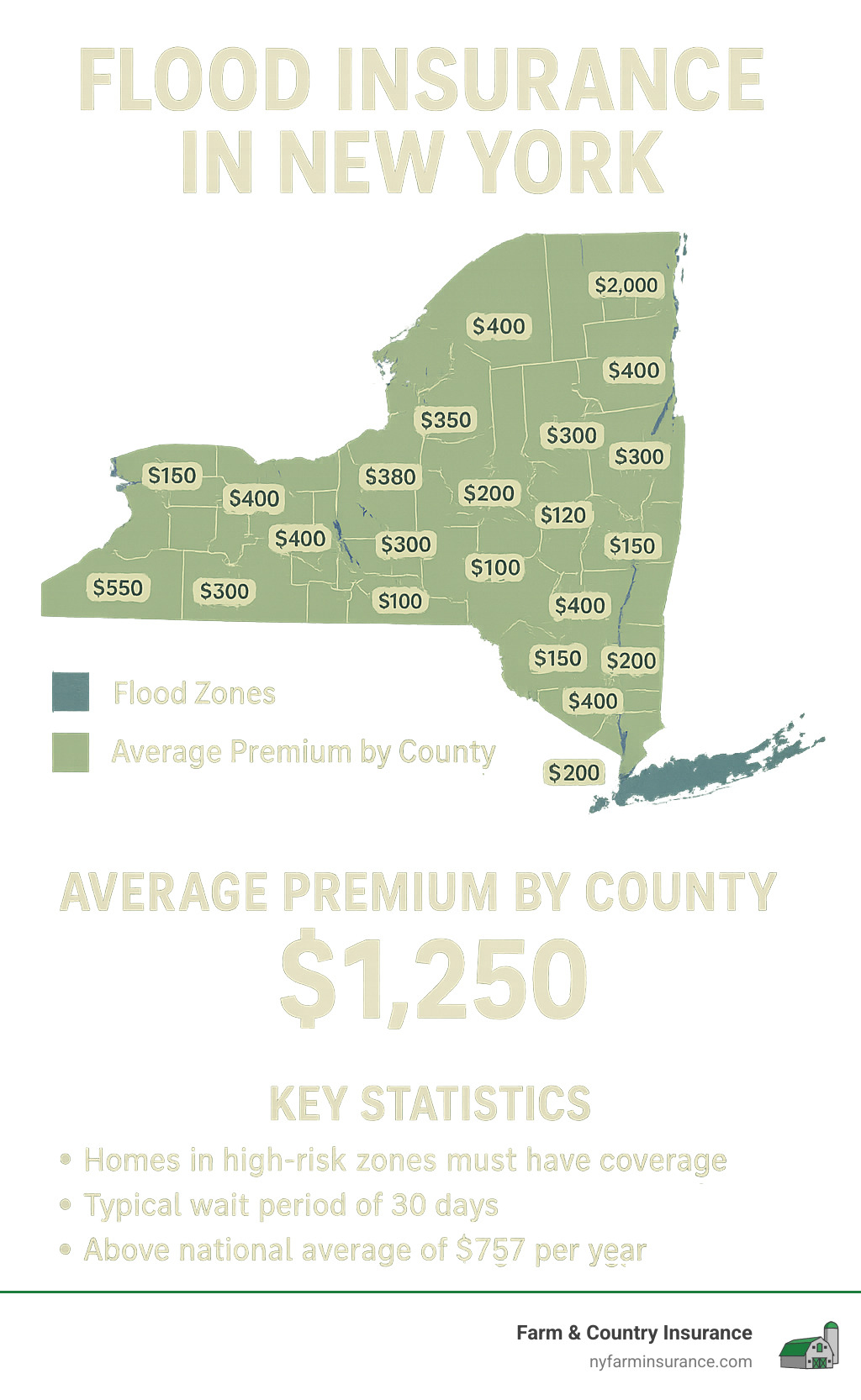
Flood insurance in New York is a critical protection that many homeowners overlook until it’s too late. Here’s what you need to know:
| Key Flood Insurance Facts for NY Homeowners |
|---|
| Average Cost: $1,250 per year (higher than national average of $767) |
| Required For: Homes in high-risk zones with federally-backed mortgages |
| Wait Period: Typically 30 days before coverage takes effect |
| Coverage Limits: Up to $250,000 for structure, $100,000 for contents |
| Not Covered By: Standard homeowners insurance policies |
When it comes to protecting your property in the Empire State, understanding flood insurance isn’t optional—it’s essential. While many New Yorkers believe flooding only affects coastal areas, the reality is sobering: 99% of counties across the United States experienced flooding between 1996 and 2019, including inland areas throughout New York.
Even more alarming, just one inch of floodwater can cause up to $25,000 in damage to your home. Standard homeowners insurance policies explicitly exclude flood damage, leaving you financially vulnerable without specific flood coverage.
New York’s diverse landscape creates multiple flood risks—from coastal storm surges to river overflows, from rapid snowmelt to urban drainage issues. With climate change intensifying weather patterns, even properties outside traditional flood zones face increasing risk.
I’m Casey Love, owner of Farm & Country Insurance, with extensive experience helping New York homeowners steer the complexities of flood insurance in New York specifically for rural and agricultural properties. My background in assessing flood risk across various NY regions allows me to provide custom protection strategies for your unique property needs.
Why Flood Insurance Matters in New York
When we talk about floods in insurance terms, it’s not just any water damage. The National Flood Insurance Program (NFIP) specifically defines a flood as “a general and temporary condition of partial or complete inundation of two or more acres of normally dry land area or of two or more properties.” This definition matters because it determines exactly what your flood policy will cover.
Remember Superstorm Sandy in 2012? It wasn’t just a news headline – it was a devastating reality check for thousands of New Yorkers. The storm releaseed approximately $19 billion in damages across New York City alone, leaving countless families with destroyed homes and shattered lives. Many homeowners made a heartbreaking findy: their standard insurance policies wouldn’t cover a penny of flood damage.

“We thought we might need to lift the house, but never imagined it would be 11 feet,” shared Andrew Rosenman, whose summer home was destroyed during Sandy. After rebuilding, he admitted with regret, “I wish I’d done it [elevation] before the storm.”
The truth is sobering: floods are the most common natural disaster in America, accounting for 90% of all presidentially declared disasters. Between 2013 and 2023, the NFIP paid out a staggering 405,500 flood claims totaling $28 billion. What’s particularly eye-opening is that nearly one-third (32%) of these claims came from areas outside high-risk flood zones. This is why flood insurance in New York matters for everyone, not just coastal residents.
Across our state, 1,466 New York communities participate in the NFIP – a clear indication that flood risk touches virtually every corner of the Empire State.
Rising Flood Threats Across the Empire State
New York’s flood landscape is changing, and not for the better. Several factors are intensifying our vulnerability:
Along our coastlines, sea level rise presents a growing threat. The New York State Department of Environmental Conservation projects sea levels could rise by up to 6 feet by 2100 – a change that would dramatically increase flooding risks for countless properties.
The picturesque Hudson River Valley faces its own challenges. This region regularly contends with flooding from heavy rainfall and spring snowmelt, with communities experiencing more frequent and severe inundations in recent years.
Up north, the Lake Ontario shoreline has seen devastating flooding episodes, particularly in 2017 and 2019. Record-high water levels caused extensive shoreline erosion and property damage that many homeowners are still recovering from.
Even more concerning is that areas traditionally considered “safe” are experiencing new flood risks due to changing weather patterns, aging infrastructure, and increased development that disrupts natural drainage systems.
Difference Between Federal Disaster Aid & Insurance
One of the most dangerous misconceptions I encounter as an insurance advisor is the belief that federal disaster assistance will cover flood losses. This simply isn’t true.
Federal disaster assistance only becomes available if the President formally declares a disaster – which happens in fewer than half of all flooding events. Even when such declarations occur, the “assistance” typically comes as loans that must be repaid with interest, not as grants covering your losses.
As the New York Department of Financial Services clearly states: “Federal disaster aid is usually a loan that must be repaid, with interest, in addition to any existing mortgage.” To make matters worse, to qualify for future disaster assistance, you’ll be required to purchase and maintain flood insurance anyway.
By contrast, having proper flood insurance in New York provides real protection:
Your coverage applies whether or not a disaster is officially declared. The claims payments are yours to keep – no repayment required. You’ll receive recovery funds much faster than waiting for federal assistance. And perhaps most valuable of all: peace of mind knowing you’re protected against one of nature’s most common and destructive forces.
At Farm & Country Insurance, we’ve seen how proper flood coverage has saved our clients from financial ruin, especially those with farms and rural properties where damages can affect both homes and livelihoods.
Does Your Existing Policy Cover Floods?
The short answer is no. This is perhaps the most eye-opening revelation for many New York homeowners when they find water seeping into their homes.
Standard homeowners insurance policies draw a clear line in the sand—they explicitly exclude damage caused by flooding. This exclusion stands firm regardless of which insurance company you’ve chosen or what type of policy you have. As the New York State Department of Financial Services plainly states: “Standard homeowners’ policies do not cover flood damage.”
This protection gap extends across all types of residential policies:
Your homeowners policy won’t cover flood damage to your home’s structure or your personal belongings inside. That beautiful hardwood flooring you installed last year? Not covered if floodwaters ruin it.
If you’re renting, your renters policy leaves your cherished possessions vulnerable when floodwaters rise. That laptop, furniture, and family heirlooms? You’d be replacing them out-of-pocket without proper flood coverage.
For condo dwellers, your condo policy won’t step in to repair your unit or replace your belongings after a flood event. That newly renovated kitchen? You’d be starting from scratch on your own dime.
Now, there are a few water-related scenarios that might be covered under your existing policy. Your standard insurance typically handles water damage from a suddenly burst pipe, rain that sneaks in through a wind-damaged roof, or even sewer backup (though this usually requires a specific endorsement with limited coverage amounts).
But here’s the reality check—these limited protections pale in comparison to what a dedicated flood insurance New York policy provides. Think of it like bringing an umbrella to a hurricane—some protection is better than none, but it’s hardly sufficient for the real threat.
Common Myths About Flood Coverage
I’ve heard countless misconceptions from homeowners across New York who believed they were protected when they were actually exposed to significant risk. Let me clear up some persistent myths:
Myth 1: Wind-driven rain is considered flooding.
The truth is quite different. The NFIP makes this distinction crystal clear: “Wind-driven rain is not considered flooding under NFIP.” When rain blows in through broken windows or a damaged roof, creating puddles or standing water, that’s classified as windstorm damage, not flooding. Your homeowners policy might cover this, but your flood policy won’t.
Myth 2: Water main breaks are covered by flood insurance.
While watching water gush from a broken municipal pipe can feel like a flood, it technically doesn’t meet the NFIP’s definition of flooding. Surprisingly, some homeowners policies may cover this type of water damage under certain circumstances, but don’t count on your flood insurance for this scenario.
Myth 3: Named storm deductibles apply to flood damage.
That special hurricane or named storm deductible in your homeowners policy? It only applies to wind damage, not flooding. Flood insurance comes with its own separate deductibles, and mixing these up can lead to expensive surprises during claims time.
Myth 4: If my mortgage is paid off, I don’t need flood insurance.
While it’s true that lenders can’t require flood insurance on mortgage-free properties, the flood risk to your home remains exactly the same. Without coverage, you’d face the full financial burden of repairs after a flood—a cost that averages $25,000 even with just one inch of water.
For homeowners in Auburn looking to understand their overall home protection needs, our Home Insurance Auburn resource provides valuable insights beyond flood considerations.
At Farm & Country Insurance, we’ve seen too many families find these coverage gaps only after water has already invaded their homes. Understanding what your existing policy does—and doesn’t—cover is the first step toward creating a complete protection plan for your home and belongings.
Who Must Have Flood Insurance in New York
Let’s talk about who actually needs to have flood insurance in New York – because while it’s not mandatory for everyone, you might be surprised to learn it’s required for more people than you’d think.
If you own property in New York, you fall into one of two categories: those legally required to have flood coverage and those who should seriously consider it anyway. The mandatory requirement applies when your property checks two important boxes:
First, your home sits in what FEMA calls a Special Flood Hazard Area (SFHA). Second, you have a mortgage from a federally regulated or insured lender. If both are true, there’s no way around it – you must have flood insurance.
As one homeowner in Rockaway Beach told me recently, “I thought flood insurance was optional until my closing day, when the bank wouldn’t proceed without proof of coverage. Talk about a last-minute surprise!”
The requirement makes sense when you think about it. Your mortgage lender has a financial stake in your property and wants to protect their investment. After all, floods can cause catastrophic damage that might leave you underwater both literally and financially.
Mandatory “Flood Insurance New York” Regulations
FEMA’s flood zone designations might look like alphabet soup, but understanding them is crucial if you own property in New York:
Zones A (including AE, AH, and AO) mark high-risk areas with at least a 1% annual chance of flooding – what you might hear called the “100-year floodplain.” If you’re in Zone V (or VE), you’re in a coastal high-risk area with additional wave action hazards. Both these zones trigger mandatory flood insurance requirements when paired with a federally-backed mortgage.
Zones B and shaded X indicate moderate flood risk, while Zones C and unshaded X show minimal risk areas. While insurance isn’t mandatory here, these designations don’t mean you’re safe from flooding.
Many lenders will ask for an Elevation Certificate – a document prepared by a licensed surveyor showing exactly how your home’s elevation compares to potential flood levels. This certificate helps determine your precise risk and insurance premium.
Since 2021, FEMA’s Risk Rating 2.0 system has changed how policies are priced. Rather than simply looking at flood zone maps, this newer approach considers your specific property characteristics, creating a more personalized (and often more accurate) risk assessment.
Can You Buy Flood Insurance New York Outside High-Risk Zones?
You absolutely can – and in many cases, you absolutely should! Here’s a statistic that surprises many of my clients: about 25% of all flood insurance claims come from properties outside those high-risk zones.
For New York homeowners in moderate-to-low risk areas (Zones B, C, and X), the NFIP offers what’s called a Preferred Risk Policy (PRP). These policies provide the same great coverage as standard flood insurance but at significantly lower rates – reflecting your reduced (but not eliminated) risk.
As I explain to my Farm & Country Insurance clients, living outside a high-risk zone is like having a smoke detector without a fire extinguisher. The warning system is nice, but you still need protection when disaster strikes.
The numbers make a compelling case: while the average flood insurance in New York costs around $1,250 annually, property owners in low-risk zones might pay just $260 per year for $100,000 of coverage. That’s less than a dollar a day for tremendous peace of mind.
A client in Watertown once told me, “I thought being outside the flood zone meant I was safe until my neighbor’s basement flooded from snowmelt. I called the next day to get coverage, even though nobody required me to.”
Smart move – because when it comes to flood insurance, it’s always better to have it and not need it than to need it and not have it.
How Much Does Flood Insurance Cost in New York?
The price tag for flood insurance in New York might make you wince at first glance, but understanding what drives those costs can help put things in perspective.
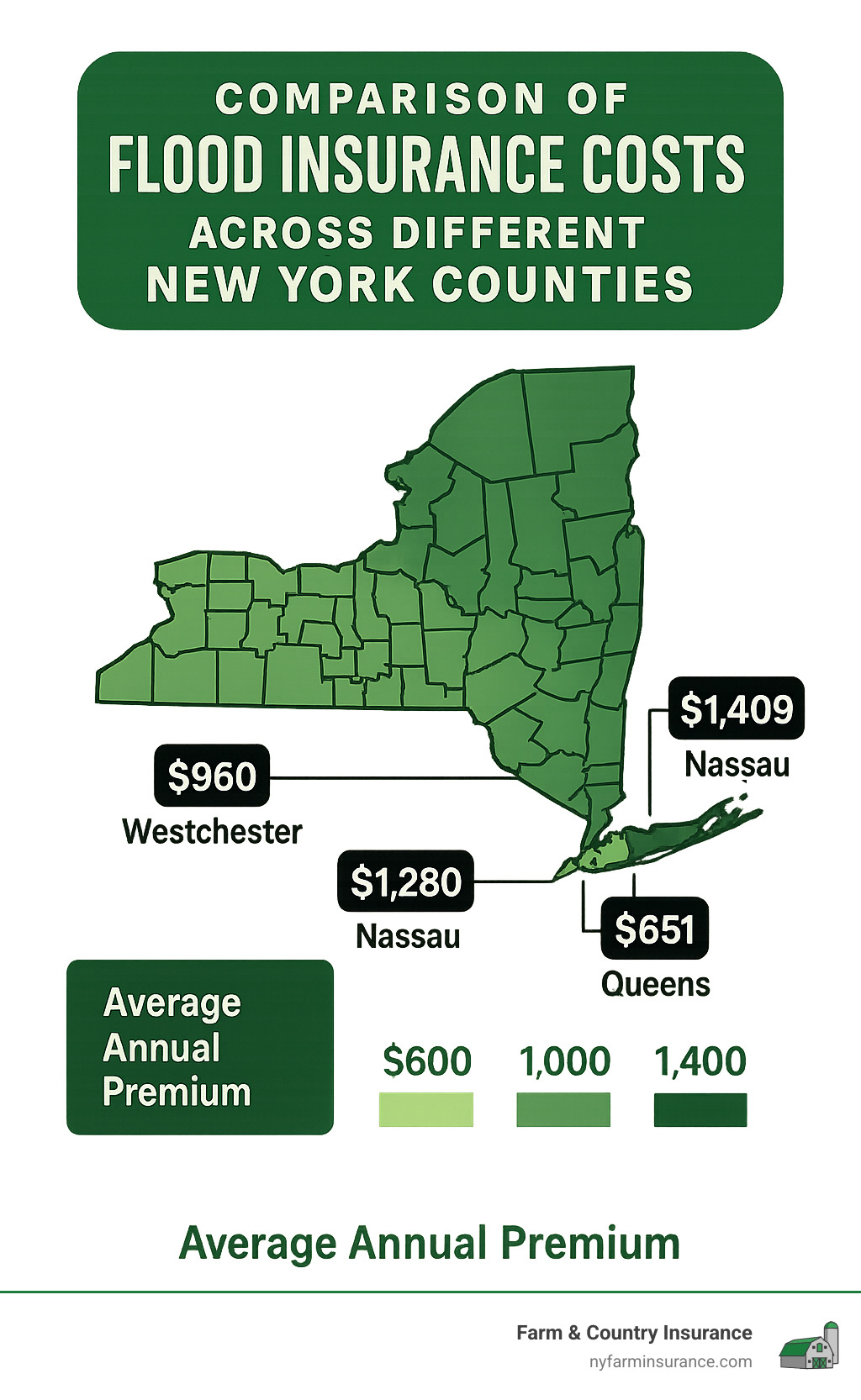
New York homeowners pay around $1,250 annually for flood coverage—quite a bit higher than the $767 national average. This premium reflects our state’s significant exposure to coastal storms, river flooding, and increasingly unpredictable weather patterns.
What you’ll pay varies dramatically depending on where your property sits. Some lucky New Yorkers in lower-risk counties might pay as little as $651 annually, while homeowners in the highest-risk areas could face premiums approaching $3,000. Nassau County, which bore the brunt of Superstorm Sandy’s fury, has experienced the most flood events statewide and carries an average premium of $1,280.
Factors That Drive Your Premium
Since FEMA rolled out its Risk Rating 2.0 system, flood insurance pricing has become much more personalized. Your premium now reflects your specific property’s characteristics rather than just your location on a flood map. Here’s what influences your costs:
Your property’s unique flood risk profile weighs heavily—how close you are to water bodies, your elevation compared to expected flood levels, and how frequently your area has flooded historically all matter.
The physical characteristics of your home make a big difference too. A home with a basement will typically cost more to insure than one built on a slab. Older homes often carry higher premiums than newer construction built to modern codes. The height of your first floor above ground level can dramatically affect your rates—even a foot or two can mean substantial savings.
Your coverage choices naturally impact your premium. Protecting a $500,000 farmhouse will cost more than insuring a $200,000 ranch home. Opting for contents coverage (to protect what’s inside your home) adds to your premium but provides crucial protection for your belongings.
One homeowner I worked with in coastal New York learned this lesson the hard way after Superstorm Sandy. “I saved maybe $200 a year skipping contents coverage,” she told me. “But I lost $30,000 in furniture, appliances, and personal items that weren’t covered.”
Prior mitigation efforts can substantially reduce your costs. As one New Jersey homeowner finded after Sandy: “Elevating our home cost about $100,000 total—$20,000 for the lift, $30,000 for masonry, $40,000 for systems, and $10,000 for appliances.” While expensive upfront, this investment slashed their annual premium from nearly $4,000 to under $800.
Ways to Save Without Sacrificing Protection
At Farm & Country Insurance, we’ve helped countless New York homeowners find that sweet spot between affordable premiums and solid protection. Here are our tried-and-true strategies for keeping costs manageable:
Adjust your deductible for immediate savings. Moving from a $1,000 to a $5,000 deductible could lower your premium by 15-20%. Just make sure you have that deductible amount set aside in your emergency fund.
Install flood vents in foundation walls and enclosures. These simple openings allow floodwaters to flow through rather than pushing against your walls. They’re particularly effective for properties with crawlspaces or garages at ground level, potentially reducing premiums by up to 80%.
Lift critical systems like your furnace, water heater, and electrical panel above the base flood elevation. This relatively affordable improvement not only reduces potential damage but can meaningfully lower your premium.
Check if your community participates in the NFIP’s Community Rating System. Many New York municipalities have implemented flood management practices that earn residents automatic discounts of 5-45% on their flood insurance.
Pay annually rather than monthly to capture easy savings of 5-10% with many insurers.
Get an accurate Elevation Certificate from a licensed surveyor. While this costs $500-$1,000 upfront, it might reveal your property sits higher than FEMA estimates, potentially saving you thousands over the years.
Farm & Country Insurance specializes in finding these hidden savings opportunities for rural and agricultural properties across New York. We understand that every dollar matters, especially for working farms where margins can be tight and flood risks unique.
For the latest premium information and personalized quotes custom to your specific property, visit the official FloodSmart.gov website or reach out to our team directly.
What Does Flood Insurance Cover—and Not Cover?
When it comes to flood insurance in New York, knowing exactly what’s protected (and what isn’t) can save you from devastating financial surprises after a flood event.
The National Flood Insurance Program (NFIP) offers two main types of coverage that work together to protect your property:
Building Coverage protects your home’s structure up to $250,000. This includes your foundation, electrical systems, plumbing, heating and cooling equipment, water heaters, and built-in appliances like your refrigerator and stove. It also covers permanently installed features like carpeting, paneling, and window blinds. Even detached garages receive protection (though limited to 10% of your building coverage), and the policy will help with debris removal after a flood.
Contents Coverage safeguards your personal belongings up to $100,000. This means your furniture, clothing, electronics, portable appliances, washers and dryers are all protected. Your freezer and the food inside it are covered too. However, be aware that valuable items like jewelry or collectibles have a combined limit of just $2,500.
One often-overlooked benefit is the Increased Cost of Compliance (ICC) coverage of up to $30,000. This helps pay for required upgrades to meet current building codes when rebuilding after a severe flood—a common requirement in many New York communities.
Covered Perils vs Exclusions
Your flood insurance in New York policy specifically covers direct physical losses caused by certain water events. These include overflow of inland or tidal waters, unusual and rapid accumulation of surface waters, mudflow (which is technically a river of liquid and flowing mud), and shoreline erosion caused by waves or currents.
What’s not protected, however, might surprise you. Moisture, mildew, or mold damage that could have been prevented won’t be covered. Your valuable papers like currency, precious metals, and stock certificates aren’t included either.
Anything outside your actual building—your landscaping, deck, patio, fences, swimming pool, and septic system—won’t be covered by flood insurance. And if you need temporary housing while repairs are made? That’s not included, nor is business interruption coverage. Your cars and most self-propelled vehicles need separate insurance, and personal property stored in basements receives very limited protection.
Special Rules for Basements & Ground-Level Enclosures
Basements deserve special attention when it comes to flood coverage. The NFIP defines a basement as “any area of a building with a floor that is below ground level on all sides,” and the coverage rules are quite restrictive.
In your basement, flood insurance will protect essential systems and structural elements—foundation components, electrical outlets and switches, circuit breaker boxes, furnaces, water heaters, and central air conditioners. Your sump pump, well water tanks and pumps, oil tanks, and cisterns are covered too. The policy also includes unfinished drywall for walls and ceilings and basic structural elements.
What won’t be covered in your basement might be more significant than you expect. Any finished improvements—walls, floors, ceilings, carpeting, tile, paneling, and bookcases—aren’t protected. Window treatments and personal belongings stored in the basement aren’t covered either. Even appliances that aren’t necessary for the building’s function (like washers, dryers, and freezers) won’t be included.
As the New York Department of Financial Services clearly states: “The NFIP offers limited basement coverage. It covers structural elements and equipment but not finished improvements or most personal contents.”
At Farm & Country Insurance, we help New York homeowners understand these critical coverage distinctions before a flood occurs—not after when it’s too late. We take the time to explain exactly what’s protected and identify potential gaps in your coverage that might need additional solutions.
Buying Flood Insurance in New York: Step-by-Step Guide
Purchasing flood insurance in New York doesn’t have to be complicated. As someone who’s helped countless New Yorkers steer these waters (pun intended!), I’ve seen how the right guidance makes all the difference.
Step 1: Don’t Wait Until It’s Too Late
Here’s something crucial many folks don’t realize – most flood policies have a 30-day waiting period before they kick in. That means if you hear a storm is coming next week, it’s already too late to get coverage for that event.
“I tell all my clients the same thing,” says Casey from Farm & Country Insurance. “The best time to buy flood insurance was yesterday. The second-best time is today.”
There are a few exceptions to this waiting period:
– When you’re getting a new mortgage
– If your property was recently mapped into a high-risk flood zone
– When you’re adding coverage at renewal time
Step 2: NFIP or Private Market?
You’ve got two main paths to choose from:
NFIP Policies feel like the classic choice – they’re backed by the federal government with standardized coverage and rates. The comfort here is knowing exactly what you’re getting, and they’re available to anyone in a participating community.
Private Market Policies are the newer players in the game. They might offer higher coverage limits (great for higher-value homes), shorter waiting periods, or different terms than what you’d get with NFIP.
Step 3: Find Someone Who Knows Their Stuff
NFIP policies are sold through private insurance companies and agents under the Write-Your-Own program. At Farm & Country Insurance, we’re fully authorized to sell these policies and can walk you through every step without the insurance jargon.
Step 4: Get Your Information Together
To get an accurate quote, you’ll need:
– Your property address and details (when it was built, how it’s constructed, number of floors)
– An Elevation Certificate (especially important for high-risk properties)
– Details about your foundation type and first floor height
– The value of both your building and the contents you want to protect
Step 5: Understand What You’re Getting
We’ll sit down with you (virtually or in person) and explain in plain English:
– How much coverage you’re getting and what the limitations are
– Your deductible options and how they affect your premium
– What you’ll pay and why
– Details about the waiting period
– How claims work when you need to use your policy
Step 6: Complete Your Application
Once you’ve decided on the right coverage, we’ll help you complete the application and process your payment. You’ll receive a declaration page and policy documents that outline everything your policy covers.
NFIP Enrollment Process
Getting an NFIP policy is straightforward:
First, give us a call at Farm & Country Insurance (or your preferred agent who sells NFIP policies). We’ll help you complete the NFIP application form, which collects information about your property’s characteristics and your desired coverage.
After paying your premium (either annually or in installments for some policies), you’ll receive your declaration page and policy documents. These outline your coverage, deductibles, limitations, and when your policy takes effect.
NFIP policies renew annually, and you’ll get a renewal notice about 45 days before expiration. Mark this on your calendar – you don’t want a lapse in coverage!
“The first flood claim I helped with was for a family who’d only had their policy for 31 days,” remembers a Farm & Country Insurance agent. “That extra day made a $47,000 difference in their recovery.”
Exploring Private Market Options
While the NFIP has been the flood insurance standard-bearer for decades, private options have grown significantly in recent years. They offer some compelling advantages:
Higher Coverage Limits – Private policies often go beyond the NFIP’s $250,000 for buildings and $100,000 for contents. For a beautiful farmhouse with quality furnishings, this extra protection matters.
Shorter Waiting Periods – Some private policies start protecting you in just 10-14 days, rather than the NFIP’s 30-day wait.
Potentially Lower Premiums – If your property is in a lower-risk area, private policies might offer more competitive rates. We’ve seen some clients save 15-30% with these options.
Excess Coverage – These supplemental policies layer on top of NFIP coverage, providing protection above the federal program’s limits.
At Farm & Country Insurance, we can help you compare NFIP and private market options side by side. Every property is unique – especially farms and rural homes – and deserves a flood insurance solution custom to its specific needs and location.
Ready to explore your flood insurance options or learn more about our Farm Liability Insurance offerings? We’re just a phone call away.
Filing a Flood Claim & Preparing Your Property

When it comes to floods, being prepared before disaster strikes and knowing exactly what to do afterward can make all the difference. At Farm & Country Insurance, we’ve guided countless New York homeowners through both preparation and claims, and we’ve seen how proper planning can dramatically reduce stress during an already difficult time.
Pre-Flood Mitigation Checklist
“An ounce of prevention is worth a pound of cure” certainly applies to flood preparation. Taking proactive steps now can save you thousands in damages later.
Installing backflow valves might not be dinner conversation material, but they’re incredibly effective at preventing sewage from backing up into your home during flooding—a particularly nasty and expensive problem to fix. Similarly, lifting utilities at least a foot above expected flood levels protects your electrical systems and heating equipment from water damage.
Fuel tanks might seem sturdy, but they can easily break free during flooding, creating both property damage and environmental hazards. Anchoring these tanks securely is a simple step that prevents major headaches.
“After losing irreplaceable family photos in our first flood, we now keep everything in waterproof containers,” shares Mary from Buffalo, a Farm & Country Insurance client. Following her lead by waterproofing vital documents and creating a detailed home inventory with photos and videos will make your life infinitely easier if you ever need to file a claim.
Some of our more flood-experienced clients have invested in temporary flood barriers. One homeowner in Westchester County purchased a 200-foot inflatable dam for $5,500: “It saved our home during the last two major storms—best money I’ve ever spent,” he told us.
Before storm season hits, take time to develop a clear emergency plan with your family. Know your evacuation routes, establish meeting points, and make sure everyone knows how to shut off utilities quickly if needed.
How to File a Successful Claim
Despite our best preparations, floods sometimes win the battle. If your property suffers damage, here’s how to steer the claims process successfully:
Contact your agent immediately. At Farm & Country Insurance, we pride ourselves on being available when our clients need us most. The sooner you report your loss, the sooner we can start helping you rebuild.
Before you start cleaning up, document everything thoroughly. The natural instinct after a flood is to start removing water and salvaging belongings, but taking 30 minutes to photograph and video all damage first can make a tremendous difference in your claim outcome. Be methodical—open drawers, cabinets, and closets to show damaged contents.
Once you’ve documented everything, you should take reasonable steps to prevent additional damage. Remove standing water, dry out what you can, and cover damaged roofs or windows. Just be sure to keep all receipts for these expenses as they’re typically reimbursable under your policy.
Preparing for the adjuster visit is crucial. Have your policy number handy, organize your documentation, and be ready to point out structural damage and high-water marks. The more organized you are, the smoother this process will be.
Within 60 days of the flood, you’ll need to submit a formal Proof of Loss document. This detailed form specifies exactly what you’re claiming under your policy. Don’t worry—at Farm & Country Insurance, we help our clients complete this paperwork correctly the first time.
“The claims process seemed overwhelming until my agent walked me through each step,” recalls a Farm & Country client from Rochester. “Having someone who knew the system made all the difference.”
If your home suffers substantial damage (repairs costing 50% or more of its pre-flood value), don’t forget to ask about Increased Cost of Compliance (ICC) coverage. This can provide up to $30,000 to help pay for flood mitigation measures like elevation, relocation, or demolition.
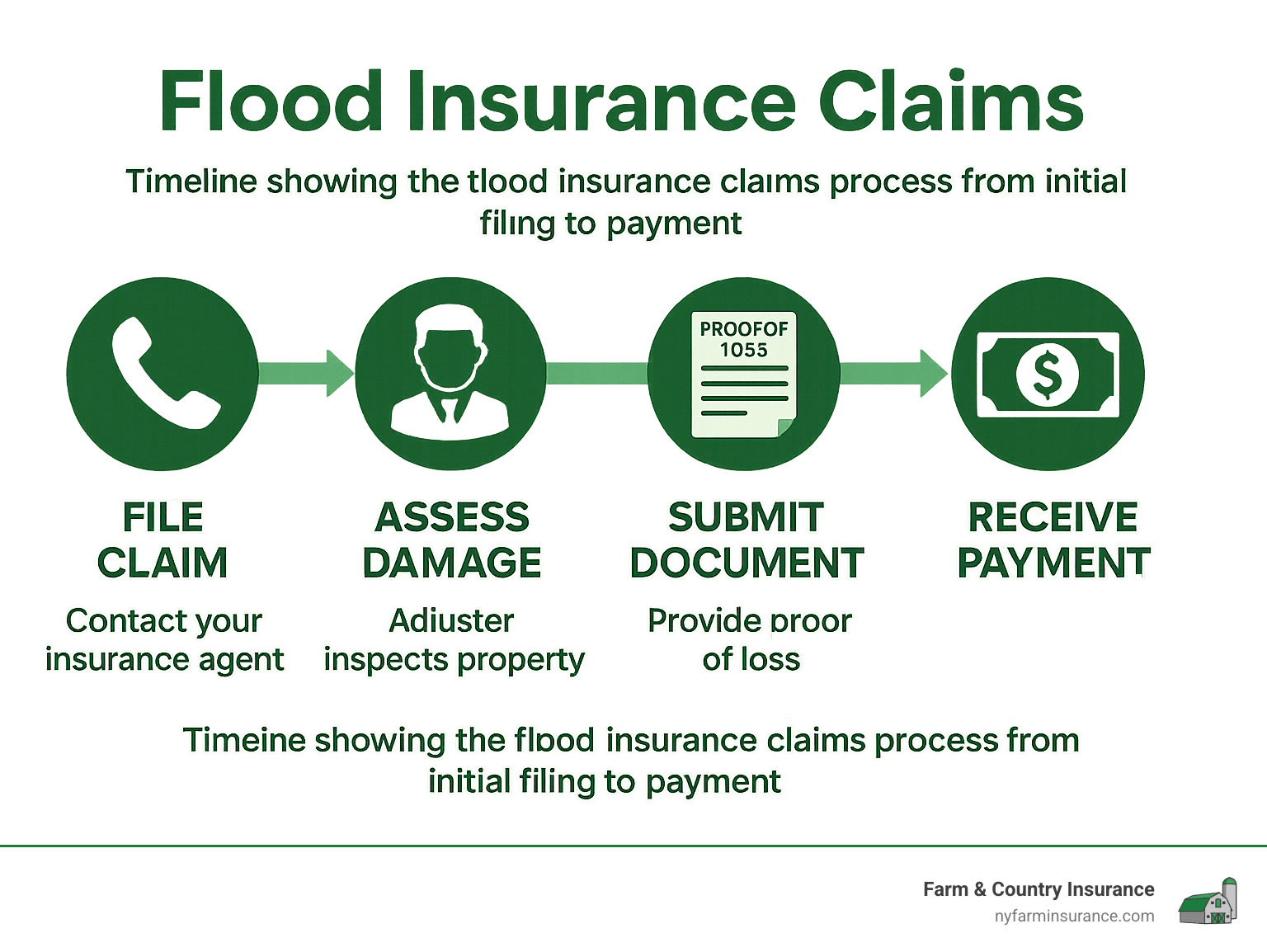
Throughout the entire claims process, stay in regular contact with your adjuster and insurance company. Don’t hesitate to ask questions or request clarification—at Farm & Country Insurance, we believe informed clients get better outcomes.
The New York Department of Financial Services offers this straightforward advice: “To file a flood damage claim, begin the process by filing with your insurance agent, broker, or company; an adjuster will assess the damage and coverage.”
The time to prepare for flooding is long before the forecast turns ominous. With proper preparation and the right coverage from Farm & Country Insurance, you can face New York’s flood seasons with confidence, knowing you’re ready for whatever Mother Nature sends your way.
Flood Insurance New York FAQs
How long does it take for a new policy to become effective?
One of the most common questions we hear at Farm & Country Insurance is about waiting periods. Here’s the straight truth: in most cases, you’ll need to wait 30 days before your flood insurance New York policy kicks in. This is why I always tell my clients not to wait until they see storm clouds on the horizon!
The 30-day waiting period exists to prevent people from buying coverage only when floods are imminent. However, there are several important exceptions worth knowing about:
If you’re buying a new home or refinancing, and your lender requires flood insurance, there’s no waiting period. Your coverage begins as soon as you close on the loan.
If your property was recently mapped into a high-risk flood zone, you can purchase coverage with just a one-day waiting period—but only if you buy within 13 months of the map change.
And if you’re simply adding more coverage at your annual renewal time, that additional protection takes effect immediately.
As one client told me after narrowly avoiding a flood: “I’m so glad I didn’t wait until the last minute. Those 30 days would have left me completely exposed.”
Can I purchase flood insurance if my property flooded before?
Absolutely yes! This surprises many homeowners, but prior flooding doesn’t affect your eligibility for flood insurance New York policies through the NFIP.
Unlike many private insurance markets where previous claims often lead to higher premiums or even denial of coverage, the NFIP doesn’t penalize you for past flood events. Your premium is based on your property’s characteristics and flood risk factors—not its claims history.
I recently helped a family in the Hudson Valley whose basement had flooded twice in five years. They were shocked to learn they could still get the same coverage at standard rates. “We thought we’d be uninsurable,” they told me. “This is such a relief!”
The New York Department of Environmental Conservation confirms this policy: previous flooding doesn’t impact your eligibility or premiums under the NFIP. This is one of the program’s most valuable features, especially in areas with recurring flood issues.
What are the coverage limits for homes, contents, and businesses?
The NFIP has established specific coverage limits that haven’t changed in several years. For homeowners, you can protect your dwelling for up to $250,000 and your personal belongings for up to $100,000.
Business owners have higher limits—up to $500,000 for both building and contents coverage.
Building and contents coverage are completely separate, with their own deductibles. You can choose to purchase either or both types of protection, depending on your specific needs and budget.
For my clients who rent their homes, I typically recommend contents-only coverage to protect personal belongings, while the building owner’s policy would cover structural damage.
“We never realized our furniture, clothing, and electronics would cost nearly $80,000 to replace until we did a home inventory,” shared one of our Farm & Country Insurance clients who purchased contents coverage.
If your property value exceeds these federal limits—which is increasingly common in many parts of New York—we can discuss supplemental private flood insurance options to cover the gap. Many high-value homeowners combine an NFIP policy with private excess coverage for complete protection.
At Farm & Country Insurance, we take time to explain these limits and help you determine the right amount of coverage for your specific situation. Every property is unique, and we believe your flood protection plan should be too.
Conclusion

When it comes to protecting your home in the Empire State, flood insurance in New York isn’t just another policy—it’s essential peace of mind for your most valuable asset.
Throughout this guide, we’ve seen how flooding affects communities across our state, from coastal neighborhoods to rural farmlands. The risks are real and growing. Climate change continues to intensify storm patterns, while development alters natural drainage systems. Even areas once considered “safe” from flooding face new vulnerabilities.
I’ve worked with hundreds of New York homeowners who thought flooding “wouldn’t happen to them”—until it did. The devastation isn’t just physical; it’s emotional and financial too. Without proper coverage, families face impossible choices about rebuilding their lives.
Standard homeowners insurance explicitly excludes flood damage. That one-inch of floodwater that causes $25,000 in damage? That’s coming straight out of your pocket without flood insurance.
Taking action now provides protection when you need it most:
First, don’t delay your decision. That 30-day waiting period means you can’t wait until storms are in the forecast. By then, it’s already too late.
Second, work with an agent who understands New York’s unique landscape. At Farm & Country Insurance, we know the difference between flood risks in the Hudson Valley versus the Southern Tier. Your coverage should reflect your specific situation.
Third, consider the value of peace of mind. Knowing you’re protected allows you to focus on what matters most—your family and your future—not worrying about weather forecasts.
Since 1984, Farm & Country Insurance has been helping New Yorkers protect what matters most. We understand the unique challenges facing homeowners across Cayuga County and beyond. Our experience with both residential properties and farms gives us unique insight into the complexities of rural property protection.
We’re your neighbors, not just your insurance providers. When you call us about flood insurance in New York, you’re speaking with someone who understands your community and its specific risks.
Don’t wait for water to reach your doorstep. Contact Farm & Country Insurance today to secure the protection your home deserves. Whether you need more information about crop coverage options or want to discuss your specific property needs, we’re here to help you steer the complexities of flood protection with confidence and clarity.
Your home is more than just a building—it’s where your life happens. Let’s make sure it stays protected, come rain or high water.