
Why Getting Insurance Quotes Online Matters for Your Financial Security
Why Bother? The Power of Comparing Insurance Quotes
When farmers and rural families stop by Farm & Country Insurance, the first question we hear is, “Why compare quotes when I’m already insured?” The short answer is simple: the market never sits still, and neither should you.
Rates change every few months as insurers tweak their models, respond to storms, or chase new customers. The policy that felt like a bargain last renewal could now be overpriced or, worse, leave dangerous gaps. Spending a few minutes to get insurance quotes is the easiest way to make sure both your wallet and your livelihood stay protected.
Opening up Significant Savings
Independent studies show that customers who switch carriers save $650–$900 per year on average. Add bundling—putting your farm, auto, and home on the same policy—and many families keep $950 or more in their pockets. For operations running multiple trucks, barns, and outbuildings, a 20 %-30 % swing in premium can mean a new piece of equipment or extra feed when prices spike.
Best of all, requesting quotes costs nothing and doesn’t obligate you to change companies. Think of it as free market research you can spend on fence posts instead of premiums.
Ensuring You Have the Right Coverage
Price matters, but coverage keeps you in business. Every time we review a new client’s paperwork we find one of two things:
- They’re paying for protection they don’t need, or
- They’re missing protection they absolutely do need.
Getting multiple quotes forces an honest inventory of your risks—liability limits, deductibles, seasonal workers, business-interruption exposure—so you can balance cost with comprehensive protection. When you get insurance quotes from Farm & Country Insurance, we don’t just mirror your current policy; we align coverage with the real risks of dairy, grain, fruit, or vegetable farming in New York.
Your Quote Toolkit: What You’ll Need to Get Started
Nothing’s more frustrating than sitting down to get insurance quotes only to realize you’re missing half the information you need. Trust me, I’ve watched countless clients start the process, hit a roadblock, and then put it off for months. The good news? A little preparation goes a long way.
Think of gathering your information like prepping for a recipe. You wouldn’t start cooking without checking you have all the ingredients first. Same principle applies here – having everything ready means you can complete multiple quotes in the time it would take to hunt down your driver’s license number.

The key is accuracy. Insurance companies will verify everything during underwriting, so there’s no point in guessing or trying to make your situation look better on paper. Being honest upfront saves time and prevents surprises later.
For Auto Insurance Quotes
When you’re ready to get insurance quotes for your vehicles, having the right details at your fingertips makes all the difference. Start with your driver’s license number – it’s the first thing most quote forms ask for, and it helps insurers pull your driving record quickly.
Your Vehicle Identification Number (VIN) is crucial because it tells insurers exactly what they’re covering. Don’t rely on memory for the make and model details – a 2018 Ford F-150 XLT is different from a 2018 Ford F-150 Lariat in the eyes of insurance companies. You can find your VIN on your registration, insurance card, or on the dashboard near the windshield.
Annual mileage matters more than most people realize. If you’re a farmer who drives 8,000 miles a year compared to a commuter doing 20,000, your rates will reflect that difference. Be realistic about your actual driving – not what you think sounds good.
Your driving history includes any accidents, tickets, or violations from the past five years. Yes, even that speeding ticket from three years ago counts. The garaging address where you park overnight affects your rates too, especially if it’s different from your home address.
Don’t forget your current insurance information. Having your existing policy details helps insurers understand your coverage history and can sometimes qualify you for continuous coverage discounts.
For Home or Farm Insurance Quotes
Property insurance gets more complex, especially for farms and rural properties. Your property address and year built are starting points, but insurers also want to know the square footage and construction materials of your buildings.
Safety features can significantly impact your rates. Smoke detectors, security systems, and fire extinguishers show insurers you’re serious about risk management. Distance to the nearest fire station matters too – rural properties often face higher rates due to longer emergency response times.
Your claims history from the past five years gives insurers insight into your risk profile. This includes any weather damage, theft, or liability claims, even if they were small.
For farm operations, the details get more specific. Insurers need to understand your livestock details – whether you raise dairy cattle, beef cattle, or sheep affects your coverage needs. Information about your specific farming operations helps determine liability exposures and property values.
At Farm & Country Insurance, we know that every farm is unique. A grain operation in Wayne County has different risks than a fruit farm in Orleans County. We’ll help you identify all the details that matter for your specific situation, ensuring nothing important gets overlooked when you’re ready to compare quotes.
The time you spend gathering this information upfront pays dividends in faster, more accurate quotes that actually reflect your real insurance needs and costs.
The Main Event: How to Get Insurance Quotes Step-by-Step
Now comes the exciting part – actually getting those quotes! With your information gathered and ready, you can get insurance quotes in just a few minutes. At Farm & Country Insurance, we’ve made this process as simple as possible while ensuring you get the coverage that truly fits your needs.
The beauty of today’s insurance market is that you have options. Whether you prefer the convenience of online tools, the personal touch of working with an agent, or a combination of both, there’s a path that works for you. Let me walk you through the three most effective ways to get started.
Method 1: Directly from Farm & Country Insurance
The most straightforward approach is coming directly to us. We know our products inside and out, and we can give you the most accurate picture of what your coverage will look like and cost.
Our online quote system is available 24/7, so you can start whenever it’s convenient for you. Maybe you’re up early checking on the cows, or you’re winding down after a long day in the fields – our website is always ready when you are. The system walks you through each step, and you can save your progress if you need to step away.
Getting quotes from us typically takes about four minutes for auto insurance and a bit longer for property coverage. Farm insurance can take 10-15 minutes since we need to understand your specific operation – whether you’re running a dairy in Fleming, growing vegetables in Sennett, or managing grain storage in Cato.
If you start a quote but can’t finish it right away, don’t worry. You’ll get an email with a link to pick up where you left off. We call this our “continue a saved quote” feature, and it’s a real time-saver for busy farmers who might get interrupted by, well, farming.
The real advantage of working directly with Farm & Country Insurance is that we understand your world. We know that a dairy operation has different risks than a grain farm, and we price accordingly. We’re not trying to fit your square farm into a round suburban hole.
Method 2: Working with Farm & Country Insurance Agents
Sometimes there’s no substitute for talking to a real person who knows the insurance business inside and out. Our agents bring decades of experience helping farmers and rural families find the right protection at the right price.
When you work with one of our agents, you get personalized service that goes way beyond just filling out forms. We’ll schedule a time that works for you – whether that’s in person at your kitchen table, over the phone while you’re in the barn, or via video call when the weather’s keeping you inside.
Our agents understand the local market in ways that big national companies simply can’t match. We know which carriers offer the best rates for dairy operations, which ones understand the seasonal nature of fruit farming, and which ones have the expertise to properly insure agribusiness operations.
The relationship doesn’t end when you sign the policy. When you need to file a claim – and hopefully you never will – you’ll work with someone who knows you, your operation, and your coverage. No sitting on hold with a call center in another state, wondering if the person on the other end understands what a manure spreader is.
For complex operations, agent guidance is invaluable. If you’re running a diversified farm with crops, livestock, and maybe some agritourism, there are a lot of moving parts to insure properly. Our agents can steer these complexities and make sure nothing important gets overlooked.
Method 3: Using Farm & Country Insurance’s Online Quote Tools
We’ve invested heavily in technology that makes getting quotes faster and more convenient while still maintaining the personal touch that sets us apart.
Our online tools work like having a knowledgeable agent available 24/7. You answer questions about your property, vehicles, and coverage needs, and the system evaluates your information to identify the right coverage options. It’s smart enough to ask follow-up questions based on your answers, so you get quotes that actually reflect your situation.
The process is designed for speed and accuracy. Most auto quotes take 4-5 minutes to complete, while property insurance might take 10-15 minutes. Farm insurance can take a bit longer because agricultural operations are more complex, but we’ve streamlined the process as much as possible.
Here’s what makes our system different: every quote gets reviewed by one of our experienced agents before it comes back to you. This ensures accuracy and completeness, and it means you’re getting the benefit of both technology and expertise.
Data security is something we take seriously. All your information is encrypted and protected according to industry standards. We never sell your data to third parties, and we only use it to provide you with quotes and service. Your privacy matters to us.
The best part about our online tools is that they’re designed to work with our agents, not replace them. Get your initial quotes online, then talk to an agent to fine-tune your coverage and make sure you’re getting the best possible protection for your specific needs.
Decoding Your Quote: Understanding What Influences Your Premium

Request three quotes and you’ll notice the numbers seldom match. That’s because every insurer weighs risk factors differently—think of it as three agronomists looking at the same field and recommending slightly different fertilizer blends.
According to the Insurance Information Institute (III, an external industry resource), companies run sophisticated models that look at dozens of data points to predict claims. Below are the big ones you can actually influence.
Key Factors That Determine Your Rate
- Location – Distance to a fire department, local weather patterns, and rebuilding costs mean a dairy in Moravia can price out very differently from a similar operation in Sterling.
- Personal profile – Age, marital status, and occupation all feed the algorithm.
- History – Driving violations, prior claims, and (in most states) credit-based insurance scores show how likely you are to file a claim.
- What you’re insuring – Newer trucks with advanced safety tech may rate cheaper than an older pickup. For property, updated wiring or sprinklers usually lower the bill.
- Coverage selections – Higher limits and lower deductibles raise the premium; the reverse is also true.
How to Save Money on Your Premiums
- Bundle policies. Placing farm, home, and autos together can trim 10 %-25 %.
- Claim your discounts. Safe-driver records, anti-theft devices, and multiple vehicles all earn credits.
- Use telematics wisely. Many carriers now reward good driving habits recorded by a plug-in device or mobile app.
- Adjust deductibles. Raising an auto deductible from $500 to $1,000 often saves a few hundred dollars a year—just keep enough cash on hand for emergencies.
- Mind your credit. Paying bills on time benefits your loan rates and, in most states, your insurance rates too.
Working with Farm & Country Insurance means we help you prioritize changes that deliver the most bang for the buck without sacrificing critical protection.
A World of Coverage: Types of Insurance Quotes Available
When you get insurance quotes you’re not just comparing prices—you’re choosing the safety nets that keep everyday mishaps from becoming business-ending disasters. Below is a quick roadmap to the most common options we place for New York farm families.
Common Personal Insurance Lines
- Auto insurance – Required by law, but also your first line of defense against costly liability claims.
- Homeowners insurance – Protects the roof over your head, your belongings, and provides liability if someone is hurt on your land.
- Renters insurance – An inexpensive way to cover personal property and liability if you don’t own your home.
- Life insurance – Term or permanent coverage that keeps the farm in the family if something happens to you.
Understanding Common Auto Insurance Coverages
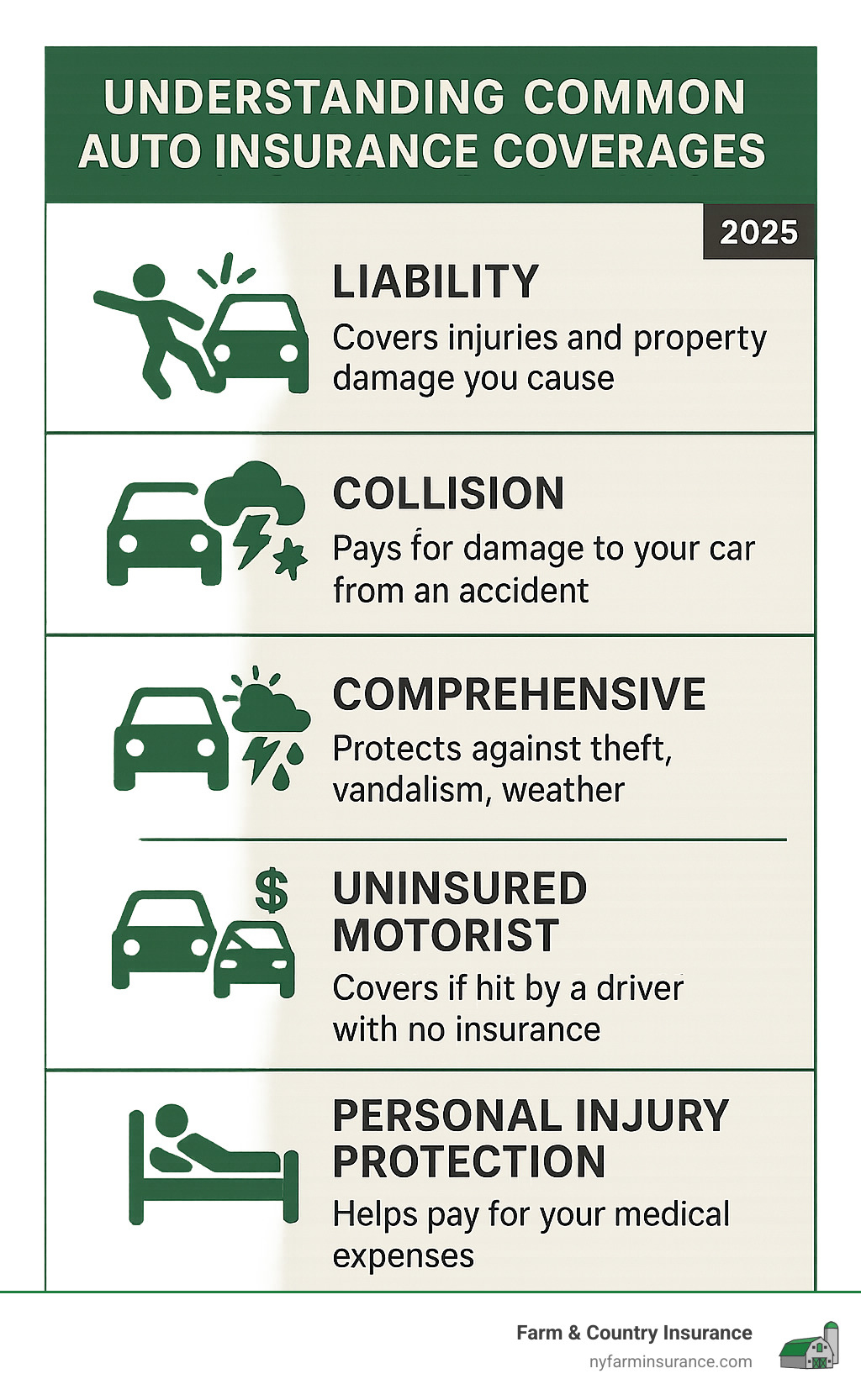
- Liability – Pays for injuries or property damage you cause to others.
- Collision – Repairs your vehicle after a crash you cause.
- Comprehensive – Handles non-collision losses like hail, theft, or a deer strike.
- Uninsured/Underinsured Motorist – Protects you from drivers who carry little or no insurance.
- Personal Injury Protection (PIP) – Covers medical bills and lost wages for you and your passengers, irrespective of fault.
Specialized and Business Insurance
Running a farm or agribusiness introduces risks beyond a typical household:
- Commercial auto – For trucks or trailers used primarily for business.
- General liability – Shields you if a customer, vendor, or tourist is injured on your property.
- Farm liability – Custom protection for livestock, field operations, and farm-produced goods.
- Agribusiness packages – Combine property, liability, and income protection for processing, storage, or retail operations tied to the farm.
Because each Cayuga County operation is different, Farm & Country Insurance customizes these coverages to your acreage, crops, and revenue streams rather than offering a one-size-fits-all policy.
Frequently Asked Questions about Getting Insurance Quotes
After helping farmers and rural families find the right insurance coverage since 1984, we’ve heard just about every question you can imagine. Here are the ones that come up most often – along with the honest answers you need to know.
Does getting an insurance quote affect my credit score?
No, getting insurance quotes won’t hurt your credit score at all. This is one of the biggest misconceptions we hear, and it keeps people from shopping around for better rates.
When you get insurance quotes, companies perform what’s called a “soft pull” on your credit report. Think of it like checking your own credit score online – it gives them the information they need without leaving any footprints that could damage your score.
Soft pulls are completely different from hard pulls. When you apply for a car loan or credit card, that’s a hard pull that shows up on your credit report and can temporarily lower your score. Insurance quote checks don’t appear anywhere on your report and won’t affect your score even if you get quotes from ten different companies in one day.
So why do insurance companies check credit at all? Years of data show that people with better credit histories tend to file fewer insurance claims. It’s not about judging your character – it’s about predicting risk. However, credit is just one factor among many, and some states have limited how much weight companies can give it.
At Farm & Country Insurance, we believe in transparency about this process. We’ll explain exactly how credit affects your rates and help you understand all the factors that go into your premium.
How often should you get insurance quotes?
We recommend shopping for new quotes every 6 months. I know that might sound like a lot of work, but hear me out – it’s worth the effort.
Insurance rates change constantly. Companies adjust their pricing based on claims experience, market conditions, and competitive pressures. The company that offered you the best rate last year might not be competitive today, while another company might have improved their rates for customers like you.
Your own situation changes too. Maybe your credit score improved, or you completed a defensive driving course, or you moved to a location with lower crime rates. These changes can qualify you for discounts you didn’t have before.
The best times to get fresh quotes are:
- Policy renewal time – You can compare your current rate with new options
- After major life events like getting married, buying a new home, or adding a teen driver
- When you buy a new vehicle – Different cars have different insurance costs
- If you’ve had violations or claims age off your record – Clean records mean better rates
For our farm clients, we also recommend getting quotes when you make changes to your operation. Adding new buildings, changing crop types, or expanding your livestock operation can all affect your insurance needs and costs.
What’s the difference between a quote and a policy?
This is a crucial distinction that can save you from unpleasant surprises later. A quote is an estimate – a policy is a binding contract.
When you get insurance quotes, you’re getting the company’s best estimate of what you’ll pay based on the information you provided. It’s like getting an estimate from a contractor – helpful for planning, but not a final price.
A policy, on the other hand, is the real deal. It’s a legal contract that provides actual coverage and protection. You pay premiums, and the company agrees to pay covered claims according to the policy terms.
Here’s what happens between quote and policy: First, you receive quotes from various companies. When you decide on one, you formally apply for coverage. The insurance company then goes through underwriting – they verify your information, check your driving record, and assess your actual risk. Finally, they provide final pricing and issue your policy.
Why might your final price differ from the quote? Sometimes the underwriting process reveals information that wasn’t captured in the initial quote. Maybe your driving record check showed a ticket you forgot about, or the home inspection revealed updates that weren’t reflected in the quote. Most of the time, if you provided accurate information upfront, your final rate will be very close to your quote.
At Farm & Country Insurance, we work hard to make sure our quotes are as accurate as possible from the start. We’d rather spend extra time gathering complete information upfront than surprise you with changes later. That’s just part of building the long-term relationships we value with our clients.
Conclusion: Take Control of Your Insurance Costs Today
The path to better insurance coverage and lower costs is right in front of you. Throughout this guide, we’ve shown you that when you get insurance quotes online, you’re not just shopping for a policy – you’re taking control of your financial future. The numbers speak for themselves: drivers who switch providers save an average of $658 to $900 annually, and those who bundle policies can save even more.
The process is simpler than most people think. You can complete most quotes in just 4-5 minutes, and since insurance companies only perform soft credit checks, your credit score won’t be affected. Best of all, there’s no obligation to buy anything. You’re simply gathering information to make an informed decision.
Why does this matter so much for farming families? Your operation faces risks that go far beyond what typical homeowners or drivers encounter. A hailstorm can destroy months of work in minutes. A liability claim from a farm visitor can threaten everything you’ve built. Equipment breakdowns can halt operations during critical seasons. Having the right coverage at the right price isn’t just smart business – it’s essential for protecting your family’s livelihood.
At Farm & Country Insurance, we’ve been walking alongside farmers since 1984. We’ve seen how proper insurance coverage can mean the difference between a temporary setback and a devastating loss. Whether you’re milking cows in Moravia, growing corn in Cato, or running a farm market in Auburn, we understand the unique challenges you face every day.
Getting started is the hardest part. Once you begin comparing quotes, you’ll quickly see the differences in both pricing and coverage options. Some companies might offer rock-bottom prices but leave gaps in protection. Others might provide comprehensive coverage but at prices that strain your budget. The sweet spot is finding comprehensive protection that fits your financial reality.
We recommend comparing 3-4 quotes to get a complete picture of your options. This gives you enough information to make a confident decision without overwhelming yourself with choices. Remember to review your rates every 6 months – insurance markets change quickly, and you want to ensure you’re always getting the best value.
For specialized coverage like farm insurance, livestock protection, or agribusiness liability, working with experts who understand your industry makes all the difference. We know the questions to ask, the coverage gaps to avoid, and the discounts that might apply to your specific operation.
Your next step is simple: gather the information we’ve outlined in this guide and start requesting quotes. Whether you prefer working with our experienced agents who can explain complex coverage options, or you want to explore our online tools for quick comparisons, we’re here to help you find the protection you need.
Get started on finding the right protection for your needs by visiting our main page at https://nyfarminsurance.com/. Your farm, your family, and your future are worth the small investment of time it takes to get insurance quotes and compare your options. The peace of mind that comes with knowing you have the right coverage at the right price? That’s priceless.