
Finding the Right Protection for Your Auburn Home
Home insurance Auburn is essential protection for homeowners looking to safeguard their most valuable asset against unexpected damage, theft, and liability claims. If you’re searching for home insurance in Auburn, here’s what you need to know:
- Best Auburn Home Insurance Providers: Local and national insurance carriers offer various coverage options
- Average Annual Premium: $900-$1,300 (varies based on home value, location, and coverage)
- Minimum Requirements: Most mortgage lenders require at least dwelling coverage equal to your loan amount
- Local Risk Factors: Auburn homeowners should consider coverage for wildfires, winter storms, and water damage
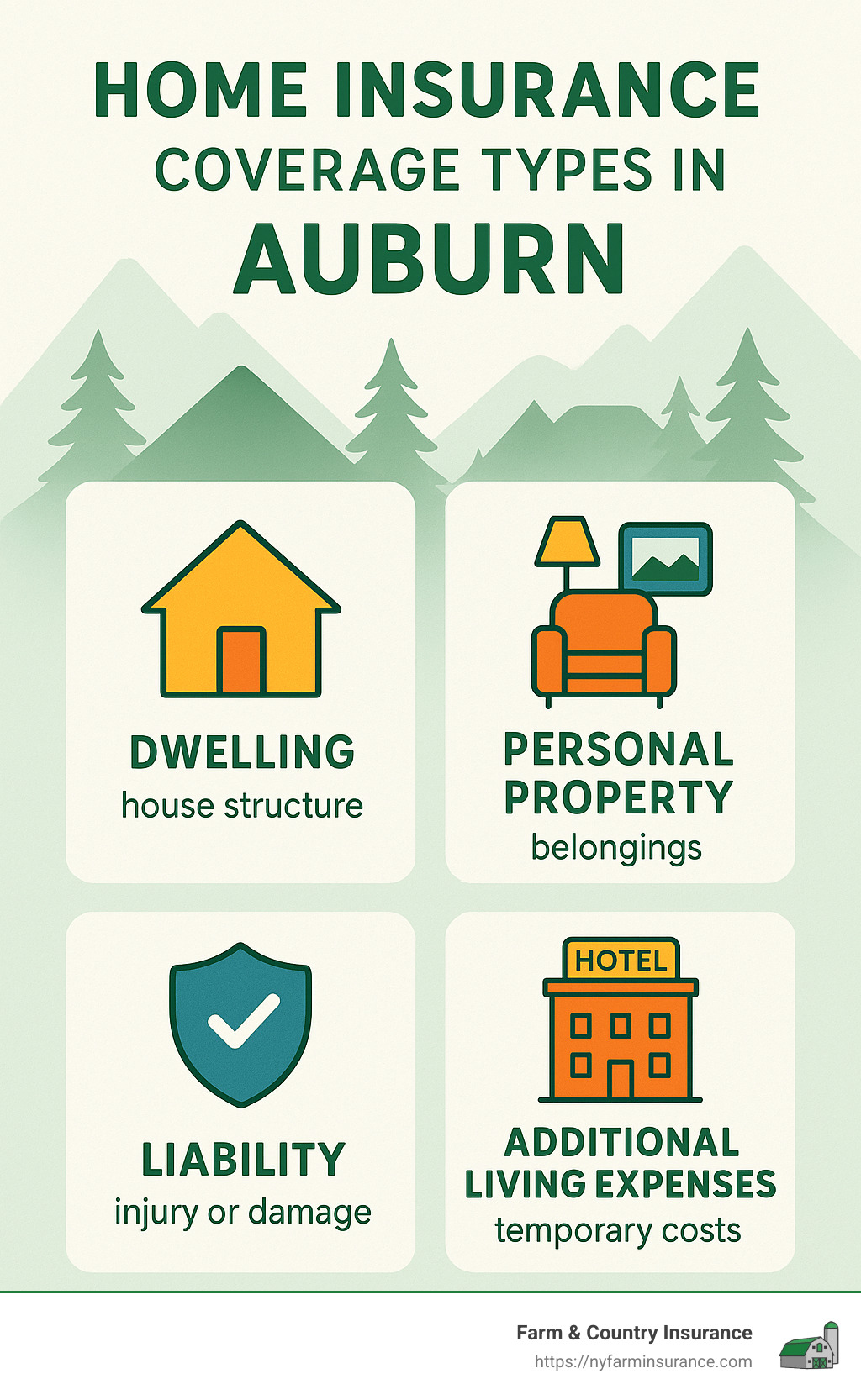
- Standard Coverage: Includes dwelling, personal property, liability, and additional living expenses
Home insurance protects more than just your house—it covers your personal belongings, provides liability protection if someone is injured on your property, and helps with temporary housing costs if your home becomes uninhabitable after a covered loss.
The cost of home insurance in Auburn depends on several factors, including your home’s value, construction type, location, and your claims history. Most homeowners can save money through discounts for security systems, bundling policies, and maintaining a claim-free record.
I’m Casey Love, founder of Farm & Country Insurance, and I’ve helped hundreds of Auburn homeowners find the right coverage for their unique needs. With over 15 years of experience in home insurance Auburn markets, I understand the specific risks and coverage options that matter most to local homeowners.
Understanding Home Insurance Auburn
When you’re a homeowner in Auburn, having the right insurance protection isn’t just smart—it’s essential. Home insurance Auburn policies provide that crucial safety net when the unexpected happens. But what exactly are you getting when you purchase a policy?
Think of your home insurance as a protective package with several important parts working together. At Farm & Country Insurance, we’ve helped Auburn homeowners understand these components for decades, and we know how confusing it can be at first.
Your premium is simply what you pay for coverage—typically ranging from $900-$1,300 annually for Auburn homeowners, though your specific situation may vary. This is influenced by everything from your home’s age to your credit score.

Your deductible is your skin in the game—the amount you’ll pay before your insurance kicks in after a claim. Many Auburn homeowners choose deductibles between $500-$2,500. Higher deductibles mean lower premiums, but more out-of-pocket costs when you need to file a claim.
Coverage limits represent the maximum your insurer will pay after a covered loss. One of the biggest mistakes we see Auburn homeowners make is setting these limits too low. As one local client told me after a serious fire, “I never imagined rebuilding would cost so much more than what I paid for my home.”
Dwelling coverage protects your home’s physical structure, while personal property coverage takes care of your belongings inside. Liability protection—which we recommend setting at least $300,000 for most Auburn homeowners—covers you if someone gets injured on your property. And don’t forget Additional Living Expenses (ALE), which pays for temporary housing if disaster strikes.
What Does a Standard Auburn Policy Cover?
A standard home insurance Auburn policy typically protects four essential areas of your home and life:
Your dwelling coverage is the foundation of your policy, protecting your home’s physical structure and attached features like garages and decks. With construction costs in Auburn averaging $150-$200 per square foot, have enough coverage to rebuild completely if needed. Your home’s market value and its rebuilding cost are often quite different!
Your personal belongings—from furniture and electronics to clothing and kitchenware—fall under personal property coverage. Most policies calculate this as 50-70% of your dwelling coverage. Those special items like grandma’s jewelry or your art collection? They might need additional coverage through what’s called “scheduled personal property.”
If disaster strikes and you can’t live in your home during repairs, loss-of-use coverage (also called Additional Living Expenses) becomes incredibly valuable. This pays for hotel stays, restaurant meals, and other extra costs while you’re displaced. In Auburn, where temporary housing options can be limited and expensive, this coverage provides real peace of mind.
Personal liability protection is often overlooked but incredibly important. If someone slips on your icy sidewalk in winter or your dog nips the mail carrier, this coverage helps with legal fees and damages. At Farm & Country Insurance, we’ve seen how quickly medical bills and legal costs can escalate, which is why we typically recommend higher liability limits than the standard $100,000 for our Auburn clients.
Home Insurance Auburn vs. National Averages
When comparing home insurance Auburn rates to the national landscape, you’ll find some interesting differences. While the national average hovers around $1,200 annually, Auburn homeowners typically pay between $900-$1,300.
Several Auburn-specific factors influence these rates. Our regional construction costs differ from national averages, affecting how much insurers estimate it would cost to rebuild your home. Auburn’s four distinct seasons bring everything from heavy snow loads in winter to summer storms, creating unique risk profiles.
Your home’s proximity to fire protection makes a significant difference too. Properties closer to Auburn’s fire stations typically enjoy lower premiums, while rural homes outside city limits might pay more due to longer emergency response times.
Parts of the Auburn area face seasonal wildfire risks, particularly in drier months. If your property sits in one of these zones, you might see higher premiums or special coverage requirements.
The good news? Auburn’s relatively low property crime rates compared to national averages often work in homeowners’ favor when it comes to insurance costs.
At Farm & Country Insurance, we’ve analyzed premium trends throughout Cayuga County and found that Auburn homeowners generally benefit from the city’s solid emergency services infrastructure. However, if you’re in the rural outskirts, those premium savings might be offset by distance from fire protection services.
Understanding these local factors helps explain why your home insurance Auburn premium might differ from what friends or family pay in other parts of the country—and why working with a local insurance partner who understands these nuances makes such a difference.
Auburn-Specific Risks & Coverage Add-Ons
Living in Auburn comes with its own unique set of challenges when it comes to protecting your home. As a local homeowner, understanding these regional risks is crucial to making sure your home insurance Auburn policy isn’t leaving you vulnerable.
When I talk with local homeowners, many are surprised to learn about the specific risks our beautiful region faces. Let’s explore what makes Auburn unique and how you can protect your home properly.
Wildfire concerns have grown in recent years, particularly during our dry summer months. While we’re fortunate not to face the extreme wildfire dangers of western states, parts of Auburn and surrounding Cayuga County have seen increased risk. Your standard policy typically covers fire damage, but if you’re in a higher-risk area, you might need additional coverage or to implement preventative measures around your property. According to the National Fire Protection Association, creating defensible space around your home can significantly reduce wildfire risk.
Our proximity to Owasco Lake is one of Auburn’s greatest assets, but it also means some neighborhoods face liftd flood risks. Here’s something critical every homeowner should know: standard home insurance does not cover flood damage. If your property sits in a flood-prone area, you’ll need separate flood insurance through the National Flood Insurance Program or a private insurer. Don’t wait until the spring thaw to think about this!
Those beautiful Auburn winters bring another concern: snow load damage. When heavy snow accumulates on roofs, the weight can cause structural damage or even collapse. While most policies cover this damage, it’s essential that your dwelling coverage reflects current rebuilding costs for full protection.
Even though Auburn enjoys relatively low crime rates compared to national averages, theft still happens. Your standard policy covers theft, but those special items—grandma’s jewelry, your art collection, or valuable electronics—may require additional scheduled personal property endorsements.
We don’t often think about earthquakes in New York, but our state does experience occasional seismic activity. Standard policies exclude earthquake damage, so consider adding this coverage if you’re concerned about this risk.
Many homes in Auburn’s charming neighborhoods were built decades ago. If yours is among them, you might face additional expenses bringing systems up to current building codes after a loss. Standard policies typically don’t cover these expenses unless you add ordinance or law coverage.
At Farm & Country Insurance, we’ve guided countless Auburn homeowners through these regional considerations. I remember helping a family near Owasco Lake who finded their standard policy wouldn’t cover potential flood damage to their lakefront property. By adding flood insurance, they were fully protected when spring flooding affected their boathouse and basement the following year—a $27,000 claim that would have otherwise come straight from their savings.
For those with agricultural properties around Auburn, specialized Farm Homeowners Insurance provides protection custom to your unique needs.
Optional Endorsements Every Auburn Homeowner Should Consider
Beyond your standard coverage, several optional add-ons (we call them endorsements) are particularly valuable for Auburn homeowners:
Water backup and sump discharge coverage is something I recommend to nearly every Auburn homeowner. This protects you from damage caused by backed-up sewers or failed sump pumps—common problems in our older neighborhoods during heavy rain. Without this endorsement, you could be on the hook for thousands in water damage repairs your standard policy won’t cover.
Guaranteed replacement cost ensures your home will be rebuilt regardless of your current coverage limits. With construction costs in Auburn rising 5-7% annually, this endorsement provides peace of mind that you won’t be underinsured after a total loss. I’ve seen too many families find their coverage wasn’t enough only after disaster struck.
Ordinance or law coverage is especially important for homes in Auburn’s historic districts. If your home is damaged, this coverage helps pay for the additional costs of bringing your home up to current building codes during repairs—costs that can add up quickly with older homes.
Cyber protection has become increasingly important as our homes get smarter. This coverage helps with expenses related to identity theft, cyberbullying, or online fraud—particularly valuable for families with smart home technology or children active online.
Home sharing coverage is essential if you rent out all or part of your Auburn home through services like Airbnb. Standard policies typically exclude damage or liability claims during rental periods, leaving a dangerous gap in your protection.
One Auburn homeowner called me in tears after experiencing a sewer backup that caused $15,000 in basement damage. “I had no idea my standard policy didn’t cover water backup,” she said. “Adding that $30 endorsement would have saved me thousands.” Don’t make the same mistake!
Local Requirements & Mortgage Lender Rules
When purchasing home insurance Auburn policies, it’s important to understand both legal requirements and what your mortgage lender will demand.
New York State doesn’t legally require homeowners to carry insurance if you own your home outright. However, if you have a mortgage (as most of us do), your lender will absolutely require it. This isn’t them being difficult—they’re protecting their investment in your property.
Most mortgage lenders in Auburn require at minimum:
– Dwelling coverage equal to or greater than your loan amount
– Deductibles below a certain threshold (typically 1-2% of dwelling coverage)
– Continuous coverage throughout your loan term
Many Auburn mortgage lenders also require escrow accounts for insurance premiums. This means your monthly mortgage payment includes a portion for insurance, which the lender then pays directly to your insurance company. While this adds to your monthly payment, it can help ensure you never miss a premium payment and risk a lapse in coverage.
For older homes (and Auburn has plenty of them!), some insurers require home inspections before issuing policies. These inspections might identify required repairs or updates before coverage is approved. Don’t be surprised if your 100-year-old Victorian needs some electrical updates before an insurer will cover it.
Properties in designated flood zones face additional requirements. Federal regulations require lenders to ensure flood insurance for mortgaged properties in high-risk flood zones. This is separate from your standard home insurance and must be purchased additionally.
At Farm & Country Insurance, we work closely with local mortgage lenders to ensure our clients’ policies meet all requirements. Recently, we helped a family purchasing a 120-year-old home in Auburn’s historic district steer their lender’s specific insurance requirements, including additional ordinance and law coverage to protect against the higher rebuilding costs associated with historic properties.
Understanding these local requirements isn’t just about satisfying your lender—it’s about making sure your most valuable asset is properly protected with the right home insurance Auburn coverage.
Factors That Affect Your Premium & How to Save
When it comes to home insurance Auburn premiums, understanding what drives your costs can help you make smarter decisions and keep more money in your pocket. I’ve seen how certain factors can make a significant difference in what homeowners pay each month.
Your home’s value and rebuilding cost typically has the biggest impact on your premium. Here in Auburn, rebuilding costs generally range from $150-$200 per square foot, depending on your home’s materials and finishes. Those beautiful historic brick homes that line some of Auburn’s older neighborhoods? They often qualify for lower premiums than wood-frame structures because of their fire-resistant properties.
Your personal claims history matters too—and so does your home’s. If your property has experienced multiple water damage claims in the past, you might face higher premiums or even have trouble finding coverage. I recently worked with a family who struggled to find affordable insurance because their home had three water damage claims in five years.
Many homeowners don’t realize that their credit score affects their insurance rates in New York State. Insurers can use credit-based insurance scores when calculating premiums, so maintaining good credit does more than help you qualify for loans—it can lower your insurance costs too.
Taking steps to protect your home can significantly reduce your premiums. Installing impact-resistant roofing after one of our notorious Auburn hailstorms, adding storm shutters before winter hits, or investing in a whole-house generator can all translate to savings. Updating electrical, plumbing, and HVAC systems in older homes not only improves safety but often qualifies for discounts. And monitored security systems typically earn you a break on premiums while giving you peace of mind.
One of the easiest ways to save is by bundling policies. When you combine your home and auto insurance with the same company, you’ll typically save 10-25% on both policies. At Farm & Country Insurance, we’ve helped countless Auburn residents reduce their overall insurance costs this way.
Your deductible choice makes a difference too. Opting for a higher deductible generally lowers your premium, but be careful—make sure you can comfortably afford to pay that amount if disaster strikes. I always tell my clients to keep their deductible amount in an emergency fund, just in case.
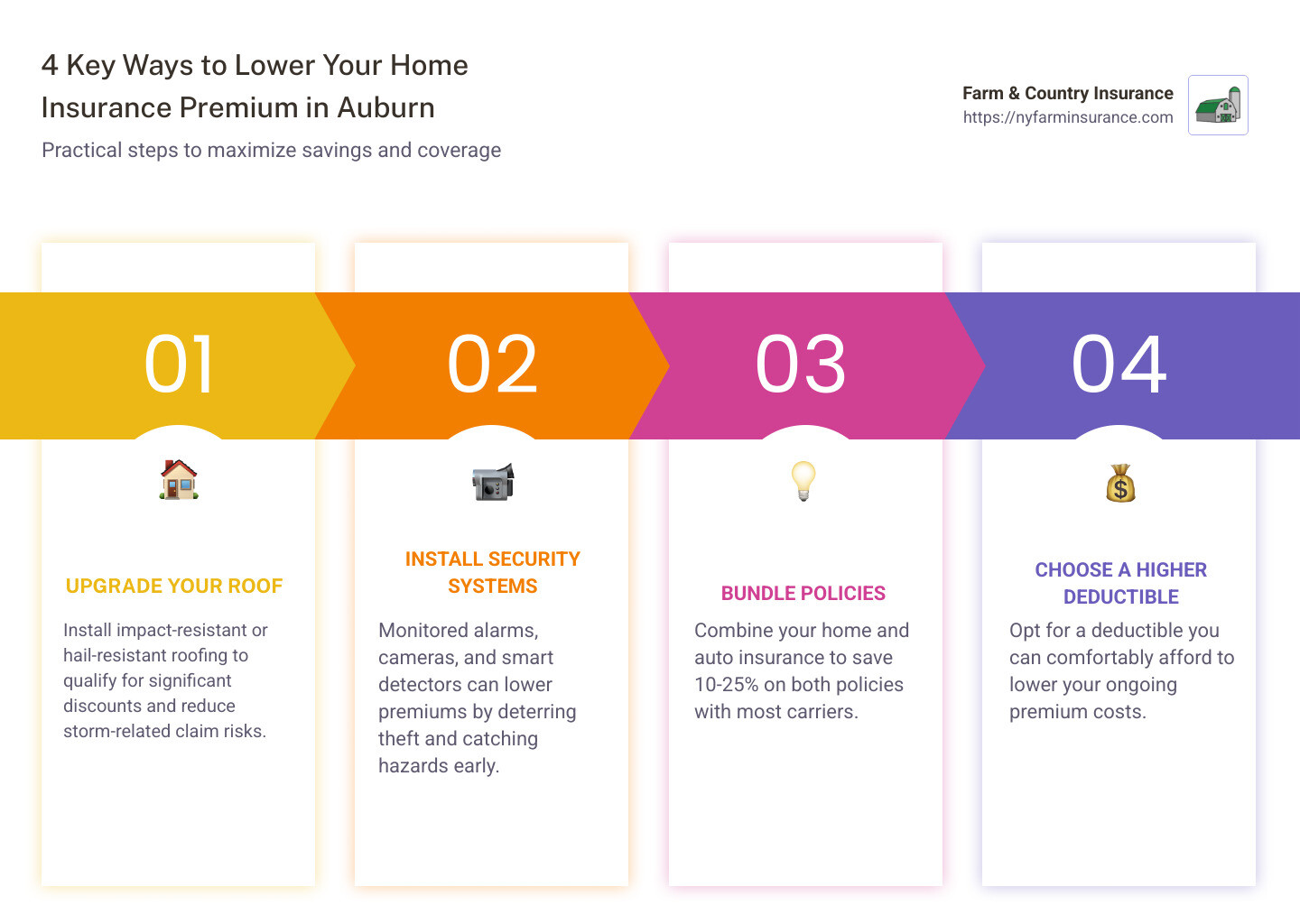
Smart home technology has become a game-changer for insurance savings. Installing connected smoke detectors, water leak sensors, and security cameras can qualify for meaningful discounts. This isn’t just marketing hype—research from the Insurance Institute for Business & Home Safety shows that smart water leak detection systems can reduce water damage claims by up to 93%. That’s significant for both insurers and homeowners.
I recently helped an Auburn family reduce their annual premium by over $400 through a combination of bundling policies, installing a monitored security system, and upgrading to impact-resistant roofing after a particularly nasty hailstorm. These improvements not only lowered their insurance costs but also provided better protection for their home—a win-win situation.
Discounts Available in Auburn
Auburn homeowners have access to several specific discounts that can make a real difference in your insurance costs. Many people don’t realize just how many savings opportunities are available!
Multi-policy discounts are the low-hanging fruit of insurance savings. By bundling your home and auto coverage, you’ll typically save 10-25% on both policies. At Farm & Country Insurance, our clients who bundle policies save an average of 18% across their insurance portfolio. That can add up to hundreds of dollars annually.
That aging roof might be costing you more than you think. New roof discounts can reduce premiums by 5-20%, which is especially valuable in Auburn where our harsh winters take a toll on roofing materials. One client saved nearly $200 annually just by replacing their 20-year-old shingles.
If you’re over 55 or retired, ask about senior discounts. Many insurers offer reduced rates for older homeowners, recognizing they typically spend more time at home and can spot problems before they become major claims.
Being a careful homeowner pays off through loss-free discounts. Maintaining a claim-free record for 3-5 years can qualify you for premium reductions of 5-15%. Think twice before filing small claims that barely exceed your deductible—they could cost you this valuable discount.
For the environmentally conscious, green home certification can lead to insurance savings. Homes with LEED certification or similar credentials may qualify for special discounts, reflecting their typically higher construction quality and sustainability.
Auburn’s occasional severe storms make hail-resistant roof discounts particularly valuable. Installing Class 4 impact-resistant roofing materials can save 5-25% on the windstorm portion of your premium. One local family I worked with recovered almost half their roof upgrade costs through insurance savings over just a few years.
Don’t overlook discounts for smart home technology. Installing connected smoke detectors, water leak sensors, and security cameras can qualify for discounts of 5-15% with many insurers. These technologies help prevent losses, which is why insurance companies are willing to reward you for using them.
Your professional affiliations might save you money too. Members of certain professional associations, alumni groups, or credit unions may qualify for special group rates or discounts. Always mention these connections when shopping for insurance.
I recently worked with an Auburn homeowner who installed a comprehensive security system, water leak detectors, and impact-resistant roofing during a renovation. These improvements, combined with bundling multiple policies, resulted in premium savings of nearly 30%—all while significantly improving their home’s resilience to common Auburn hazards.
Money-Saving Tips for Rural & Hobby Farms
If you’re one of the many Auburn residents with a rural property or hobby farm, you need specialized coverage considerations that both protect your assets and save you money. Standard homeowners policies often fall short for these unique properties.
Start with a thorough outbuilding inventory. Document all structures on your property, including barns, sheds, and workshops. I’ve seen too many rural homeowners find after a loss that their standard home policy provided inadequate coverage for these outbuildings. Take photos, note construction materials, and estimate replacement costs for each structure.
If you host farm tours, U-pick events, or other public activities on your property, you need agritourism liability coverage. Standard homeowners policies typically exclude business activities, leaving you exposed to potentially devastating claims. One local lavender farm owner told me this specialized coverage saved them when a visitor was injured during a harvest festival.
Your farm equipment represents a significant investment, even for hobby operations. Ensure your policy adequately covers equipment sheds and storage, providing full replacement value for tractors, ATVs, and specialized equipment. These items often exceed the personal property limits on standard homeowners policies.
For those keeping animals, even as pets, consider specialized farm insurance that includes livestock coverage. Standard home policies provide very limited, if any, coverage for animals. After a neighbor’s dog frightened and injured several sheep at one client’s small farm, they were grateful for their specialized coverage that helped with veterinary bills.
If you’re growing crops, even on a small scale, crop protection coverage for weather-related losses may be valuable, particularly for high-value specialty crops. One Auburn-area berry farmer told me their crop insurance was “a lifesaver” after an unexpected late frost damaged their early plantings.
At Farm & Country Insurance, we specialize in farm and rural property coverage throughout Cayuga County. I recently worked with a client who had a small hobby farm outside Auburn with a standard homeowners policy. After reviewing their coverage, we finded they would have been significantly underinsured after a barn fire. By switching to a specialized farm policy, they gained comprehensive coverage for outbuildings, equipment, and liability at a cost only slightly higher than their previous inadequate coverage.
Rural properties have unique risks and opportunities—make sure your insurance reflects both.
Choosing the Right Policy & Provider
Finding the perfect home insurance Auburn policy isn’t just about getting the lowest price—it’s about finding the right protection for your specific home and needs. At Farm & Country Insurance, we’ve guided hundreds of Auburn homeowners through this important decision, and we’ve learned a few things along the way.
Working with an independent agent gives you a significant advantage in your search. Unlike captive agents who can only offer policies from one company, independent agents like our team at Farm & Country Insurance can shop multiple carriers to find the best combination of coverage and value. This approach typically leads to better protection at competitive rates.
Before committing to any insurer, take a moment to check their financial strength ratings. Companies like A.M. Best, Moody’s, and Standard & Poor’s evaluate insurers’ financial stability—essentially their ability to pay claims even after a major disaster affects many customers simultaneously. These ratings offer peace of mind that your insurer will be there when you need them most.
Claims service reputation matters tremendously. After all, insurance is a promise to help when disaster strikes, and that promise is only as good as the company’s claims process. Take time to read reviews and ask neighbors about their experiences. As one of our clients recently told us, “The few extra dollars per month I pay for a company with excellent claims service was the best investment I ever made after a tree fell on my roof last winter.”
There’s something special about working with a local agency that understands Auburn’s unique challenges. Our agents live and work in the same communities as our clients, giving us knowledge of local building costs, weather patterns, and neighborhood-specific risks. We can visit your property, see its special features, and recommend coverage that truly fits your situation.
When comparing quotes, make sure you’re looking at equivalent coverage levels. A policy that’s $200 cheaper annually but has a $2,500 higher deductible might actually cost you more in the long run. Similarly, a budget policy that excludes important coverages like water backup protection could leave you exposed to significant out-of-pocket expenses.
The right policy should be custom to your specific situation. A historic home in downtown Auburn has very different insurance needs than a newly built property in a suburban development. Your policy should reflect those differences.
Step-by-Step: Getting a Personalized Home Insurance Auburn Quote
Getting a personalized home insurance Auburn quote is simpler than most people expect. Here’s what the process typically looks like:
The journey begins with an initial contact—whether you prefer reaching out through an online form, making a phone call, or stopping by our office in person. During this first conversation, we’ll gather basic information about your property and what kind of coverage you’re looking for.
For an accurate quote, we’ll need some specific details about your home. This includes your address, when the home was built, its square footage, number of bedrooms and bathrooms, and construction details like roof type and exterior materials. We’ll also want to know about special features like fireplaces or security systems, any recent renovations, and your claims history.
Some situations may call for a home appraisal or inspection, particularly for older homes or those with unique architectural features. This extra step helps ensure we’re calculating the true replacement cost—what it would actually take to rebuild your home if it were completely destroyed.
Photos can be incredibly helpful in this process. Current images of your home’s interior and exterior, along with documentation of recent renovations or appraisals for valuable items, help us create a more accurate picture of what we’re insuring.
Once we’ve gathered all the necessary information, we’ll present you with multiple coverage options. A good agent will take time to explain the differences between these options, including various deductibles, coverage limits, and endorsements that might be valuable for your situation.
When you’ve selected your preferred coverage, we’ll finalize the policy details and bind coverage, providing proof of insurance for your mortgage lender if needed. At Farm & Country Insurance, we’ve made this process as convenient as possible, offering virtual appointments and digital document submission for those who prefer not to meet in person.
“I was surprised by how painless the whole process was,” shared one recent client. “I expected a lot of paperwork and back-and-forth, but Farm & Country Insurance made everything clear and simple. I had multiple quote options within a day of our conversation.”
Red Flags & Common Mistakes to Avoid
After helping hundreds of Auburn homeowners find the right coverage, we’ve seen some common pitfalls that you’ll want to avoid:
Under-insuring your home is perhaps the most dangerous mistake. Many homeowners insure their property for its market value or purchase price, but rebuilding costs are often higher—especially in Auburn where many homes have custom features or historic elements that are expensive to replicate. Always insure for replacement cost, not market value.
Choosing deductibles that are too high might seem like a smart way to lower your premium, but it can create financial stress after a loss. We recommend selecting a deductible you could comfortably pay from savings if needed. That sweet spot varies for everyone—it might be $1,000 for some families and $2,500 for others.
Many homeowners make the mistake of ignoring important endorsements that cover significant risks. Standard policies have limitations, and skipping add-ons like water backup coverage or ordinance/law protection can leave dangerous gaps in your protection. These endorsements often cost just a few dollars per month but provide thousands in additional coverage.
Home improvements typically increase your home’s value and rebuilding cost, so failing to update coverage after renovations can leave you underinsured. That beautiful new kitchen or master bath addition should be reflected in your dwelling coverage limits.
Many Auburn homeowners don’t realize that standard home insurance doesn’t cover flood damage. If you’re in or near a flood zone, separate flood insurance is essential. Don’t wait until the forecast calls for heavy rain—flood policies typically have a 30-day waiting period before coverage begins.
Even brief lapses in coverage can lead to higher premiums when you reinstate insurance. Some mortgage lenders may also purchase force-placed insurance at much higher rates if they find a lapse. Set up automatic payments or calendar reminders to ensure continuous coverage.
Finally, focusing only on price rarely leads to the best protection. The cheapest policy often achieves its low price by limiting coverage in ways that might not be obvious until you have a claim. Compare coverage details, not just premium amounts.
One of our clients learned this lesson the hard way when they purchased a policy based solely on price, only to find after a significant loss that their personal property coverage was inadequate to replace their belongings. The $300 annual savings resulted in thousands out-of-pocket after the claim—a painful reminder that the best value isn’t always the lowest price.
Claims, Denials & What to Expect After a Loss
The moment you find damage to your Auburn home can feel overwhelming. Understanding how to steer the claims process for your home insurance Auburn policy can make this stressful time more manageable and help you get back to normal faster.
Filing a claim begins with promptly reporting the damage to your insurance company. Most insurers now offer multiple ways to report claims—by phone, online through their website, or via mobile apps—available 24 hours a day, 7 days a week. When you make that initial contact, be prepared to provide basic information about what happened and a general description of the damage.
Before jumping into cleanup (assuming it’s safe to remain in the area), take time to thoroughly document everything. “The photos and videos you take immediately after a loss are often your most powerful evidence,” explains one of our agents at Farm & Country Insurance. Walk through your property capturing clear images of all damaged areas and items from multiple angles. Create a detailed inventory of affected belongings, noting approximate purchase dates and values when possible.
Your insurance company will assign an adjuster to your case who will schedule an inspection of the damage. This might be in-person or, increasingly common today, through a virtual assessment. The adjuster’s job is to evaluate the extent of the damage and determine whether it’s covered under your policy terms.
For significant damage, you’ll typically need to obtain repair estimates from licensed contractors. Some insurance companies have preferred contractor programs that can simplify this process, though you generally maintain the right to choose your own repair professionals. At Farm & Country Insurance, we maintain relationships with reputable local contractors who understand the unique characteristics of Auburn homes.
The payout process often unfolds in stages rather than a single lump sum, particularly for major claims. You might receive an initial payment to begin repairs, additional payments as work progresses, and a final payment when everything is complete. This approach helps ensure funds are available throughout the repair process while protecting both you and the insurer.
If your claim is denied, don’t lose hope. You have the right to appeal, and many initially denied claims are eventually approved with additional documentation or clarification. Start by requesting a written explanation of the denial that cites specific policy language. This gives you a clear understanding of why the insurer believes the damage isn’t covered and provides a roadmap for your appeal.
When disputes can’t be resolved directly with your insurer, New York State offers a mediation program specifically for insurance disagreements. This can provide a more affordable and less time-consuming alternative to litigation while still giving you a fair hearing.
The Home Insurance Auburn Claims Timeline
Knowing what to expect during each phase of a home insurance Auburn claim helps set realistic expectations for the process:
Day 0-2: Initial Response
The first 48 hours after finding damage are critical. Report your claim immediately to start the process. Your insurance company will assign a claim number and adjuster to your case. During this period, focus on making only those emergency repairs necessary to prevent further damage—boarding up broken windows, placing tarps over roof damage, or shutting off water sources. Save all receipts for these emergency measures as they’re typically reimbursable. If your home is uninhabitable, secure temporary housing and keep detailed records of all additional living expenses.
Days 3-7: Assessment
Within the first week, expect the adjuster to inspect your property either in person or through video assessment. You’ll need to provide a comprehensive inventory of damaged items. The adjuster will explain what’s covered under your policy and outline next steps. Many insurers issue initial payments during this period to cover emergency expenses or begin the repair process.
Days 7-14: Evaluation
In the second week, a more detailed damage assessment is completed. This is when you should obtain repair or replacement estimates from contractors. The adjuster will review these estimates alongside your documentation to determine the appropriate settlement amount. By the end of this period, the coverage determination is typically finalized.
Days 14-30: Settlement Offer
Between two weeks and a month after filing, you’ll receive a settlement offer from your insurance company. Review this carefully, comparing it against your contractor estimates and personal inventory. You can accept the offer or negotiate if you believe it’s insufficient. Once an agreement is reached, the initial payment is issued, and you can begin scheduling contractors for repairs.
Beyond 30 Days: Repairs and Follow-up
The repair phase begins, with additional payments issued as work progresses. Your insurer may request inspection reports at various stages. Once all repairs are complete, a final inspection occurs, followed by the last payment. Only then is your claim officially closed.
For major losses, especially those involving structural damage, this timeline often extends significantly. Complex claims can take several months from start to finish. At Farm & Country Insurance, we’ve found that setting realistic expectations about timing helps Auburn homeowners better manage the emotional and practical challenges during recovery.
What to Do If Your Claim Is Rejected
Opening a rejection letter from your insurance company after suffering property damage can feel like a second disaster. However, Auburn homeowners have several effective options if their claim is denied:
First, request a re-inspection of the damage, possibly with a different adjuster. Being present during this second assessment allows you to point out damage that might have been overlooked initially. “Sometimes a fresh set of eyes sees things differently,” notes a claims specialist at Farm & Country Insurance.
Carefully review your policy language, focusing on the specific section cited in the denial. Insurance policies are complex documents, and misinterpretations happen. Request the exact policy section being referenced so you can evaluate whether the denial aligns with your coverage terms.
For many of my customers, their home is the most valuable asset they own, shares a local insurance professional. “That’s why I encourage them to be thorough with documentation when appealing a denied claim.”
Gathering additional supporting evidence can make a significant difference in appeals. This might include contractor assessments confirming the cause of damage, more detailed photographs, statements from neighbors who witnessed the event, or reports from specialized experts like structural engineers or water damage professionals.
Most home insurance Auburn policies include an appraisal clause that allows for independent evaluation when there’s disagreement about the amount of loss. This formal process involves hiring an independent appraiser, with costs typically split between you and the insurer. The resulting determination is often binding.
The New York State Department of Financial Services provides oversight for insurance companies and can review your case if you believe the denial was improper or handled unfairly. Filing a complaint with this agency triggers a formal review of your claim and the insurer’s handling of it.
For significant claims, consulting with an attorney specializing in insurance matters may be worthwhile. Many offer free initial consultations to evaluate the strength of your case before you commit to legal expenses.
At Farm & Country Insurance, we pride ourselves on serving as advocates for our clients throughout difficult claims processes. Recently, we helped an Auburn family successfully challenge a claim denial after winter storm damage. The insurer initially classified the damage as pre-existing, but our detailed documentation of the home’s condition before and after the storm helped reverse the decision, resulting in a full settlement for the needed repairs.
Frequently Asked Questions about Home Insurance Auburn
How often should I review my policy?
Life changes, and your insurance should keep up. That’s why we recommend taking a fresh look at your home insurance Auburn policy at least once a year. Think of it as an annual check-up for your financial protection.
Your annual review ensures your coverage keeps pace with rising rebuilding costs in the Auburn area, which have been trending upward by 5-7% annually in recent years. But don’t wait for your renewal date if you’ve made significant changes to your home or lifestyle.
When should you definitely review your coverage? After completing home renovations or additions, purchasing valuable items like jewelry or art, installing security systems, welcoming new family members, launching a home-based business, or paying off your mortgage. Each of these life events can significantly impact your insurance needs.
At Farm & Country Insurance, we make this easy with complimentary annual policy reviews for all clients. During these conversations, we often uncover coverage gaps or discount opportunities our clients weren’t aware of. Just last month, an Auburn homeowner was delighted to find she qualified for a substantial discount after installing a whole-house generator—a savings opportunity she wouldn’t have known about without our review.
Do I need separate flood insurance in Auburn?
This is one of the most important questions Auburn homeowners ask us, and the answer might surprise you. Standard home insurance Auburn policies simply do not cover flood damage—regardless of what caused the flooding. This is true whether you’re with a national carrier or a local agency like ours.
Your flood risk in Auburn largely depends on your property’s location. Homes near Owasco Lake, along the Owasco River, or in low-lying areas naturally face higher flood risks. But here’s what many homeowners don’t realize: even properties outside FEMA-designated flood zones can experience flooding during extreme weather events, which have become increasingly common in our region.
To make a smart decision about flood insurance, start by checking your property’s flood zone designation on FEMA’s Flood Map Service Center. Then consider your property’s elevation and proximity to water bodies, review the local flood history (including events that may not have directly affected your property), and honestly assess your personal risk tolerance.
Many Auburn homeowners are surprised to learn that flood insurance in low-risk zones is often quite affordable—sometimes just a few hundred dollars annually. At Farm & Country Insurance, we help clients evaluate their specific flood risk and provide quotes for both National Flood Insurance Program (NFIP) policies and private flood insurance options, which sometimes offer broader coverage or more competitive premiums for Auburn properties.
Can smart-home devices really lower my premium?
Absolutely! Smart-home technology isn’t just convenient—it can significantly reduce your home insurance Auburn premium. Why? Because these devices help prevent or minimize damage, reducing both the likelihood and severity of claims.
The savings can be substantial. Water leak detection systems that automatically shut off your water supply when leaks are detected typically earn discounts of 3-8%, as they prevent one of the most common and costly claims we see in Auburn homes. Smart smoke and carbon monoxide detectors that alert you to problems even when you’re away can reduce fire-related risks, typically earning discounts of 2-5%.
The biggest savings usually come from professionally monitored security systems, which can reduce premiums by 5-20% depending on their features. Even smaller upgrades like smart locks, doorbell cameras (discounts of 1-3%), and temperature monitoring systems that prevent frozen pipes (discounts of 2-4%) can make a difference on your bottom line.
The cumulative effect of a comprehensive smart home system can be impressive. One Auburn family we work with at Farm & Country Insurance recently saved nearly 15% on their annual premium after installing water leak detection, security monitoring, and connected smoke detectors throughout their home. With average annual premiums in Auburn ranging from $900-$1,300, these technologies often pay for themselves within just a few years through insurance savings alone—not to mention the peace of mind they provide.
Conclusion
Selecting the right home insurance Auburn policy is a crucial decision that balances protection, cost, and peace of mind. Throughout this guide, we’ve explored the fundamentals of home insurance, Auburn-specific considerations, and strategies for finding the best coverage for your unique situation.
Finding the perfect home insurance isn’t just about checking a box for your mortgage lender – it’s about protecting what matters most. Your home isn’t just a structure; it’s where your family creates memories, where you feel safe, and likely your most significant investment.
At Farm & Country Insurance, we’ve helped Auburn homeowners steer these important decisions for nearly 40 years. Our team understands that every home has its own story and unique protection needs. The historic Victorian downtown requires different coverage than the modern farmhouse on the outskirts of town.
We’ve built our reputation on truly understanding the local landscape – both literally and figuratively. Our deep knowledge of Auburn’s construction costs, weather patterns, and neighborhood-specific risks allows us to create protection plans that make sense for your particular situation.
What sets us apart is our commitment to personalized service in an age where many companies want to reduce you to an algorithm. We believe insurance is fundamentally about people, not policies. When you call our office, you’ll speak with a real person who knows Auburn and cares about getting your coverage right.
Whether you’re buying your first home, upgrading to accommodate a growing family, or preparing for retirement, we’re here to help you steer the complexities of home insurance. Our approach combines old-fashioned customer service with modern risk management techniques to deliver both superior protection and potential savings.
Don’t leave your home’s protection to chance or to a faceless corporation. Contact Farm & Country Insurance today to schedule a no-obligation consultation and find how our expertise can provide both superior protection and potential savings for your Auburn home.
For more information about our personalized coverage options, visit our website or call our Auburn office to speak with a local agent who understands your unique needs.