
Protecting Your Livestock Investment
So, how does livestock insurance work to safeguard the animals that represent your livelihood? Think of it as a financial shield that protects your farm when the unexpected happens. Whether it’s a sudden storm, an accident during transport, or theft, livestock insurance steps in to help you recover from losses that could otherwise be devastating to your operation.
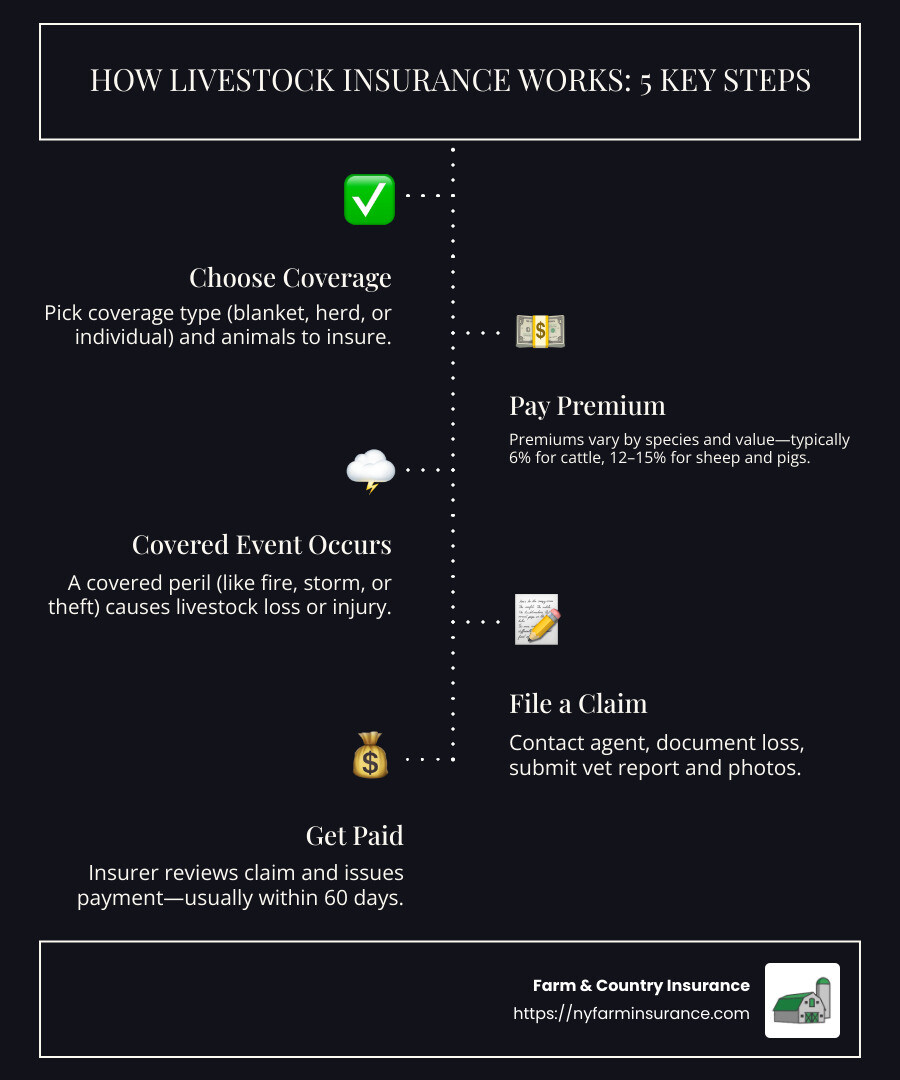
Quick Answer: How Livestock Insurance Works
| Core Element | Explanation |
|---|---|
| Coverage Types | Choose between blanket (up to $5,000/animal), herd (group coverage), or individual/scheduled (up to $25,000/animal) |
| What’s Covered | Fire, lightning, windstorm, hail, theft, collision, electrocution, wild animal attacks, accidental shooting, and transport incidents |
| What’s Excluded | Disease, illness, old age, or death by natural causes (unless you purchase specialized mortality coverage) |
| Claims Process | Contact your agent after a covered event, document the loss, and receive payment within 60 days (typically) |
| Premiums | Cost varies by animal type: approximately 6% of value for cattle and 12-15% for sheep, goats, and hogs |
When you look across your pastures at your cattle, sheep, or other livestock, you’re not just seeing animals – you’re seeing a significant investment. In Idaho alone, over 2 million cattle graze on more than 11 million acres. That’s an enormous financial stake that deserves proper protection.
I’ve walked many farms with worried owners after they’ve experienced unexpected losses. The relief on their faces when I explain their coverage is one of the most rewarding parts of my job. As the owner of Farm & Country Insurance, I’ve helped countless farmers understand how does livestock insurance work to create a safety net for their operations – whether they’re raising a handful of animals or managing extensive herds.
Most standard farm policies include some basic livestock coverage, but the protection is often limited. That’s where specialized coverage comes in. You might need additional endorsements or specific policies custom to your unique situation. The right insurance doesn’t just protect your animals; it protects your peace of mind and your financial future.
When farmers ask me about livestock coverage, I often point them to these key resources to better understand their options:
- cattle mortality insurance for comprehensive protection against unexpected cattle losses
- livestock risk protection to guard against market price declines
- livestock transport insurance for coverage during the vulnerable loading, transit, and unloading periods
At Farm & Country Insurance, we understand that your animals aren’t just numbers on a balance sheet – they’re the heart of your operation and often represent generations of careful breeding and management. That’s why we take the time to create protection plans as unique as your farm itself.

Understanding Livestock Insurance Basics
When you’re raising animals, you understand the bond you form with them – but you also know they represent a significant financial investment for your farm. That’s where livestock insurance comes in. Let me walk you through the essentials of how this protection works for New York farmers.
What Animals Can Be Covered?
Your farm’s animals are valuable assets, and most types of livestock can be insured. Cattle (both beef and dairy) are the most commonly covered, but policies also protect horses, swine, sheep, goats, poultry, and even specialty animals like llamas and alpacas.
As Ryan Thurston, a livestock insurance specialist, puts it: “Full-risk livestock mortality insurance is like life insurance for an individual animal. It protects that investment, even if it’s just for a short term like one year.”
Named Perils and Coverage Triggers
How does livestock insurance work when it comes to covered events? Standard policies operate on what’s called a “named perils” basis. This means your animals are protected against specific dangers listed in your policy, rather than blanket coverage for any cause of death.
These named perils typically include fire, lightning, windstorm, hail, theft, collision (including transit accidents), electrocution, wild animal attacks, and accidental shooting. It’s worth noting that most policies include a 30-day death window – meaning the animal must die within 30 days of the covered incident for the claim to be valid.
Standard Exclusions
Understanding what’s not covered is just as important as knowing what is. Your standard livestock policy generally won’t cover deaths from:
- Disease or illness (unless specifically added)
- Old age or natural causes
- Poor nutrition or neglect
- Intentional injury
- Pre-existing conditions
- Government-ordered destruction (without special endorsement)
One New York farmer shared his experience: “I learned the hard way that my basic farm policy didn’t cover when my prize bull died from pneumonia. I should have added mortality coverage.”
Liability Coverage Inclusion
Your livestock insurance doesn’t just protect the animals themselves – it also typically includes liability coverage. This means if your cattle break through a fence and cause a traffic accident, or your horse kicks a visitor, you’re protected from the financial fallout of those incidents.
This liability component is especially important for farms in more populated areas of New York state, where your animals might have more opportunities to interact with the public or neighboring properties.
At Farm & Country Insurance, we understand the question Can You Insure Livestock? comes with many nuances depending on your specific operation. The answer is almost always yes – but the right type and extent of coverage will vary based on your unique farm needs, the animals you raise, and the risks you face.
How Does Livestock Insurance Work?
How does livestock insurance work when you actually need it? Let’s walk through the real-world mechanics from the day you buy a policy to the moment you might need to file a claim.
Valuation Methods
Before your animals can be insured, we need to establish what they’re worth. Think of it as setting the “replacement cost” for your livestock:
- Market Value: What similar animals are selling for at auction or in private sales
- Purchase Price: Simply what you paid for the animal
- Agreed Value: A specific amount you and Farm & Country Insurance agree upon
- Production Value: Based on what the animal produces (especially important for dairy cows)
I recently worked with a Cayuga County dairy farmer who told me, “We had our prize Holstein bull appraised separately since his genetic value far exceeded what a standard policy would cover.” For show animals or breeding stock with exceptional genetics, getting a proper appraisal makes all the difference.
Premium Calculation and Collection
Your premium cost typically reflects a percentage of your animals’ value, with rates varying by species:
Cattle insurance generally runs about 5.8-6% of the animal’s value, while sheep, goats, and hogs typically cost 12-15%. For specialized or high-value animals, we’ll often work out custom rates that make sense for your situation.
To put this in dollars and cents: if your herd is valued at $291,000, you might pay approximately $1,018.50 per year at a rate of $0.35 per $100 of coverage. Most farmers pay annually, though some government programs like Livestock Risk Protection allow payment at the end of the coverage period rather than upfront.
Deductibles and Their Impact
Just like your car insurance, livestock policies include deductibles – your portion of the loss before insurance kicks in. These might be:
Per-occurrence deductibles apply to each separate incident, while per-animal deductibles apply individually to each affected animal. Some policies offer aggregate deductibles that apply once to all losses during your policy period.
Choosing a higher deductible typically lowers your premium costs but means you’ll pay more out-of-pocket when something happens. It’s about finding the right balance for your farm’s financial situation.
Claim Timeline and Process
When disaster strikes, here’s what happens:
First, contact your Farm & Country Insurance agent right away – don’t wait. You’ll need to document the loss with photos, veterinary reports, and any other relevant evidence. In some cases, an adjuster might visit to evaluate the claim.
Once we verify the cause of loss is covered under your policy, we work toward settlement. Most livestock claims are settled within 60 days, though complex situations may take longer.
One Seneca County farmer shared: “When lightning struck three of my beef cattle, I called my agent immediately. Having photos and the vet’s report ready made the process much smoother than I expected.”
Payout Calculation
The check you receive after a claim depends on several factors:
- Your animal’s insured value
- Your policy’s coverage limits
- Any deductibles that apply
- Specific terms in your policy
With blanket coverage, payouts typically max out at $5,000 per animal, while scheduled/individual coverage can provide up to $25,000 per animal or even more for especially valuable livestock.
Mortality vs. Standard Coverage
Here’s a critical distinction many farmers miss: standard livestock insurance covers death from accidents and specific named perils, while livestock mortality insurance is much more comprehensive, covering death from disease, illness, and sometimes even old age.
“Mortality insurance for livestock works much like life insurance for humans,” as we often explain to our Farm & Country Insurance clients. “It costs more, but it protects against virtually all causes of death unless specifically excluded in the policy.”
How does livestock insurance work for animals in transit?
Moving animals creates special risks that need specific coverage. While standard policies might provide some transit protection, dedicated livestock transit insurance offers far better safeguards.
Transit coverage typically protects against accidents during loading and unloading, collisions while on the road, vehicle overturns, bridge collapses, and fires during transport.
A particularly valuable feature is “coverage-after-transit,” which extends protection for 2-10 days after animals arrive at their destination. This covers deaths that occur as a direct result of transport stress or injury, even if they don’t happen immediately.
“When we move cattle between our pastures in Sennett and Owasco, having that extended coverage period gives us peace of mind,” a local beef producer told me recently. “Animals don’t always show transport stress right away.”
Many policies also include a carcass removal endorsement – a practical consideration that can save hundreds or thousands in disposal costs when the unthinkable happens.
How does livestock insurance work under government-backed programs?
The USDA Risk Management Agency offers several specialized programs designed to protect against market risks rather than physical loss:
Livestock Risk Protection (LRP) protects against declining market prices with coverage periods from 13 to 52 weeks. You can insure from 1 to 12,000 head per endorsement with an annual limit of 25,000 head. The government provides premium subsidies, and payment is due only at the end of the endorsement period. An LRP policy pays out if the actual ending value falls below the coverage price you selected.
Livestock Gross Margin (LGM) protects your gross margin (market value minus feed costs) for cattle, dairy, and swine. It guards against both falling market prices and rising feed costs with coverage periods up to 11 months. Deductible options range from $0 to $150 in $10 increments, and most programs must be purchased on Thursdays.
Dairy Revenue Protection (DRP) specifically helps dairy producers by covering quarterly revenue from milk sales. It protects against declines in price, production, or both with two pricing options to reflect individual farm-level risk and subsidized premiums.
“Buying a livestock insurance policy is one risk management option,” notes the USDA RMA. “Producers should always carefully consider how a policy will work in conjunction with their other risk management strategies.”
At Farm & Country Insurance, we can help you steer these government programs and determine which options best complement your overall risk management approach. With the right coverage in place, you can focus on what you do best – raising healthy, productive livestock.
Coverage Options & Specialized Policies
Livestock insurance isn’t a one-size-fits-all solution for farmers. Your operation is unique, and your coverage should reflect that. Whether you’re raising a few specialty animals or managing large herds, understanding your options is crucial to protecting your investment.
Blanket Coverage
Blanket coverage is like throwing a protective net over all your livestock at once. Instead of listing each animal individually, this approach insures all your animals under a single sum.
“With over 100 head of cattle, blanket coverage makes perfect sense for us,” explains one Aurelius farmer I worked with. “I don’t need to worry about tracking individual animals for insurance purposes.”
This option works beautifully for:
- Farms with many similar-valued animals
- Operations wanting simplified paperwork
- Situations where individual identification isn’t practical
Most Farm Personal Property Coverage provides blanket protection up to $5,000 per animal, giving you solid protection without administrative headaches.
Herd Coverage
Herd coverage strikes a middle ground by insuring a specific number of animals of the same type. For example, you might insure “100 head of Holstein cattle” as a defined group.
This approach is particularly popular among dairy and beef operations throughout Cayuga County. It’s often more cost-effective than individual coverage while still providing targeted protection for specific animal groups. Many farmers appreciate how it simplifies administration while still acknowledging the distinct value of different herds.
Scheduled/Individual Coverage
When you’ve invested in high-value animals, scheduled (or individual) coverage allows you to list specific animals with their individual values.
A Scipio farmer I recently helped told me, “When we invested in a prize Angus bull for our breeding program, we specifically scheduled him on our policy. His genetic value to our operation warranted the extra coverage.”
This option is ideal for:
- Breeding stock with superior genetics
- Show animals with competition value
- Specialty livestock with unique characteristics
Individual coverage can provide protection up to $25,000 per animal or more, but requires proper identification via ear tags, names, or detailed descriptions.
Here’s how these options compare:
| Coverage Type | Best For | Identification Required | Typical Limits | Administrative Burden |
|---|---|---|---|---|
| Blanket | General herds with similar values | No | Up to $5,000/animal | Low |
| Herd | Defined groups of similar animals | No | Based on per-head value | Medium |
| Individual/Scheduled | High-value animals | Yes | Up to $25,000/animal or more | High |
Liability Add-Ons
While protecting your animals is important, protecting yourself from liability is equally crucial. Standard farm policies typically include some liability coverage for damage or injury caused by your animals, but additional coverage is often necessary.
“After a neighbor’s child was injured when our goat escaped, we increased our liability coverage,” shared a Fleming farm owner I work with. “The extra premium is well worth the peace of mind.”
Consider these liability options:
- Premises liability protects against incidents that happen right on your property
- Off-premises liability covers situations when animals escape or are being transported
- Umbrella liability provides additional coverage beyond standard limits
Specialized Endorsements
How does livestock insurance work when you need protection beyond the basics? Several specialized endorsements can customize your coverage to fit your operation’s unique needs.
The Collision Endorsement covers animals killed or injured when they roam off your property and are struck by vehicles. This protection is particularly important for farms near roadways or with less secure fencing.
For New York’s harsh winters, a Freezing Endorsement covers death directly caused by freezing (though animals must typically be older than 30 days to qualify).
If you’re concerned about feed quality, Contaminated Feed Coverage protects against losses from tainted feed or water sources—particularly valuable for confined animal operations.
Species-Specific Coverage Options
Different livestock types face different risks, which is why specialized coverage options exist for various species.
Dairy Cattle Insurance can include protection for milk production losses, contaminated milk situations, and even reproductive failure coverage. These specialized protections address the unique risks dairy farmers face beyond simple mortality.
Swine Insurance often includes options for power interruption coverage (critical for ventilation-dependent operations), suffocation protection, and even contract penalties coverage for producers working under contract with processors.
Poultry Insurance can cover egg income loss, mechanical breakdown protection for critical systems, and specialized hatchery options for breeding operations.
At Farm & Country Insurance, we understand the unique needs of different livestock operations across New York. Whether you’re exploring cattle mortality insurance options or need a specialized livestock mortality policy, we’ll help design coverage that protects your specific investment. Our goal is straightforward: make sure your farm’s valuable animals have the right protection at a price that makes sense for your operation.
Premiums, Claims & Risk Management
Let’s talk dollars and sense when it comes to livestock insurance. Understanding what affects your premiums and knowing how to handle claims can make a big difference to your bottom line.
Premium Rate Factors
Ever wonder why your neighbor pays a different rate than you do? Several variables influence your premium:
- Species: Cattle generally cost about 6 % of their value to insure each year, while sheep, goats, and hogs often run 12 – 15 %.
- Animal Value: A $2,000 cow might cost roughly $120 a year to protect; a $10,000 breeding bull could run about $600 at the same rate.
- Location: Weather patterns, predator pressure, disease prevalence, and proximity to busy roads all affect risk (and therefore price) here in New York.
- Coverage Choices: Higher deductibles lower premiums but increase your out-of-pocket exposure. Adding all-risk mortality or extra endorsements raises cost but broadens protection.
- Government Subsidies: USDA programs such as Livestock Risk Protection (LRP) can significantly offset premiums for qualifying producers.
Documentation Requirements
As our Farm & Country Insurance agents like to say, “Your camera is your best friend.” Good records make for smooth claims.
When you set up a policy, be ready to provide:
- Current inventory counts and values
- Identification records for any scheduled animals
- Purchase receipts or appraisals for high-value stock
- Recent health or veterinary certificates (for mortality coverage)
If a loss occurs, gather the following right away:
- Clear, date-stamped photos of the animal(s)
- A veterinarian’s report confirming cause of death
- Proof of value (bills of sale, registration papers, appraisals)
- Witness statements, if applicable
One Cayuga County dairy client lost two Holsteins to lightning. “I was so distraught I forgot pictures,” he recalled. “Luckily my vet documented everything—that saved the claim.”
Loss Prevention and Risk Management
Insurance is only one piece of a broader risk-management plan:
- Enforce strong biosecurity: quarantine new arrivals, sanitize equipment, and monitor feed and water quality.
- Maintain facilities: sturdy fencing, functional ventilation, and fire-safety systems all cut losses (and may earn premium credits).
- Keep organized records: health treatments, breeding data, and valuations support both herd management and future claims.
- Combine tools: use forward contracts, diversification, and emergency funds alongside insurance to stabilize cash flow.
Our team at Farm & Country Insurance can help you tailor a plan that blends policy coverage with practical on-farm safeguards and USDA programs like Livestock Risk Protection.
FAQ #1 – What animals can I insure?
Most commercially raised livestock are eligible:
- Cattle (dairy and beef)
- Swine
- Poultry
- Sheep and goats
- Equine
- Specialty species such as alpacas, llamas, bison, elk, and deer
“If it has feathers, fur, or hooves and you sell the product, we can probably insure it,” says one of our senior agents.
FAQ #2 – How much does livestock insurance cost?
Pricing is usually a percentage of animal value:
- Cattle: about 6 % annually
- Sheep/goats/hogs: 12 – 15 % annually
Another method is a rate per $100 of value (e.g., $0.35 for named-peril coverage versus $5.50–$10.00 for all-risk mortality). Subsidies from programs like LRP can lower those figures.
FAQ #3 – What is the process for filing a claim?
- Notify your Farm & Country Insurance agent immediately.
- Photograph the loss and obtain a vet report.
- Complete the claim form with identification and value documentation.
- Cooperate with any adjuster visit.
- Expect settlement—provided all paperwork is in order—within about 60 days.
Good documentation and prompt reporting are the surest ways to keep that timeline short.
Conclusion
Livestock insurance plays a critical role in protecting your farm’s financial stability against unexpected losses. As we’ve explored throughout this guide, how does livestock insurance work depends on your specific operation, the types of animals you raise, and the risks you face.
To recap the key points:
When you invest in livestock insurance, you’re essentially buying peace of mind. Those cattle grazing peacefully in your fields represent thousands of dollars of investment – investment that could disappear overnight without proper protection. The blanket, herd, and individual policy options we’ve discussed give you flexibility to match coverage to your farm’s unique needs, whether you’re running a small hobby farm or managing hundreds of animals.
Standard policies protect against those heart-stopping moments every farmer dreads – lightning strikes during summer storms, barn fires, or predator attacks. But as we’ve seen, mortality insurance goes further, covering those less dramatic but equally devastating losses from disease and illness.
For many New York farmers I’ve worked with, government programs like LRP, LGM, and DRP have been game-changers. These programs don’t just protect against physical loss – they shield you from market volatility too, giving you a financial safety net when prices drop unexpectedly.
Premium costs vary significantly – typically around 6% of value for cattle and 12-15% for smaller animals like sheep and goats. While this might seem substantial, compare it to the financial devastation of losing multiple animals without coverage.
I can’t stress enough how important good documentation is. Those photos and records you keep might seem tedious, but trust me – when you’re filing a claim after losing valuable animals, you’ll be grateful for every receipt and identification record you maintained.
Livestock insurance functions as a risk transfer tool, allowing you to shift financial uncertainty from your operation to an insurance carrier in exchange for a predictable premium. When integrated with other risk management strategies, it creates a safety net that enables your farm to weather unexpected challenges.
At Farm & Country Insurance, we’ve been helping New York farmers protect their livestock investments since 1984. Our deep understanding of the unique risks faced by dairy, beef, swine, and other livestock operations throughout Cayuga County and beyond allows us to tailor coverage solutions that provide meaningful protection at competitive rates.
Whether you’re managing a multi-generation dairy operation in Aurelius, raising beef cattle in Scipio, or running a specialty livestock farm in Sennett, we can help you steer the complexities of livestock insurance and design a program that meets your specific needs.
For more information about customized farm coverage options, including livestock protection, visit Farm & Country Insurance or contact one of our local agents. We’re committed to serving the agricultural community with the expertise and personalized service your operation deserves.