
Property Insurance 2025: Secure Your Assets
Why Property Insurance Protects Your Most Valuable Assets
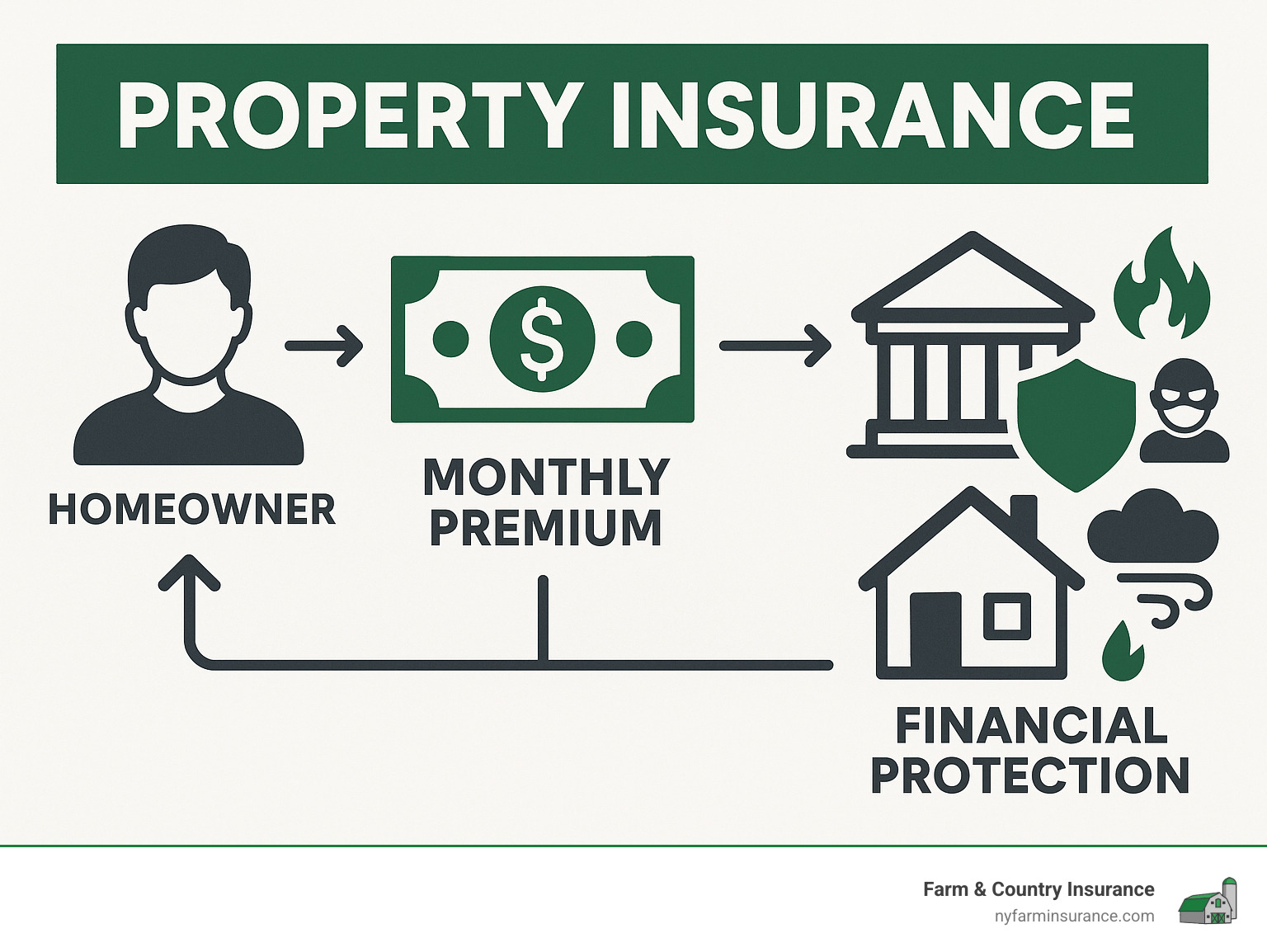
Property insurance provides financial protection for your physical assets—like your home, belongings, and business property—against covered losses from events like fire, theft, wind damage, and vandalism. Here’s what you need to know:
What Property Insurance Covers:
- Your home’s structure and other buildings on your property
- Personal belongings like furniture, electronics, and clothing
- Liability protection if someone gets injured on your property
- Additional living expenses if you can’t stay in your home after a covered loss
Common Types:
- Homeowners Insurance – Protects your house and belongings
- Renters Insurance – Covers your personal property in a rental
- Condo Insurance – Fills gaps left by your association’s policy
- Commercial Property Insurance – Protects business buildings and equipment
What’s Usually NOT Covered:
- Flood damage (requires separate flood insurance)
- Earthquake damage
- Normal wear and tear
- Pest infestations
Property insurance works by spreading risk across many policyholders. You pay a premium, and in return, the insurance company promises to help cover repair or replacement costs when disaster strikes. Most mortgage lenders require homeowners insurance, but even if you own your property outright, it’s one of the smartest financial protections you can buy.
As Casey Love, owner of Farm & Country Insurance, I’ve seen how the right coverage can mean the difference between a manageable setback and financial disaster for New York property owners.
Relevant articles related to property insurance:
Understanding Property Insurance: Your Financial Safety Net
Property insurance is a financial safety net for life’s unexpected storms, protecting the physical assets that matter most, from a family home in the Finger Lakes to a dairy operation in Western New York. It works on a simple promise: you pay regular premiums, and in return, your insurer helps cover costs when disasters like fire, theft, or storms strike. This provides invaluable peace of mind.

What makes property insurance so essential is its broad scope of protection, covering your building’s structure and your personal belongings against perils like fire, theft, windstorms, and vandalism.
While New York state doesn’t legally require property insurance, your mortgage lender almost certainly does. Even if you own your property outright, going without coverage is a significant risk. For detailed guidance, you can review What New York says about Homeowners and Tenants Insurance.
What Property Insurance Typically Covers
Your property insurance policy is a package of several protections. Here’s what’s inside this financial safety net.
Dwelling coverage is the backbone of your policy, protecting your home’s structure—walls, roof, and foundation. For farm owners in Cayuga County, it also covers other structures like detached garages, sheds, and fences.
Personal property coverage protects the contents of your home, like furniture, electronics, and clothing. A smart tip is to create a home inventory with photos, as it’s difficult to recall everything you own after a loss.
Liability protection helps with medical and legal costs if someone is injured on your property, such as a neighbor slipping on an icy driveway. It can also cover incidents on vacant land.
Additional Living Expenses (ALE) coverage pays for temporary housing, meals, and other extra costs if a covered loss makes your home unlivable. This is especially valuable in rural areas with limited housing options.
What Standard Policies Usually Exclude
Standard policies have exclusions. Understanding them helps you find the right additional coverage.
Flood damage is a major exclusion. Standard policies do not cover damage from natural flooding, like overflowing creeks or heavy rains.

For flood protection, you’ll need a separate policy. We can help you steer this process.
Earthquake damage is another common exclusion requiring separate coverage.
Wear and tear isn’t covered because insurance is for sudden, accidental events, not routine maintenance. A worn-out roof isn’t covered, but one damaged by a windstorm is.
Other common exclusions include damage from pests, sinkholes, war, nuclear hazards, and neglect. Insurance covers accidents and disasters, not poor maintenance.
A Tour of Property Insurance Policies: From Homes to Businesses
Property insurance isn’t one-size-fits-all. Whether you’re in a Niles home, an Auburn apartment, or a Springport farm, you need a policy custom to your specific situation.
The main types of property insurance include homeowners, renters, condo, landlord, and commercial property insurance, each serving a distinct purpose.
Standard Residential Policies
Let’s start with policies that protect where we live.
Homeowners insurance is for those who own and live in their house, protecting the structure, personal belongings, and providing liability coverage. The most common policy, an HO-3, typically covers the dwelling against all perils unless excluded, while personal property is covered only for perils named in the policy.
Renters insurance is essential because a landlord’s policy only covers the building, not your belongings. It protects your furniture, electronics, and clothes from fire, theft, and other perils. It also includes liability coverage if a guest is injured in your rental.
Condo insurance (HO-6) fills the gap left by the condo association’s master policy. While the master policy covers the building’s exterior and common areas, an HO-6 policy protects your unit’s interior, personal belongings, and provides personal liability coverage.
Commercial and Business Property Insurance
For business owners, property insurance is critical.
Commercial property insurance protects a business’s physical assets, including buildings, equipment, inventory, and office furniture. It helps you repair or replace these assets after events like fire, theft, or wind damage.
Business interruption coverage is a vital component, helping replace lost income and cover extra expenses if a covered event forces you to temporarily close.
Costs vary based on risk, location, and coverage limits. For example, a retail shop in Auburn faces different risks than an office in Ira, and premiums will reflect that.
At Farm & Country Insurance, we’ve seen how the right commercial property insurance can mean the difference between a temporary setback and permanent closure for New York businesses.
Specialized Property Insurance in New York
New York’s diverse landscape presents unique insurance challenges that standard policies may not cover.

Risks for vacant land, hobby farms, and full-scale agricultural operations in areas like Brutus, Locke, or Scipio require specialized coverage.
Standard homeowners policies often limit coverage for agricultural activities. That’s why specialized policies for Homeowners Insurance for Hobby Farms are so important.
For New York’s dairy farms, grain operations, and fruit growers, property insurance is complex and critical. It must cover vast acreage, expensive equipment, livestock, crops, and unique structures. We offer comprehensive Farm Property Insurance Coverage and specific policies like Barn Insurance Coverage.
Since 1984, Farm & Country Insurance has helped New York’s agricultural community steer these complexities. Working with specialists means you get a policy that truly fits your unique situation.
The Mechanics of a Policy: From Premiums to the Claims Process
Your property insurance policy is a contract between you and your insurer. Understanding the key components makes it much more manageable.
The declarations page is your policy’s summary, listing your name, property address, policy period, coverage limits, and deductible.
Your deductible is the amount you pay out-of-pocket before insurance pays. For example, with a $1,000 deductible on an $8,000 claim, you pay $1,000 and the insurer pays $7,000. A higher deductible can lower your premium.
The claims process involves notifying your insurer, having an adjuster assess the damage, and receiving approval and payment for a covered loss.
An experienced agent from Farm & Country Insurance is invaluable, guiding you through the claims process and ensuring you have the right protection. We’ve been helping New Yorkers since 1984.
Understanding Your Coverage Value: Replacement Cost vs. Actual Cash Value
One of the most important decisions is choosing how your property will be valued after a loss.
| Feature | Replacement Cost (RC) | Actual Cash Value (ACV) |
|---|---|---|
| What it pays for | The cost to repair or replace damaged property with new, comparable items, without deducting for depreciation. | The replacement cost of the item, minus depreciation (wear and tear). |
| Example | A 10-year-old couch damaged by fire is replaced with a brand new couch of similar quality. | A 10-year-old couch damaged by fire is paid out at its current depreciated value, not the cost of a new one. |
| Premium Impact | Generally results in a higher premium. | Generally results in a lower premium. |
| Benefit | Helps us return to our pre-loss state more easily without significant out-of-pocket expenses. | Provides less financial protection but is more budget-friendly upfront. |
Replacement Cost (RC) coverage helps you buy new, comparable items. With RC, a fire-damaged 15-year-old fridge is replaced with a brand new one of similar quality.
Actual Cash Value (ACV) coverage pays the current, depreciated value. With ACV, you’d receive what that 15-year-old fridge is worth today, which means more out-of-pocket cost for you to buy a new one.
Some policies offer Extended Replacement Cost coverage, which pays an additional percentage (e.g., 25%) above your coverage limit if rebuilding costs surge, which is valuable after widespread disasters.
How to File a Property Insurance Claim
Taking the right steps can make filing a property insurance claim much smoother.
- Prioritize safety. Ensure everyone is safe and secure the property to prevent further damage. Stay out if there’s structural damage.
- Document the damage. Take extensive photos and videos from every angle once it’s safe.
- Make an inventory. List all damaged or destroyed items with descriptions, ages, and values.
- Contact Farm & Country Insurance promptly. The sooner you report the loss, the faster we can start your claim.
- Provide details. Be ready to explain what happened, when, and the extent of the damage.
- Cooperate with the adjuster. Provide them with access and any requested documentation to assess the damage.
- Keep records. Log all communication related to your claim, including dates, times, and names.
You’re not alone in this process. We’re here to advocate for you and make sure you get the coverage you’ve been paying for.
Decoding Your Premium: What Determines the Cost of Property Insurance?
Ever wonder why your property insurance premium differs from your neighbor’s? Insurers calculate risk based on the likelihood and potential cost of a claim. Understanding these factors can help you make smarter coverage decisions.

Location is a huge factor. Proximity to a fire station, local crime rates, and specific New York weather risks (like heavy snow in Sempronius or windstorms across the Finger Lakes) all influence your premium.
Your home’s characteristics are key. The age of the home, its construction materials (brick vs. wood), and the condition of the roof all affect your rates. A newer roof, for example, signals lower risk to insurers.
Personal factors like your claims history and, in New York, your credit-based insurance score, also play a role in determining your premium.
How to Save Money on Your Property Insurance Policy
Smart strategies can reduce your costs without sacrificing protection.
- Bundle your policies. Combining home and auto insurance with one provider is one of the easiest ways to get a significant discount.
- Raise your deductible. Agreeing to a higher out-of-pocket cost for a claim will lower your annual premium. Just be sure you can afford the amount.
- Install safety devices. Fire and security alarms, smoke detectors, and deadbolts can earn you discounts.
- Maintain a good claims history. Avoiding small claims can keep your rates lower over time.
- Review your policy regularly. Life changes, and so should your insurance. A regular review with us ensures your coverage and discounts are up to date.
The Power of Bundling
Bundling your insurance policies creates a win-win situation.
Bundling offers significant multi-policy discounts, with homeowners often saving hundreds of dollars annually. It also offers the convenience of one provider for all your policies, simplifying payments and claims.
Bundling with Farm & Country Insurance means you get customized packages from a local team that understands New York’s unique risks. Whether you’re combining home and auto coverage or integrating farm insurance with personal lines, we create packages that provide comprehensive protection while maximizing your savings.
Frequently Asked Questions about Property Insurance
At Farm & Country Insurance, we often hear the same questions from New York property owners. Here are answers to some of the most common ones.
How much property insurance coverage do I actually need?
Getting your coverage amount right is crucial for your financial security.
- Base your coverage on your home’s rebuilding cost, not its market value. Market value includes land, which isn’t covered. You need enough to reconstruct your home using similar materials at today’s prices.
- Create a home inventory to determine the value of your personal belongings. Document everything with photos or video to make filing a claim easier.
- Assess your liability risk. Factors like a swimming pool or dog may mean you need higher liability limits or even a separate umbrella policy for extra protection.
For farming clients, this is even more complex, as you must also value structures, equipment, and inventory. It’s easy to be underinsured, a topic we cover here: Is Your Farm Property Underinsured? The Answer Might Surprise You!.
What is the difference between property insurance and a home warranty?
This is a common question. The key difference is that insurance covers unexpected disasters, while warranties cover expected breakdowns.
- Property insurance covers sudden, accidental events like fires, storms, and theft. It protects you from major, unforeseen financial losses.
- A home warranty covers the repair or replacement of major systems and appliances due to normal wear and tear, like a furnace or dishwasher breaking down.
For New York property owners, having both can create a comprehensive safety net.
Does my policy cover items stored outside my home, like in a storage unit?
Most policies include “off-premises coverage” for personal belongings, so the answer is yes, but with limits.
This protects your belongings when they are away from home, such as in a storage unit, in your car, or with you while traveling. However, this coverage is usually limited to a percentage of your total personal property coverage, often 10%.
The same covered perils (fire, theft, etc.) generally apply. High-value items like jewelry or art have special, lower limits, regardless of where they are stored. You may need extra coverage, called a floater or endorsement, for these items.
Review your policy with us to ensure you have adequate protection for items stored off-premises.
Conclusion
Property insurance is more than just a bill; it’s a financial lifeline that helps you recover when disaster strikes your home, business, or farm in New York.
We’ve covered the essentials: what property insurance protects, the different policy types, and how understanding your coverage and the claims process empowers you. We’ve also seen how smart choices, like bundling policies, can lead to significant savings.
Most importantly, property insurance is not a one-size-fits-all product. Your needs are as unique as your property. This is especially true for New York’s agricultural community. Farms face unique risks—from equipment damage to crop loss—that require specialized expertise and customized solutions.
Since 1984, Farm & Country Insurance has specialized in helping New York property owners, especially farmers, steer these complexities. Our deep industry knowledge ensures you get coverage that truly fits your needs.
Don’t leave your most valuable assets vulnerable. Ready to get the protection you deserve? For those with specialized agricultural needs, we invite you to explore our comprehensive farm coverage options: Find the right farm homeowners insurance for your New York property.
Your property represents your security, your livelihood, and often your legacy. Let’s make sure it’s properly protected.